Africa Centre for Health and Population Studies, University of KwaZulu-Natal, Somkhele, South Africa.
Glob Health Action. 2013 Jan 23;6:19201. doi: 10.3402/gha.v6i0.19201.
To describe and compare the health status, emotional wellbeing, and functional status of older people in Uganda and South Africa who are HIV infected or affected by HIV in their families.
Data came from the general population cohort and Entebbe cohort of the Medical Research Council/Uganda Virus Research Institute, and from the Africa Centre Demographic Information System through cross-sectional surveys in 2009/10 using instruments adapted from the World Health Organization (WHO) Study on Global Ageing and Adult Health (SAGE). Analysis was based on 932 people aged 50 years or older (510 Uganda, 422 South Africa).
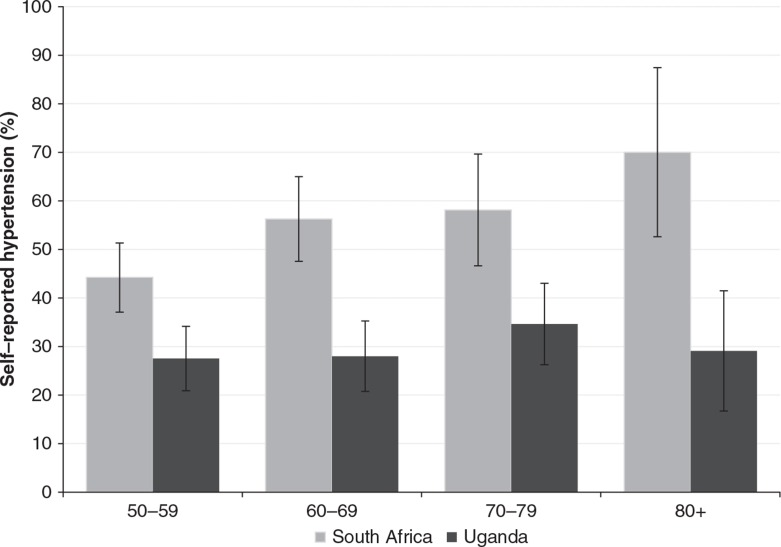
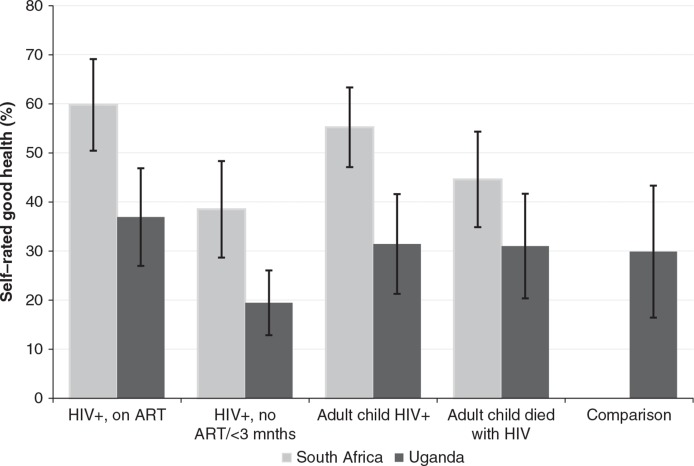
Participants in South Africa were slightly younger (median age - 60 years in South Africa, 63 in Uganda), and more were currently married, had no formal education, were not working, and were residing in a rural area. Adjusting for socio-demographic factors, older people in South Africa were significantly less likely to have good functional ability [adjusted odds ratio (aOR) 0.72, 95% CI 0.53-0.98] than those in Uganda, but were more likely to be in good subjective wellbeing (aOR 2.15, 95% CI 1.60-2.90). South Africans were more likely to be obese (aOR 5.26, 95% CI 3.46-8.00) or to be diagnosed with hypertension (aOR 2.77, 95% CI 2.06-3.73).
While older people's health problems are similar in the two countries, marked socio-demographic differences influence the extent to which older people are affected by poorer health. It is therefore imperative when designing policies to improve the health and wellbeing of older people in sub-Saharan Africa that the region is not treated as a homogenous entity.
描述和比较乌干达和南非受艾滋病毒感染或受家庭中艾滋病毒影响的老年人群的健康状况、情绪健康和功能状况。
数据来自医学研究委员会/乌干达病毒研究所的一般人群队列和恩特贝雷队列,以及通过 2009/10 年跨部门调查从非洲人口动态信息系统获得,调查采用了世界卫生组织(世卫组织)全球老龄化和成人健康研究(SAGE)的工具改编版。分析基于 932 名 50 岁及以上的人(510 名乌干达人,422 名南非人)。
南非的参与者年龄稍小(中位数年龄-南非 60 岁,乌干达 63 岁),目前已婚者、无正规教育、不工作者和居住在农村地区者更多。调整社会人口因素后,南非的老年人功能能力良好的可能性显著低于乌干达(调整后的优势比(aOR)0.72,95%可信区间(CI)0.53-0.98),但主观幸福感良好的可能性更高(aOR 2.15,95%CI 1.60-2.90)。南非人更有可能肥胖(aOR 5.26,95%CI 3.46-8.00)或被诊断患有高血压(aOR 2.77,95%CI 2.06-3.73)。
尽管两个国家老年人的健康问题相似,但显著的社会人口差异影响了老年人受健康状况不佳影响的程度。因此,在制定改善撒哈拉以南非洲老年人健康和福祉的政策时,当务之急是不要将该地区视为同质实体。