Verma Smriti, Senger Stefania, Cherayil Bobby J, Faherty Christina S
Mucosal Immunology and Biology Research Center, Division of Pediatric Gastroenterology and Nutrition, Massachusetts General Hospital, Charlestown Navy Yard, Boston, 02129 MA, USA.
Harvard Medical School, Boston, 02115 MA, USA.
Microorganisms. 2020 Apr 1;8(4):504. doi: 10.3390/microorganisms8040504.
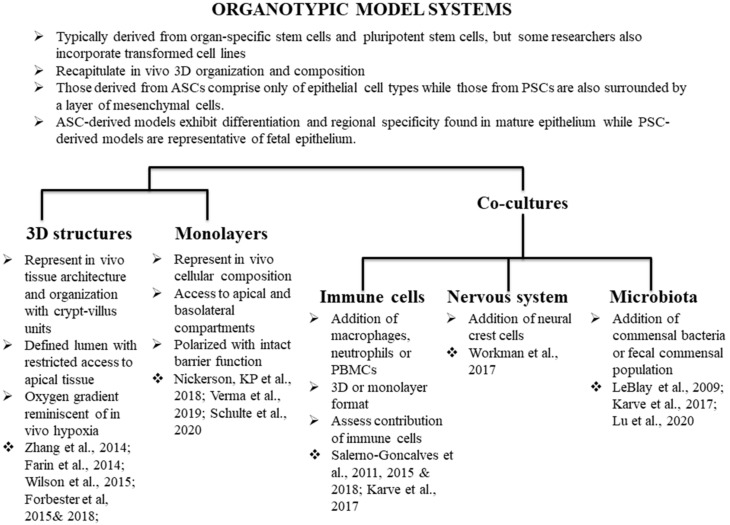
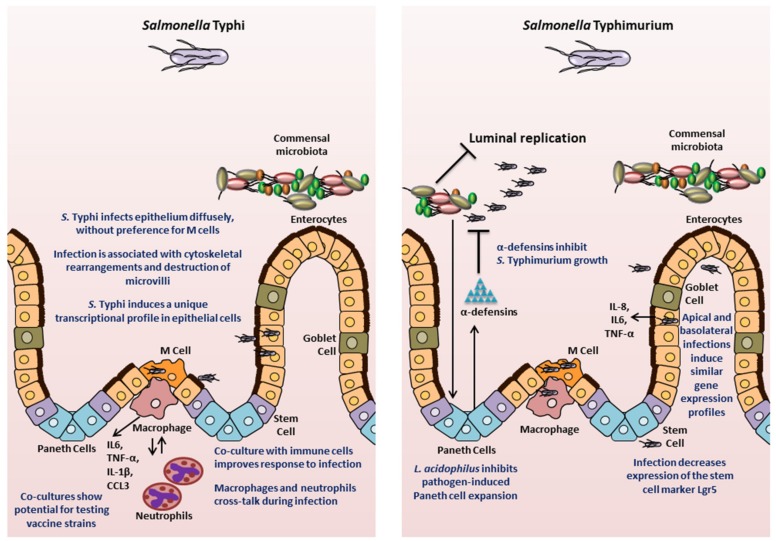
The molecular complexity of host-pathogen interactions remains poorly understood in many infectious diseases, particularly in humans due to the limited availability of reliable and specific experimental models. To bridge the gap between classical two-dimensional culture systems, which often involve transformed cell lines that may not have all the physiologic properties of primary cells, and in vivo animal studies, researchers have developed the organoid model system. Organoids are complex three-dimensional structures that are generated in vitro from primary cells and can recapitulate key in vivo properties of an organ such as structural organization, multicellularity, and function. In this review, we discuss how organoids have been deployed in exploring infection in mice and humans. In addition, we summarize the recent advancements that hold promise to elevate our understanding of the interactions and crosstalk between multiple cell types and the microbiota with . These models have the potential for improving clinical outcomes and future prophylactic and therapeutic intervention strategies.
在许多传染病中,宿主与病原体相互作用的分子复杂性仍未得到充分理解,特别是在人类中,因为可靠且特异的实验模型有限。为了弥合经典二维培养系统(通常涉及可能不具备原代细胞所有生理特性的转化细胞系)与体内动物研究之间的差距,研究人员开发了类器官模型系统。类器官是由原代细胞在体外生成的复杂三维结构,能够重现器官的关键体内特性,如结构组织、多细胞性和功能。在本综述中,我们讨论了类器官如何被用于探索小鼠和人类的感染情况。此外,我们总结了近期的进展,这些进展有望提升我们对多种细胞类型与微生物群之间相互作用和串扰的理解。这些模型具有改善临床结果以及未来预防和治疗干预策略的潜力。