Pandey Ankit Kumar, Sharma Anuj K, Marques Carlos
Physics Division, Department of Applied Sciences, National Institute of Technology Delhi, Narela, Delhi-110040, India.
I3N & Physics Department, University of Aveiro, 3810-193 Aveiro, Portugal.
Materials (Basel). 2020 Apr 1;13(7):1623. doi: 10.3390/ma13071623.
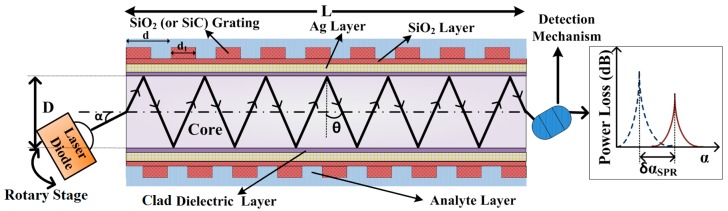
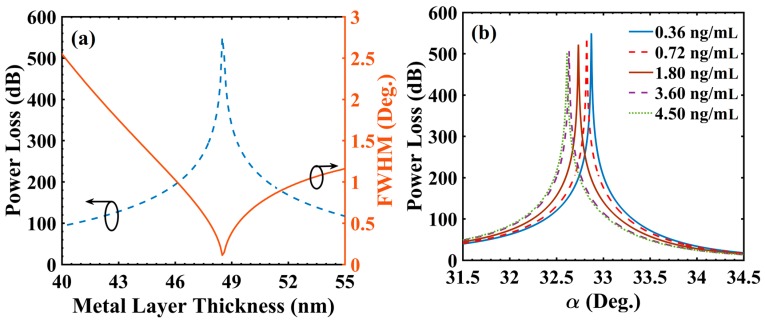
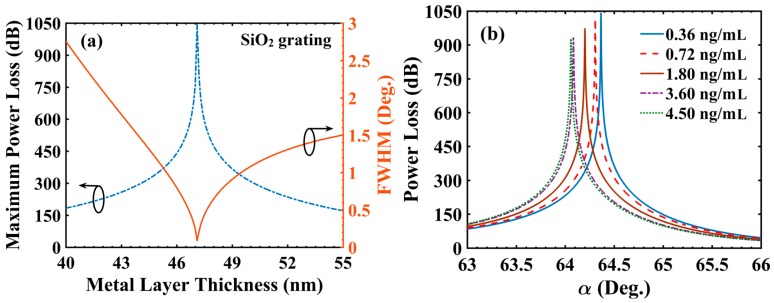
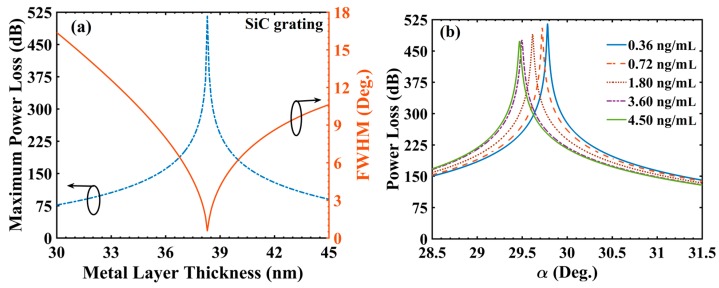
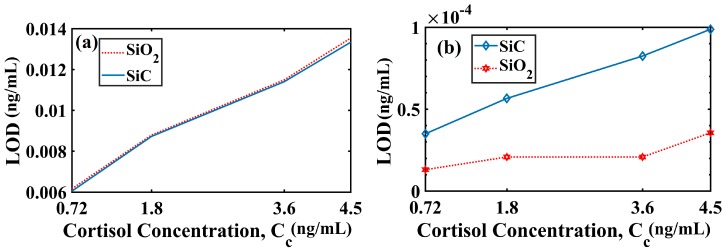
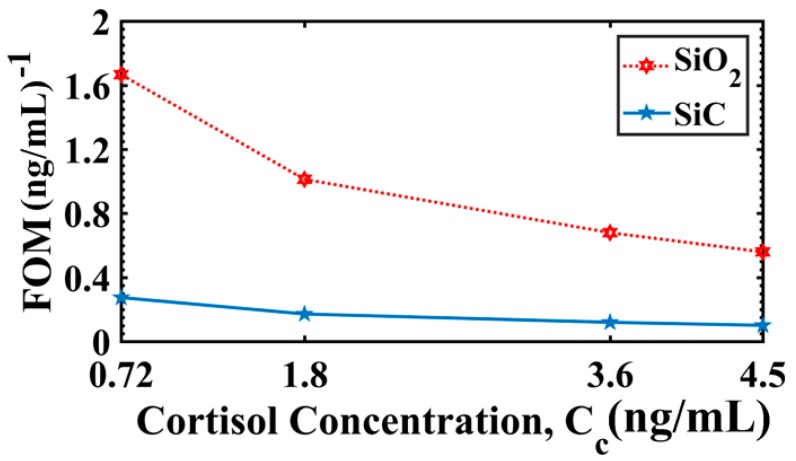
This paper reports on high-accuracy simulation of a grating structure based fiber optic plasmonic sensor for salivary cortisol sensing. Gratings of SiO and SiC (one at a time) in combination with a thin Ag layer are considered to be in direct contact with analyte medium (solutions containing different concentrations of cortisol) considering that the groove regions are also filled with analyte. The optimization of Ag layer thickness is carried out to achieve maximum power loss (PL) corresponding to cortisol concentration variation. The variation of PL (in dB) spectra with the angle of incidence (α) is the sensing mechanism of the proposed scheme. Sensing performance is extensively analyzed in terms of sensitivity, limit-of-detection (LOD) and figure-of-merit (FOM) that incorporates both the sensitivity and the width of the corresponding PL curves. While the sensitivity and FOM values are significantly large, the results also reveal that in angular interrogation mode (AIM), an average LOD of 9.9 pg/mL and 9.8 pg/mL is obtained for SiO and SiC-based sensor designs, respectively. When the intensity interrogation method (IIM) in place of AIM is considered, an average LOD of 22.6 fg/mL and 68.17 fg/mL is obtained for SiO and SiC-based sensor designs, respectively. LOD (with IIM, in particular) is considerably better than the present-state-of-art related to cortisol monitoring. Pragmatic model for possible practical implementation of sensor scheme is also discussed. The involvement of optical fiber in the proposed sensor design makes it possible to implement it as a flexible sensor or for wearable solution for cortisol detection via sweat monitoring as well as for measuring cortisol level in aquaculture tanks where concentration levels are much lower than 10 ng/mL.
本文报道了一种用于唾液皮质醇传感的基于光栅结构的光纤等离子体传感器的高精度模拟。考虑到凹槽区域也充满了分析物,将SiO和SiC光栅(一次一个)与薄银层相结合,使其与分析物介质(含有不同浓度皮质醇的溶液)直接接触。对银层厚度进行优化,以实现与皮质醇浓度变化相对应的最大功率损耗(PL)。PL(以dB为单位)光谱随入射角(α)的变化是该方案的传感机制。从灵敏度、检测限(LOD)和品质因数(FOM)方面对传感性能进行了广泛分析,其中FOM综合了灵敏度和相应PL曲线的宽度。虽然灵敏度和FOM值非常大,但结果还表明,在角度询问模式(AIM)下,基于SiO和SiC的传感器设计的平均LOD分别为9.9 pg/mL和9.8 pg/mL。当考虑用强度询问方法(IIM)代替AIM时,基于SiO和SiC的传感器设计的平均LOD分别为22.6 fg/mL和68.17 fg/mL。尤其是采用IIM时的LOD比目前皮质醇监测的现有技术要好得多。还讨论了传感器方案可能实际应用的实用模型。所提出的传感器设计中光纤的参与使得它可以作为一种灵活的传感器来实现,或者用于通过汗液监测进行皮质醇检测的可穿戴解决方案,以及用于测量水产养殖池中皮质醇水平(浓度水平远低于10 ng/mL)。