Immunology and Infectious Diseases Program, Division of BioMedical Sciences, Faculty of Medicine, Memorial University of Newfoundland, 300 Prince Philip Drive, St. John's, NL A1B 3V6, Canada.
Lady Davis Institute for Medical Research, Jewish General Hospital, Division of Experimental Medicine, McGill University, Montreal, QC H3A 0G4, Canada.
Cells. 2020 Mar 20;9(3):766. doi: 10.3390/cells9030766.
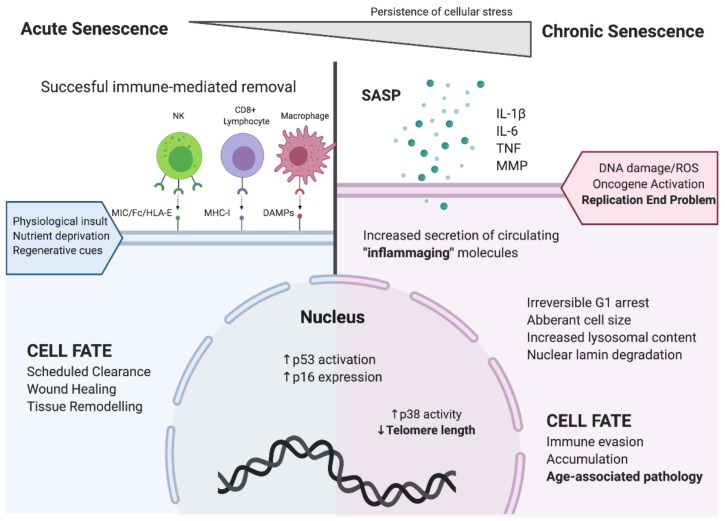
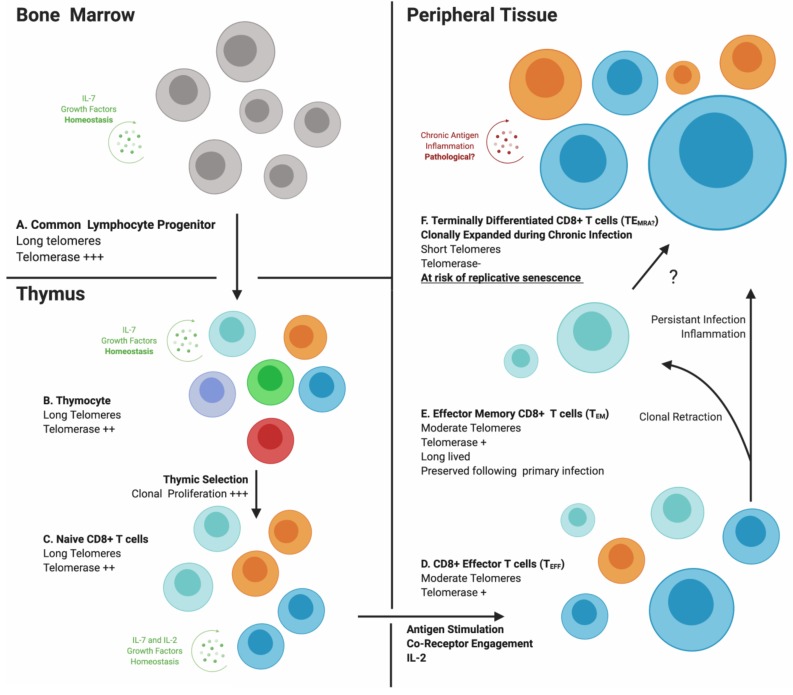
Aging reflects long-term decline in physiological function and integrity. Changes arise at a variable pace governed by time-dependent and -independent mechanisms that are themselves complex, interdependent and variable. Molecular decay produces inferior cells that eventually dominate over healthy counterparts in tissues they comprise. In a form of biological entropy, progression from molecular through cellular to tissue level degeneration culminates in organ disease or dysfunction, affecting systemic health. To better understand time-independent contributors and their potential modulation, common biophysical bases for key molecular and cellular changes underlying age-related physiological deterioration must be delineated. This review addresses the potential contribution of cytomegalovirus (CMV)-driven T cell proliferation to cellular senescence and immunosenescence. We first describe molecular processes imposing cell cycle arrest, the foundation of cellular senescence, then focus on the unique distribution, phenotype and function of CMV-specific CD8 T cells in the context of cellular senescence and "inflammaging". Their features position CMV infection as a pathogenic accelerant of immune cell proliferation underlying immune senescence. In human immunodeficiency virus (HIV) infection, where increased inflammation and exaggerated anti-CMV immune responses accelerate immune senescence, CMV infection has emerged as a major factor in unhealthy aging. Thus, we speculate on mechanistic links between CMV-specific CD8 T-cell expansion, immune senescence and prevalence of age-related disorders in HIV infection.
衰老是指生理功能和完整性的长期下降。变化以受时间依赖和独立机制控制的可变速度出现,这些机制本身就很复杂、相互依存且多变。分子衰减会产生劣质细胞,最终在它们组成的组织中超过健康细胞。在一种生物熵的形式中,从分子到细胞再到组织水平的退化进展最终导致器官疾病或功能障碍,影响全身健康。为了更好地了解时间独立的贡献者及其潜在的调节机制,必须阐明与年龄相关的生理恶化相关的关键分子和细胞变化的常见生物物理基础。这篇综述探讨了巨细胞病毒 (CMV) 驱动的 T 细胞增殖对细胞衰老和免疫衰老的潜在贡献。我们首先描述了导致细胞周期停滞的分子过程,这是细胞衰老的基础,然后专注于 CMV 特异性 CD8 T 细胞在细胞衰老和“炎症衰老”背景下的独特分布、表型和功能。它们的特征将 CMV 感染定位为免疫细胞增殖的致病加速剂,从而导致免疫衰老。在人类免疫缺陷病毒 (HIV) 感染中,炎症增加和抗 CMV 免疫反应夸大加速了免疫衰老,CMV 感染已成为不健康衰老的主要因素。因此,我们推测 HIV 感染中 CMV 特异性 CD8 T 细胞扩增、免疫衰老和与年龄相关疾病的流行之间的机制联系。