Mauricio Gastón Institute for Latino Community Development and Public Policy, University of Massachusetts Boston, Boston, USA.
Graduate Entry Medical School, University of Limerick, Limerick, Ireland.
BMC Infect Dis. 2020 Apr 3;20(1):263. doi: 10.1186/s12879-020-04987-8.
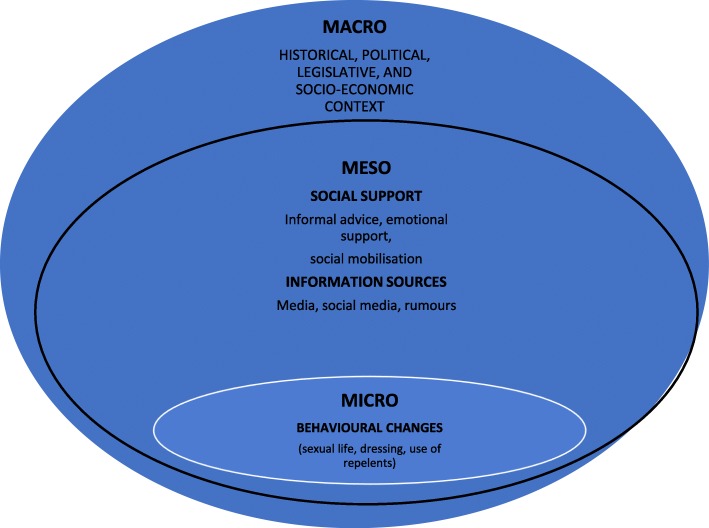
The public health response to Zika outbreak has mostly focused on epidemiological surveillance, vector control, and individual level preventative measures. This qualitative study employs a social-ecological framework to examine how macro (historical, legislative, political, socio-economic factors), meso (sources of information, social support, social mobilization) and micro level factors (individual actions, behavioral changes) interacted to influence the response and behavior of women with respect to Zika in different contexts.
A qualitative study was carried out. Women were recruited through the snowball sampling technique from various locations in Brazil, Puerto Rico, and the United States. They were of different nationalities and ethnicities. Data were collected through semi-structured interviews. The data transcripts were analyzed using thematic analysis.
Women in this study deemed the information provided as insufficient, which led them to actively reach out and access a variety of media sources. Social networks played a vital role in sharing information but also resulted in the spread of hoaxes or rumors. Participants in our research perceived socio-economic inequities but focused on how to remedy their microenvironments. They did not engage in major social activities. Lack of trust in governments placed women in vulnerable situations by preventing them to follow the guidance of health authorities. These impacts were also a result of the response tactics of health and government administrations in their failed attempts to ensure the well-being of their countries' populations.
Our findings call for public health interventions that go beyond individual level behavioral change campaigns, to more comprehensively address the broader meso and macro level factors that influence women' willingness and possibility to protect themselves.
寨卡疫情的公共卫生应对措施主要集中在流行病学监测、病媒控制和个人层面的预防措施上。本定性研究采用社会生态学框架,考察宏观(历史、立法、政治、社会经济因素)、中观(信息来源、社会支持、社会动员)和微观层面因素(个人行为、行为改变)如何相互作用,影响不同背景下妇女对寨卡的反应和行为。
进行了一项定性研究。通过滚雪球抽样技术从巴西、波多黎各和美国的不同地点招募了女性参与者。她们来自不同的国籍和种族。通过半结构化访谈收集数据。使用主题分析对数据记录进行分析。
本研究中的女性认为提供的信息不足,这导致她们积极寻求并访问各种媒体来源。社交网络在信息共享方面发挥了至关重要的作用,但也导致了虚假信息或谣言的传播。研究参与者意识到社会经济不平等,但专注于如何改善自己的微观环境。她们没有参与重大社会活动。对政府的不信任使妇女处于脆弱境地,使她们无法遵循卫生当局的指导。这些影响也是卫生和政府行政部门应对策略的结果,他们未能确保其国家民众的福祉。
我们的研究结果呼吁采取公共卫生干预措施,不仅要关注个人层面的行为改变活动,还要更全面地解决影响妇女保护自己意愿和能力的更广泛的中观和宏观层面因素。