The University of Queensland, School of Dentistry, Herston, QLD 4006, Australia.
Shanghai Engineering Research Center of Tooth Restoration and Regeneration, Shanghai, 200072, PR China.
Sci Rep. 2020 Apr 3;10(1):5935. doi: 10.1038/s41598-020-62407-y.
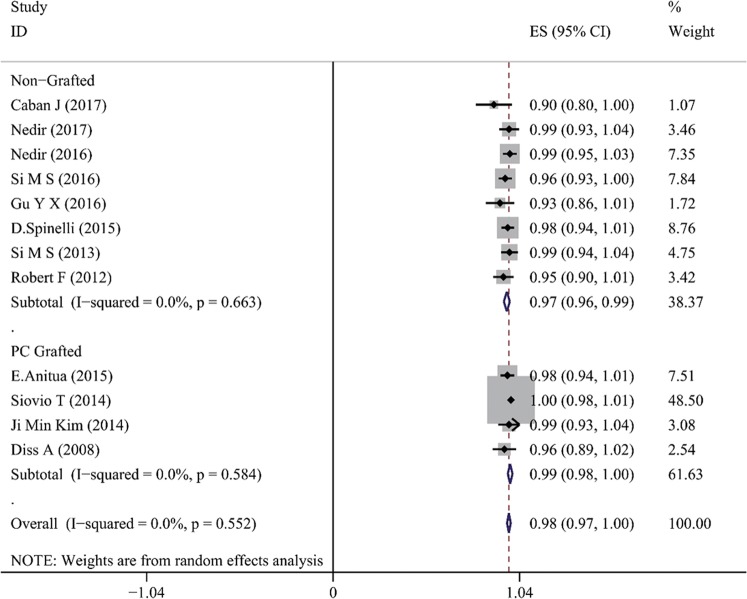
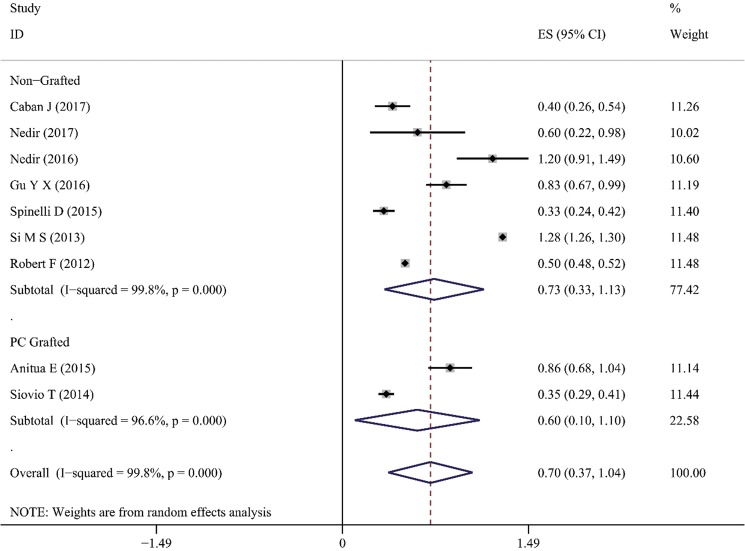
To evaluate and compare the stability, quantity and quality of bone augmentation at maxillary sinus elevation sites by non-grafted transcrestal sinus floor elevation (TSFE) and platelet concentration grafted transcrestal sinus floor elevation (PC-TSFE). A complete literature search was performed up to April 2019. Clinical controlled trials, retrospective cohort studies, and prospective cohort studies were selected based on inclusion criteria. The clinical outcomes were implant survival rate (ISR), marginal/crestal bone loss (MBL/CBL) and endo-sinus bone gain (ESBG). Meta-analysis was conducted on these 1-year based values. Furthermore, another meta-analysis on 1-year ISR value was conducted among studies with different residual bone heights (RBH) within the non-grafted TSFE group. A total of 18 studies were included: 13 in TSFE group and 5 in PC-TSFE group. No significant differences were displayed between the 1-year ISR of TSFE (97%, 95%CI = 0.96-0.99) and PC-TSFE group (99%, 95%CI = 0.97-1.00). Among the various studies with different RBH within TSFE group, no significant differences in 1-year ISR were displayed. The 1-year MBL/CBL value of PC-TSFE group (0.73 mm, 95%CI = 0.43-1.13 mm) did not show significant difference as compared to TSFE group (0.60 mm, 95%CI = 0.10-1.10 mm). Furthermore, no significant enhancement was observed on 1-year ESBG value on PC-TSFE group (3.51 mm, 95%CI = 2.31-4.71 mm) in comparison with the TSFE group (2.87 mm, 95%CI = 2.18m-3.55 mm). Grafting platelet concentrations around dental implants at TSFE sites did not significantly enhance the adjacent bone regeneration. Moreover, TSFE was shown to be a reliable therapeutic option for implant sites that need simultaneous maxillary sinus augmentation, even under limited RBH.
评估和比较经非穿牙槽嵴窦底提升(TSFE)和血小板浓度植骨经穿牙槽嵴窦底提升(PC-TSFE)的上颌窦提升部位的稳定性、骨量和质量。截至 2019 年 4 月,进行了全面的文献检索。根据纳入标准,选择了临床对照试验、回顾性队列研究和前瞻性队列研究。临床结果为种植体存活率(ISR)、边缘/嵴骨损失(MBL/CBL)和窦内骨增益(ESBG)。对这些基于 1 年的数值进行了荟萃分析。此外,还对非植骨 TSFE 组内不同剩余骨高度(RBH)的研究进行了基于 1 年 ISR 值的另一个荟萃分析。共纳入 18 项研究:TSFE 组 13 项,PC-TSFE 组 5 项。TSFE 组和 PC-TSFE 组的 1 年 ISR 无显著差异(97%,95%CI=0.96-0.99)。在 TSFE 组内不同 RBH 的各种研究中,1 年 ISR 无显著差异。PC-TSFE 组的 1 年 MBL/CBL 值(0.73mm,95%CI=0.43-1.13mm)与 TSFE 组(0.60mm,95%CI=0.10-1.10mm)无显著差异。此外,与 TSFE 组(2.87mm,95%CI=2.18m-3.55mm)相比,PC-TSFE 组 1 年 ESBG 值(3.51mm,95%CI=2.31-4.71mm)未见显著升高。在上颌窦提升部位的牙种植体周围添加血小板浓度并没有显著增强相邻骨的再生。此外,即使在 RBH 有限的情况下,TSFE 也被证明是一种可靠的治疗选择,适用于需要同时进行上颌窦提升的种植体部位。