He Tingwei, Li Saisai, Jiang Yuanzhi, Qin Chaochao, Cui Minghuan, Qiao Lu, Xu Hongyu, Yang Jien, Long Run, Wang Huanhua, Yuan Mingjian
Key Laboratory of Advanced Energy Materials Chemistry (Ministry of Education), Renewable Energy Conversion and Storage Center (RECAST), College of Chemistry, Nankai University, 300071, Tianjin, People's Republic of China.
Henan Key Laboratory of Infrared Materials and Spectrum Measures and Applications, Henan Normal University, 453007, Xinxiang, People's Republic of China.
Nat Commun. 2020 Apr 3;11(1):1672. doi: 10.1038/s41467-020-15451-1.
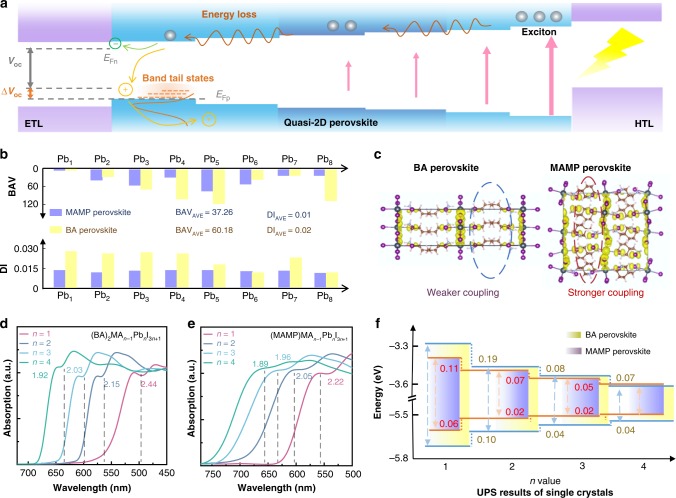
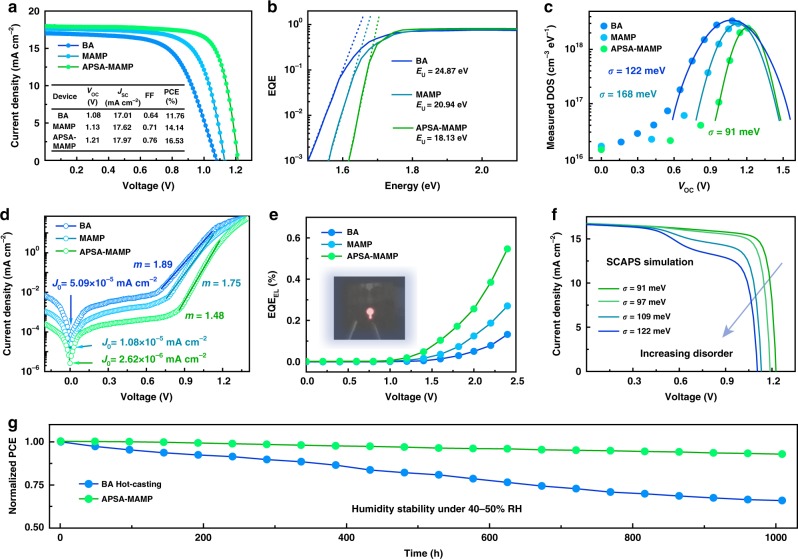
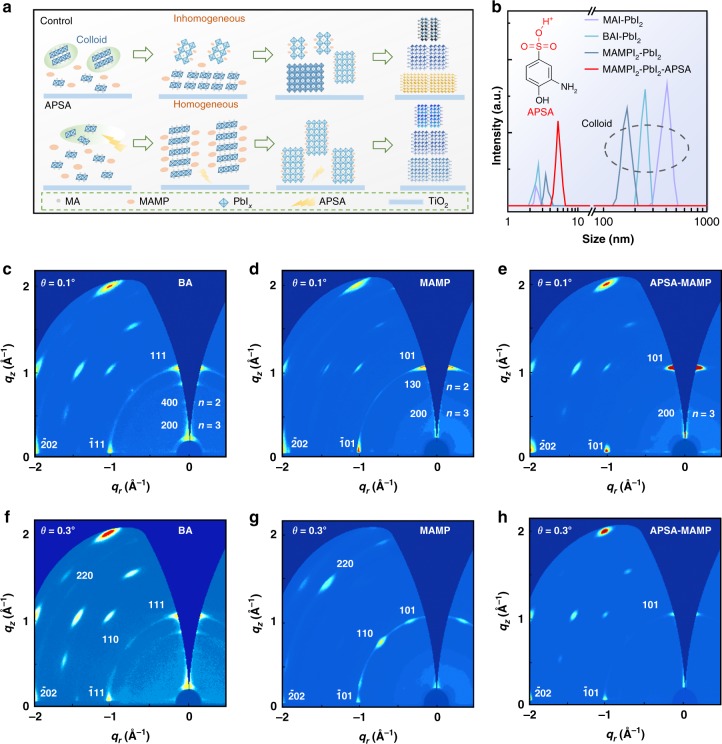
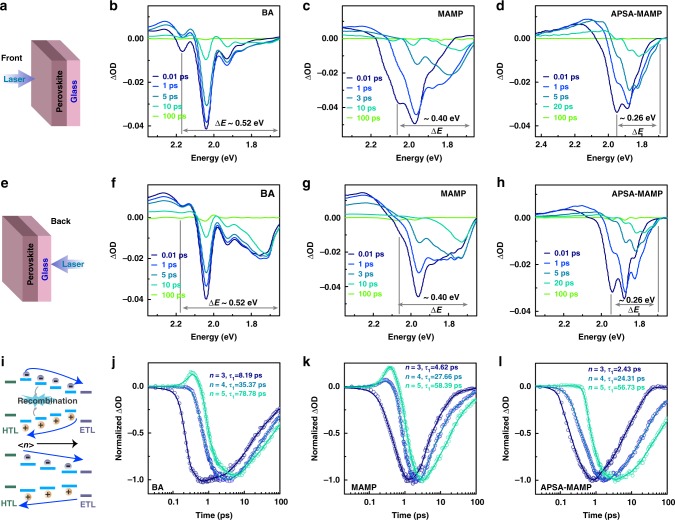
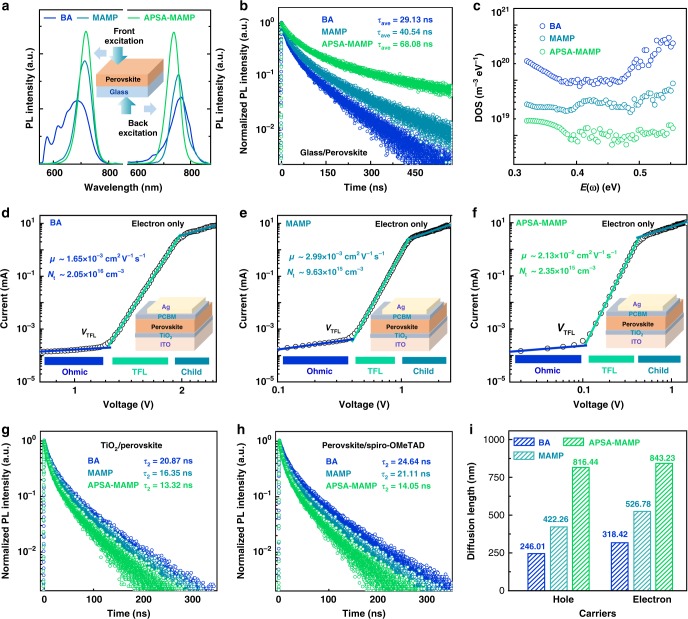
Reduced-dimensional (quasi-2D) perovskite materials are widely applied for perovskite photovoltaics due to their remarkable environmental stability. However, their device performance still lags far behind traditional three dimensional perovskites, particularly high open circuit voltage (V) loss. Here, inhomogeneous energy landscape is pointed out to be the sole reason, which introduces extra energy loss, creates band tail states and inhibits minority carrier transport. We thus propose to form homogeneous energy landscape to overcome the problem. A synergistic approach is conceived, by taking advantage of material structure and crystallization kinetic engineering. Accordingly, with the help of density functional theory guided material design, (aminomethyl) piperidinium quasi-2D perovskites are selected. The lowest energy distribution and homogeneous energy landscape are achieved through carefully regulating their crystallization kinetics. We conclude that homogeneous energy landscape significantly reduces the Shockley-Read-Hall recombination and suppresses the quasi-Fermi level splitting, which is crucial to achieve high V.
低维(准二维)钙钛矿材料因其卓越的环境稳定性而被广泛应用于钙钛矿光伏领域。然而,它们的器件性能仍远远落后于传统的三维钙钛矿,尤其是开路电压(V)损失较大。在此,非均匀能量景观被指出是唯一原因,它会引入额外的能量损失,产生带尾态并抑制少数载流子传输。因此,我们提议形成均匀能量景观以克服该问题。通过利用材料结构和结晶动力学工程,构思了一种协同方法。相应地,在密度泛函理论指导的材料设计帮助下,选择了(氨基甲基)哌啶鎓准二维钙钛矿。通过仔细调节其结晶动力学,实现了最低能量分布和均匀能量景观。我们得出结论,均匀能量景观显著降低了肖克利-里德-霍尔复合,并抑制了准费米能级分裂,这对于实现高V至关重要。