Department of General Practice and Elderly Care Medicine, Amsterdam Public Health Research Institute, Amsterdam UMC - location VUmc, van der Boechorststraat 7, 1081 BT, Amsterdam, the Netherlands.
Julius Center for Health Sciences and Primary Care, University Medical Center Utrecht, Utrecht University, Utrecht, the Netherlands.
Diabetologia. 2020 Jun;63(6):1110-1119. doi: 10.1007/s00125-020-05134-3. Epub 2020 Apr 3.
AIMS/HYPOTHESIS: The aims of this study were to identify all published prognostic models predicting retinopathy risk applicable to people with type 2 diabetes, to assess their quality and accuracy, and to validate their predictive accuracy in a head-to-head comparison using an independent type 2 diabetes cohort.
A systematic search was performed in PubMed and Embase in December 2019. Studies that met the following criteria were included: (1) the model was applicable in type 2 diabetes; (2) the outcome was retinopathy; and (3) follow-up was more than 1 year. Screening, data extraction (using the checklist for critical appraisal and data extraction for systemic reviews of prediction modelling studies [CHARMS]) and risk of bias assessment (by prediction model risk of bias assessment tool [PROBAST]) were performed independently by two reviewers. Selected models were externally validated in the large Hoorn Diabetes Care System (DCS) cohort in the Netherlands. Retinopathy risk was calculated using baseline data and compared with retinopathy incidence over 5 years. Calibration after intercept adjustment and discrimination (Harrell's C statistic) were assessed.
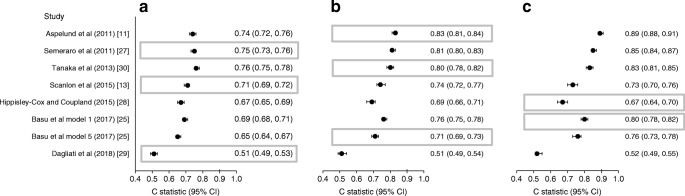
Twelve studies were included in the systematic review, reporting on 16 models. Outcomes ranged from referable retinopathy to blindness. Discrimination was reported in seven studies with C statistics ranging from 0.55 (95% CI 0.54, 0.56) to 0.84 (95% CI 0.78, 0.88). Five studies reported on calibration. Eight models could be compared head-to-head in the DCS cohort (N = 10,715). Most of the models underestimated retinopathy risk. Validating the models against different severities of retinopathy, C statistics ranged from 0.51 (95% CI 0.49, 0.53) to 0.89 (95% CI 0.88, 0.91).
CONCLUSIONS/INTERPRETATION: Several prognostic models can accurately predict retinopathy risk in a population-based type 2 diabetes cohort. Most of the models include easy-to-measure predictors enhancing their applicability. Tailoring retinopathy screening frequency based on accurate risk predictions may increase the efficiency and cost-effectiveness of diabetic retinopathy care.
PROSPERO registration ID CRD42018089122.
目的/假设:本研究的目的是确定所有已发表的预测 2 型糖尿病患者视网膜病变风险的预后模型,评估其质量和准确性,并使用独立的 2 型糖尿病队列进行头对头比较来验证其预测准确性。
我们于 2019 年 12 月在 PubMed 和 Embase 中进行了系统检索。符合以下标准的研究被纳入:(1)模型适用于 2 型糖尿病;(2)结局为视网膜病变;(3)随访时间超过 1 年。两名评审员独立进行了筛选、数据提取(使用系统评价中预测模型的关键性评价和数据提取清单[CHARMS])和偏倚风险评估(使用预测模型偏倚风险评估工具[PROBAST])。选择的模型在荷兰的大型霍恩糖尿病护理系统(DCS)队列中进行了外部验证。使用基线数据计算视网膜病变风险,并与 5 年内的视网膜病变发生率进行比较。评估了截距调整后的校准和区分度(哈雷尔 C 统计量)。
系统评价共纳入 12 项研究,报道了 16 个模型。结局范围从可转诊的视网膜病变到失明。7 项研究报告了区分度,C 统计量范围为 0.55(95%CI 0.54,0.56)至 0.84(95%CI 0.78,0.88)。5 项研究报告了校准情况。在 DCS 队列中可对头对头比较 8 个模型(N=10715)。大多数模型低估了视网膜病变风险。验证模型对不同严重程度的视网膜病变的区分度,C 统计量范围为 0.51(95%CI 0.49,0.53)至 0.89(95%CI 0.88,0.91)。
结论/解释:一些预后模型可以准确预测基于人群的 2 型糖尿病队列的视网膜病变风险。大多数模型都包含易于测量的预测因子,提高了其适用性。基于准确的风险预测来调整视网膜病变筛查的频率,可能会提高糖尿病视网膜病变护理的效率和成本效益。
PROSPERO 注册号 CRD42018089122。