Department of Radiology and Medical Imaging University of Virginia Charlottesville VA.
Department of Experimental Physiology and Pathophysiology Medical University of Białystok Białystok Poland.
J Am Heart Assoc. 2020 Apr 7;9(7):e015154. doi: 10.1161/JAHA.119.015154. Epub 2020 Apr 4.
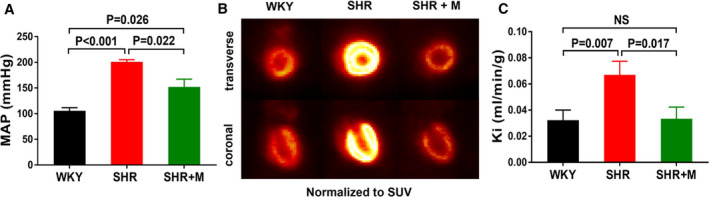
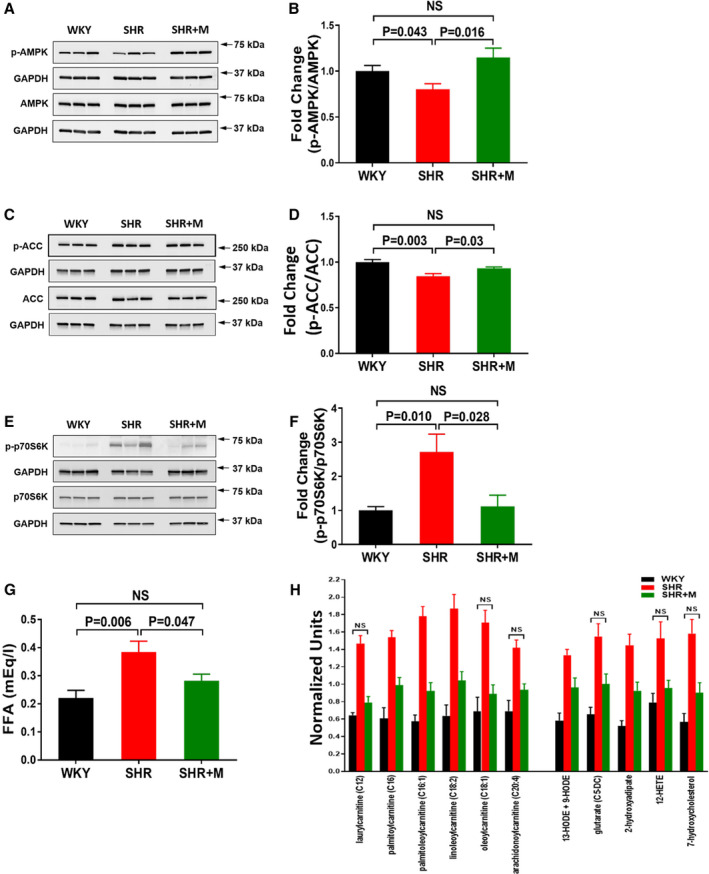
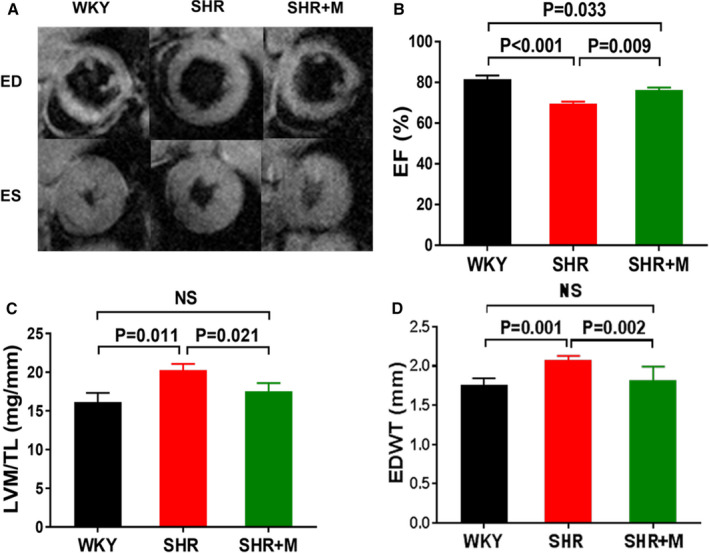
Background In spontaneously hypertensive rats (SHR) we observed profound myocardial metabolic changes during early hypertension before development of cardiac dysfunction and left ventricular hypertrophy. In this study, we evaluated whether metformin improved myocardial metabolic abnormalities and simultaneously prevented contractile dysfunction and left ventricular hypertrophy in SHR. Methods and Results SHR and control Wistar-Kyoto rats were treated with metformin from 2 to 5 months of age, when SHR hearts exhibit metabolic abnormalities and develop cardiac dysfunction and left ventricular hypertrophy. We evaluated the effect of metformin on myocardial glucose uptake rates with dynamic 2-[F] fluoro-2-deoxy-D-glucose positron emission tomography. We used cardiac MRI in vivo to assess the effect of metformin on ejection fraction, left ventricular mass, and end-diastolic wall thickness, and also analyzed metabolites, AMP-activated protein kinase and mammalian target-of-rapamycin activities, and mean arterial blood pressure. Metformin-treated SHR had lower mean arterial blood pressure but remained hypertensive. Cardiac glucose uptake rates, left ventricular mass/tibia length, wall thickness, and circulating free fatty acid levels decreased to normal, and ejection fraction improved in treated SHR. Hearts of treated SHR exhibited increased AMP-activated protein kinase phosphorylation and reduced mammalian target-of-rapamycin activity. Cardiac metabolite profiling demonstrated that metformin decreased fatty acyl carnitines and markers of oxidative stress in SHR. Conclusions Metformin reduced blood pressure, normalized myocardial glucose uptake, prevented left ventricular hypertrophy, and improved cardiac function in SHR. Metformin may exert its effects by normalizing myocardial AMPK and mammalian target-of-rapamycin activities, improving fatty acid oxidation, and reducing oxidative stress. Thus, metformin may be a new treatment to prevent or ameliorate chronic hypertension-induced left ventricular hypertrophy.
在自发性高血压大鼠(SHR)中,我们观察到在出现心功能障碍和左心室肥厚之前的早期高血压期间,心肌代谢发生了深刻变化。在这项研究中,我们评估了二甲双胍是否可以改善心肌代谢异常,同时预防 SHR 的收缩功能障碍和左心室肥厚。
从 2 到 5 个月大时,SHR 心脏出现代谢异常并发生心功能障碍和左心室肥厚时,SHR 和对照 Wistar-Kyoto 大鼠开始接受二甲双胍治疗。我们通过动态 2-[F]氟-2-脱氧-D-葡萄糖正电子发射断层扫描评估二甲双胍对心肌葡萄糖摄取率的影响。我们使用心脏 MRI 体内评估二甲双胍对射血分数、左心室质量和舒张末期壁厚度的影响,并分析代谢物、AMP 激活的蛋白激酶和哺乳动物雷帕霉素靶蛋白的活性以及平均动脉压。接受二甲双胍治疗的 SHR 的平均动脉压较低,但仍处于高血压状态。心脏葡萄糖摄取率、左心室质量/胫骨长度、壁厚度和循环游离脂肪酸水平降至正常,治疗后的 SHR 射血分数提高。治疗后的 SHR 心脏中 AMP 激活的蛋白激酶磷酸化增加,哺乳动物雷帕霉素靶蛋白的活性降低。心脏代谢物分析表明,二甲双胍降低了 SHR 中的脂肪酸酰基辅酶 A 和氧化应激标志物。
二甲双胍降低了 SHR 的血压,使心肌葡萄糖摄取正常化,预防了左心室肥厚并改善了心功能。二甲双胍可能通过正常化心肌 AMPK 和哺乳动物雷帕霉素靶蛋白的活性、改善脂肪酸氧化和减少氧化应激来发挥作用。因此,二甲双胍可能是预防或改善慢性高血压引起的左心室肥厚的新治疗方法。