Bissong Marie Ebob Agbortabot, Ateba Collins Njie
Antibiotic Resistance and Phage Biocontrol Research Group (AREPHABREG), Department of Microbiology, School of Biological Sciences, North-West University-Mafikeng Campus, Private Bag X2046, Mmabatho 2735, South Africa.
Department of Biomedical Science, University of Bamenda, Bambili P. O. Box 39, Cameroon.
Antibiotics (Basel). 2020 Apr 2;9(4):156. doi: 10.3390/antibiotics9040156.
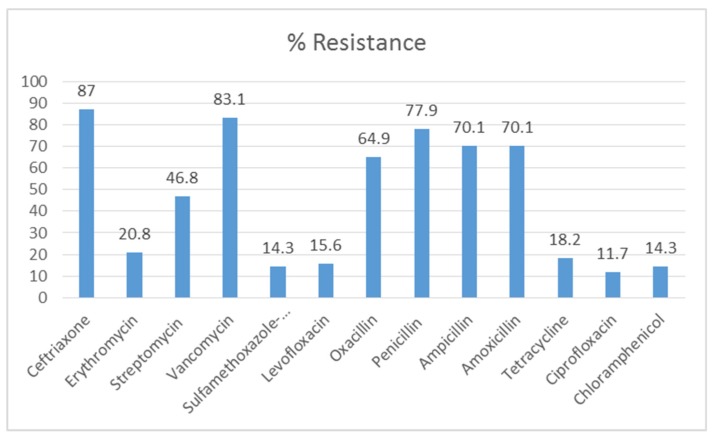
: Biofilm formation in may reduce the rate of penetration of antibiotics, thereby complicating treatment of infections caused by these bacteria. The aim of this study was to correlate biofilm-forming potentials, antimicrobial resistance, and genes in isolates. : A total of 64 milk samples were analysed, and 77 were isolated. : Seventy (90.9%) isolates were biofilm producers. The biofilm-forming genes were detected among 75.3% of the isolates, with A being the most prevalent (49, 63.6%). The B gene was significantly ( = 0.027) higher in isolates with strong biofilm formation potentials. High resistance (60%-90%) of the isolates was observed against ceftriaxone, vancomycin, and penicillin, and 25 (32.5%) of showed multidrug resistance (MDR) to at least three antibiotics. Five resistance genes, namely (29, 37.7%), (29, 37.7%), (24, 31.2%), tetL (21, 27.3%), and (16, 20.8%) were detected. Most MDR phenotypes possessed at least one resistance gene alongside the biofilm genes. However, no distinct pattern was identified among the resistance and biofilm phenotypes. : The high frequency of potentially pathogenic MDR in milk samples intended for human consumption, demonstrates the public health relevance of this pathogen in the region.
:[细菌名称]中的生物膜形成可能会降低抗生素的渗透速率,从而使这些细菌引起的感染治疗复杂化。本研究的目的是关联[细菌名称]分离株中的生物膜形成潜力、抗菌药物耐药性和基因。:共分析了64份牛奶样本,分离出77株[细菌名称]。:70株(90.9%)分离株是生物膜产生菌。在75.3%的分离株中检测到[细菌名称]生物膜形成基因,其中A基因最为普遍(49株,63.6%)。B基因在具有强生物膜形成潜力的分离株中显著更高(P = 0.027)。观察到分离株对头孢曲松、万古霉素和青霉素具有高耐药性(60% - 90%),并且25株(32.5%)的[细菌名称]对至少三种抗生素表现出多重耐药(MDR)。检测到五个耐药基因,即[基因名称1](29株,37.7%)、[基因名称2](29株,37.7%)、[基因名称3](24株,31.2%)、tetL(21株,27.3%)和[基因名称4](16株,20.8%)。大多数MDR表型除了生物膜基因外还拥有至少一个耐药基因。然而,在耐药性和生物膜表型之间未发现明显模式。:在供人类消费的牛奶样本中潜在致病性MDR[细菌名称]的高频率,证明了该病原体在该地区的公共卫生相关性。