Stokes Jessica E, Mullan Siobhan, Takahashi Taro, Monte Federica, Main David C J
Bristol Vet School, University of Bristol, Langford House, Langford BS40 5DU, UK.
School of Agriculture, Food and the Environment, Royal Agricultural University, Cirencester GL7 6JS, UK.
Animals (Basel). 2020 Apr 2;10(4):610. doi: 10.3390/ani10040610.
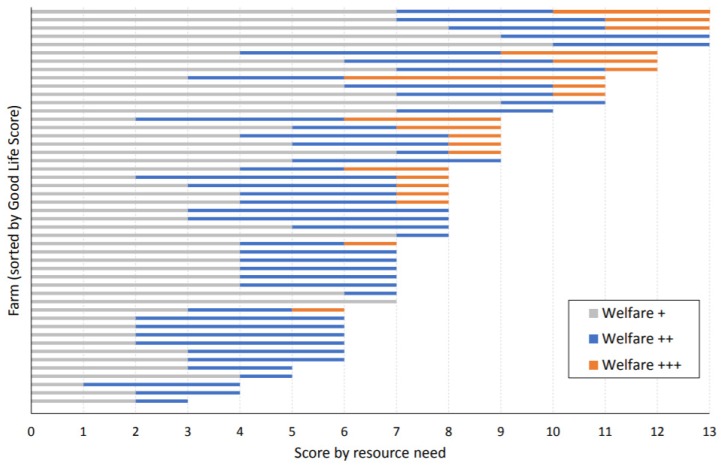
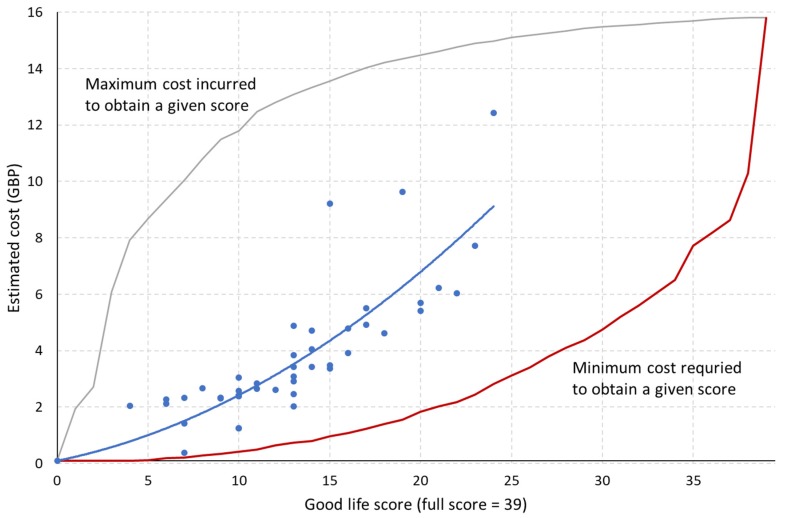
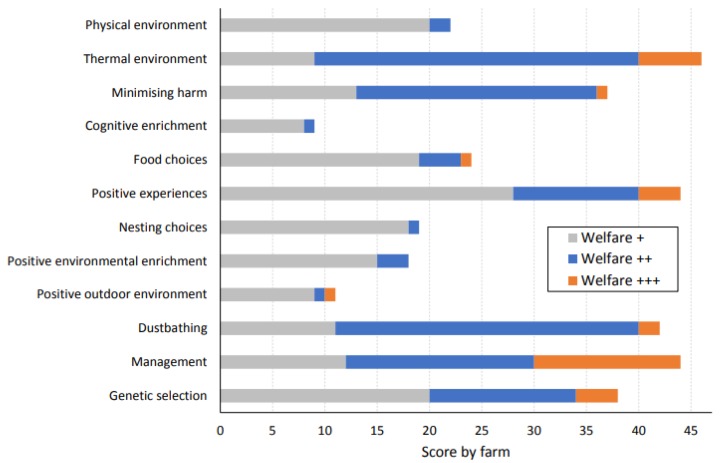
Existing animal welfare standards for legislation and food certification programmes are primarily designed to avoid harms to the livestock, with minimal consideration given to their behavioural freedoms. Recent research has shown, however, that animal welfare should not only be evaluated by the absence of negative states but also by the presence of "good life" or positive experiences enjoyed by animals. The objective of the present study is to investigate the scientific validity and on-farm cost implications of utilising potential input-based measures of positive welfare as part of evaluation criteria for farm assurance schemes. Building upon the Farm Animal Welfare Council's concept of good life opportunities, an assessment was undertaken on 49 noncaged laying hen farms across the UK by measuring on-farm resources to facilitate positive experiences alongside commonly measured metrics for welfare outcomes. The financial cost of providing these resources on each enterprise was also estimated using a farm-scale costing tool. The results suggested that 63% of resource needs that facilitate the behaviour opportunities of laying hens are already being provided by these producers, far above legal and commercial requirements. This practice attracts no reward mechanism or direct financial benefit under the current market structure. Additional provision of opportunities was positively associated with behavioural outcomes, but only limited impact was observed on health and productivity measures. Economic modelling indicated that significant room exists to further improve welfare scores on these farms, on average by 97%, without incurring additional costs. Together we argue that these results can be seen as evidence of market failure since producers are providing positive welfare value to society that is not being currently recognised. It is therefore contended that measuring and rewarding the supply of good life opportunities could be a novel policy instrument to create an effective marketplace that appropriately recognises high welfare production.
现行的立法及食品认证计划中的动物福利标准主要旨在避免对牲畜造成伤害,而对其行为自由的考虑极少。然而,最近的研究表明,动物福利不仅应通过是否不存在负面状态来评估,还应通过动物所享受的“美好生活”或积极体验的存在来评估。本研究的目的是调查将基于潜在投入的积极福利措施作为农场保证计划评估标准的一部分的科学有效性和农场成本影响。基于农场动物福利委员会的美好生活机会概念,通过测量农场资源以促进积极体验,并结合福利结果的常用衡量指标,对英国49个非笼养蛋鸡养殖场进行了评估。还使用农场规模成本核算工具估计了每个企业提供这些资源的财务成本。结果表明,这些生产者已经提供了63%的有助于蛋鸡行为机会的资源需求,远远高于法律和商业要求。在当前市场结构下,这种做法没有奖励机制或直接经济利益。额外提供机会与行为结果呈正相关,但对健康和生产力指标的影响有限。经济模型表明,这些农场在不产生额外成本的情况下,平均仍有很大空间将福利得分进一步提高97%。我们共同认为,这些结果可被视为市场失灵的证据,因为生产者为社会提供了目前未得到认可的积极福利价值。因此,有人认为,衡量和奖励美好生活机会的供应可能是一种新颖的政策工具,以创建一个能够适当认可高福利生产的有效市场。