Aonuma Hitoshi, Mezheritskiy Maxim, Boldyshev Boris, Totani Yuki, Vorontsov Dmitry, Zakharov Igor, Ito Etsuro, Dyakonova Varvara
Research Center of Mathematics for Social Creativity, Research Institute for Electronic Science, Hokkaido University, Hokkaido, Japan.
Core Research for Evolutional Science and Technology (CREST), Japan Science and Technology Agency, Saitama, Japan.
Front Physiol. 2020 Mar 17;11:221. doi: 10.3389/fphys.2020.00221. eCollection 2020.
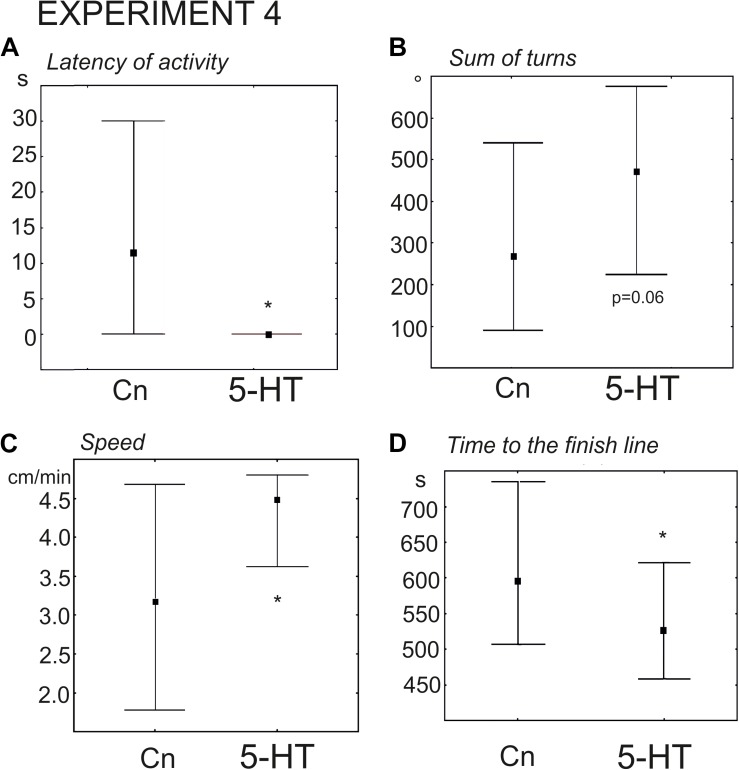
The role of serotonin in the immediate and delayed influence of physical exercise on brain functions has been intensively studied in mammals. Recently, immediate effects of intense locomotion on the decision-making under uncertainty were reported in the Great Pond snail, (Korshunova et al., 2016). In this animal, serotonergic neurons control locomotion, and serotonin modulates many processes underlying behavior, including cognitive ones (memory and learning). Whether serotonin mediates the behavioral effects of intense locomotion in mollusks, as it does in vertebrates, remains unknown. Here, the delayed facilitating effects of intense locomotion on the decision-making in the novel environment are described in . Past exercise was found to alter the metabolism of serotonin, namely the content of serotonin precursor and its catabolites in the cerebral and pedal ganglia, as measured by high-performance liquid chromatography. The immediate and delayed effects of exercise on serotonin metabolism were different. Moreover, serotonin metabolism was regulated differently in different ganglia. Pharmacological manipulations of the serotonin content and receptor availability suggests that serotonin is likely to be responsible for the locomotor acceleration in the test of decision-making under uncertainty performed after exercise. However, the exercise-induced facilitation of decision-making (manifested in a reduced number of turns during the orienting behavior) cannot be attributed to the effects of serotonin.
血清素在体育锻炼对大脑功能的即时和延迟影响中的作用已在哺乳动物中得到深入研究。最近,在大池塘蜗牛中报道了剧烈运动对不确定性下决策的即时影响(科尔舒诺娃等人,2016年)。在这种动物中,血清素能神经元控制运动,血清素调节许多行为背后的过程,包括认知过程(记忆和学习)。血清素是否像在脊椎动物中那样介导软体动物中剧烈运动的行为效应,仍然未知。在这里,描述了剧烈运动对新环境中决策的延迟促进作用。通过高效液相色谱法测量发现,过去的运动改变了血清素的代谢,即大脑和足神经节中血清素前体及其分解代谢物的含量。运动对血清素代谢的即时和延迟影响不同。此外,不同神经节中血清素代谢的调节方式也不同。对血清素含量和受体可用性的药理学操作表明,血清素可能是运动后在不确定性决策测试中运动加速的原因。然而,运动诱导的决策促进作用(表现为定向行为中转弯次数减少)不能归因于血清素的作用。