Zhou Wei, Ouyang Feiyun, Nergui Oyun-Erdene, Bangura Joseph Benjamin, Acheampong Kwabena, Massey Isaac Yaw, Xiao Shuiyuan
Xiangya School of Public Health, Central South University, Changsha, China.
Hospital Administration Institute, Xiangya Hospital, Central South University, Changsha, China.
Front Psychiatry. 2020 Mar 18;11:150. doi: 10.3389/fpsyt.2020.00150. eCollection 2020.
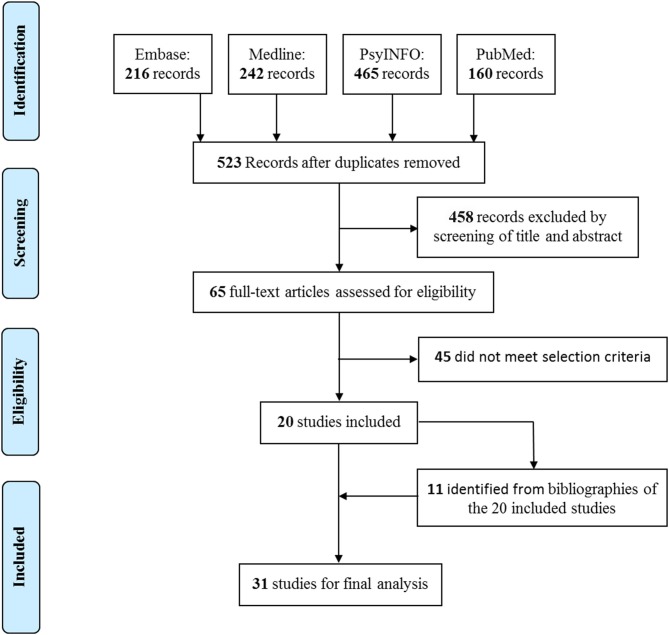
Child and adolescent mental health (CAMH) policy is essential for the rational development of mental health systems for children and adolescents. However, there is a universal lack of CAMH policy, especially in low- and middle-income countries (LMICs). Therefore, this review aims to identify challenges and lessons for LMICs to develop and implement CAMH policy. PubMed (1781-), MEDLINE (1950-), EMBASE (1966-), and PsycINFO (1895-) were searched from inception to December 31, 2018, for publications on CAMH policy development and/or implementation. Abstracts and main texts of articles were double screened, and extracted data were analyzed through thematic synthesis. A total of 31 publications were included through the systematic review. Six major challenges were identified for CAMH policy in LMICs: (i) poor public awareness and low political willingness; (ii) stigma against mental disorders; (iii) biased culture values toward children, adolescents and CAMH, from developmental nihilism to medicalization; (iv) the lack of CAMH data and evidence, from service statistics to program evaluation; (v) the shortage of CAMH resources, including human resources, service facilities, and funding; and (vi) unintended consequence of international support, including reducing local responsibilities, planning fragmentation, and unsustainability. Six lessons to overcome challenges were summarized: (i) rethinking the concept of CAMH, (ii) encouraging a stand-alone CAMH policy and budget, (iii) involving stakeholders, (iv) reinforcing the role of research and researchers in policy process, (v) innovating the usage of human and service resources, and (vi) maximizing the positive influence of international organizations and non-governmental organizations. Many LMICs are still facing various challenges for their CAMH policy development and implementation. To overcome the challenges, great and long-term efforts are needed, which include great determination of from domestic and global agents, multidisciplinary innovations, and collaboration and coordination from different sectors.
儿童和青少年心理健康(CAMH)政策对于儿童和青少年心理健康系统的合理发展至关重要。然而,普遍缺乏CAMH政策,尤其是在低收入和中等收入国家(LMICs)。因此,本综述旨在确定LMICs制定和实施CAMH政策所面临的挑战和经验教训。检索了PubMed(1781年起)、MEDLINE(1950年起)、EMBASE(1966年起)和PsycINFO(1895年起)从创刊至2018年12月31日关于CAMH政策制定和/或实施的出版物。对文章的摘要和正文进行了双重筛选,并通过主题综合分析提取的数据。通过系统综述共纳入31篇出版物。确定了LMICs在CAMH政策方面的六大挑战:(i)公众意识淡薄和政治意愿低下;(ii)对精神障碍的污名化;(iii)从发展虚无主义到医学化,对儿童、青少年和CAMH存在有偏见的文化价值观;(iv)缺乏CAMH数据和证据,从服务统计到项目评估;(v)CAMH资源短缺,包括人力资源、服务设施和资金;(vi)国际支持的意外后果,包括减轻当地责任、规划分散和不可持续性。总结了克服挑战的六大经验教训:(i)重新思考CAMH的概念;(ii)鼓励制定独立的CAMH政策和预算;(iii)让利益相关者参与;(iv)加强研究和研究人员在政策过程中的作用;(v)创新人力和服务资源的利用;(vi)最大化国际组织和非政府组织的积极影响。许多LMICs在其CAMH政策的制定和实施方面仍面临各种挑战。为了克服这些挑战,需要做出巨大而长期的努力,这包括国内和全球行为体的坚定决心、多学科创新以及不同部门的协作与协调。