Kim Min Jung, Lee Da-Hye, Ahn Jiyun, Jang Young-Jin, Ha Tae-Youl, Do Eunju, Jung Chang Hwa
Research Division of Food Functionality, Korea Food Research Institute, Wanju-gun, Jeonbuk 55365, Republic of Korea.
Department of Food Biotechnology, Korea University of Science and Technology, Wanju-gun, Jeonbuk 55365, Republic of Korea.
Nutr Res Pract. 2020 Apr;14(2):102-108. doi: 10.4162/nrp.2020.14.2.102. Epub 2019 Dec 13.
BACKGROUND/OBJECTIVES: In Oriental medicine, certain foods may be beneficial or detrimental based on an individual's constitution; however, the scientific basis for this theory is insufficient. The purpose of this study was to investigate the effect of body constitution, based on the Sasang type of Korean traditional medical classification system, on the bioavailability of soy isoflavones of , a quick-fermented soybean paste.
SUBJECTS/METHODS: A pilot study was conducted on 48 healthy Korean men to evaluate the bioavailability of isoflavone after ingestion of food based on constitution types classified by the Sasang typology. The participants were classified into the Taeeumin (TE; n = 15), Soyangin (SY; n = 15), and Soeumin (SE; n = 18) groups. Each participant ingested 50 g of per 60 kg body weight. Thereafter, blood was collected, and the soy isoflavone metabolites were analyzed by ultra-performance liquid chromatography/quadrupole time-of-flight mass spectrometry. Ntrikinetic analysis of individual isoflavone-derived metabolites was performed.
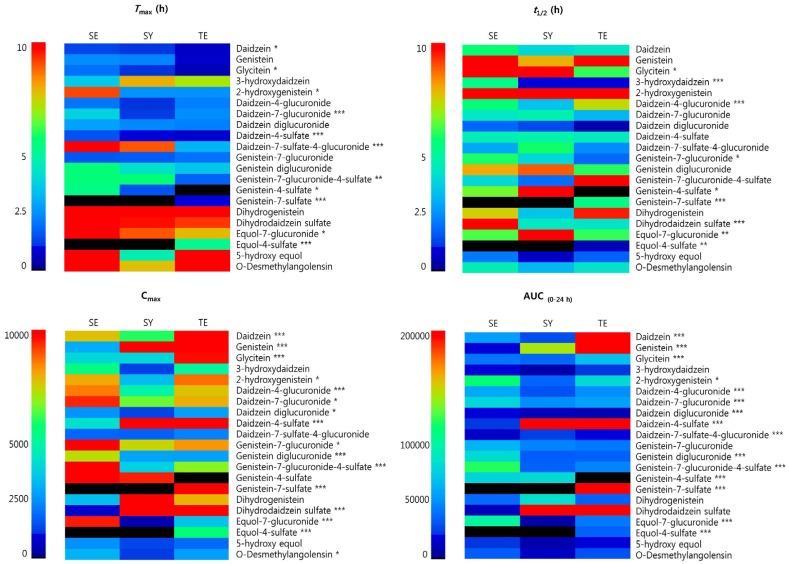
Our nutrikinetic analysis identified 21 metabolites derived from isoflavones in the blood samples from 48 healthy Korean men (age range, 21-29 years). Significant differences were observed in the time to maximum concentration ( ) and elimination half-life ( ) for nine metabolites among the three groups. The and of the nine metabolites were higher in the SE group than in the other groups. Moreover, the absorption rates, as determined by the area under the plasma-level curve (AUC) values of intact isoflavone, were 5.3 and 9.4 times higher in the TE group than in the SY and SE groups, respectively. Additionally, the highest AUC values for phase I and II metabolites were observed in the TE group.
These findings indicate that isoflavone bioavailability, following insgestion, is high in individuals with the TE constitution, and relatively lower in those with the SE and SY constitutions.
背景/目的:在东方医学中,某些食物根据个人体质可能有益或有害;然而,这一理论的科学依据并不充分。本研究的目的是基于韩国传统医学分类系统的四象类型,探讨体质对速发酵大豆酱中大豆异黄酮生物利用度的影响。
对象/方法:对48名健康韩国男性进行了一项初步研究,以评估根据四象类型分类的体质类型摄入食物后异黄酮的生物利用度。参与者被分为太阴人(TE;n = 15)、少阳人(SY;n = 15)和少阴人(SE;n = 18)组。每位参与者每60公斤体重摄入50克[具体食物名称未给出]。此后,采集血液,并用超高效液相色谱/四极杆飞行时间质谱法分析大豆异黄酮代谢产物。对个体异黄酮衍生代谢产物进行了营养动力学分析。
我们的营养动力学分析在48名健康韩国男性(年龄范围21 - 29岁)的血液样本中鉴定出21种源自异黄酮的代谢产物。三组中九种代谢产物的达峰时间( )和消除半衰期( )存在显著差异。这九种代谢产物的 和 在SE组高于其他组。此外,根据完整异黄酮的血浆水平曲线下面积(AUC)值确定的吸收速率,TE组分别比SY组和SE组高5.3倍和9.4倍。此外,TE组中I期和II期代谢产物的AUC值最高。
这些发现表明,摄入[具体食物名称未给出]后,TE体质个体的异黄酮生物利用度高,而SE和SY体质个体的异黄酮生物利用度相对较低。