Wongwat Thidarat, Srihaphon Kanyarat, Pitaksutheepong Chetsadaporn, Boonyo Worawan, Pitaksuteepong Tasana
Department of Pharmaceutical Technology, Faculty of Pharmaceutical Sciences and Center of Excellence for Innovation in Chemistry, Naresuan University, Tha Pho, Mueang Phitsanulok, Phitsanulok, 65000, Thailand.
Food Biotechnology Research Unit, National Center for Genetic Engineering and Biotechnology (BIOTEC), 113 Thailand Science Park, Phahonyothin Road, Khlong Nueng, Khlong Luang, Pathum Thani, 12120, Thailand.
J Tradit Complement Med. 2019 Mar 22;10(2):132-140. doi: 10.1016/j.jtcme.2019.03.006. eCollection 2020 Mar.
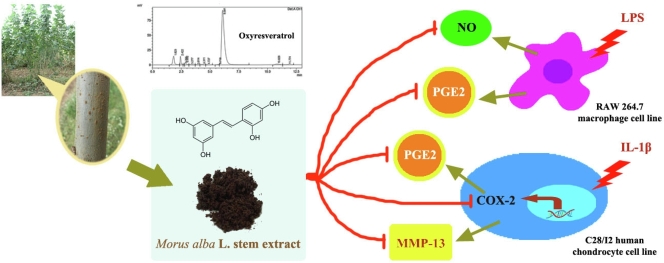
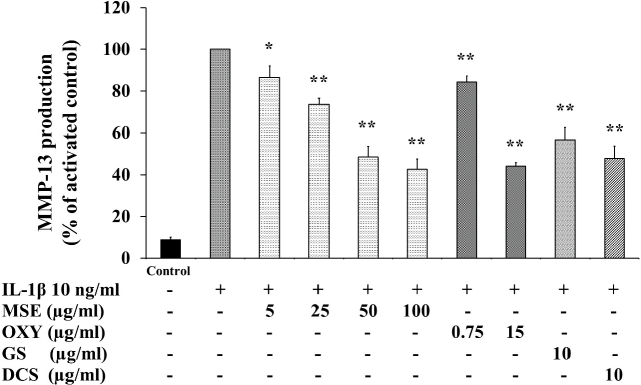
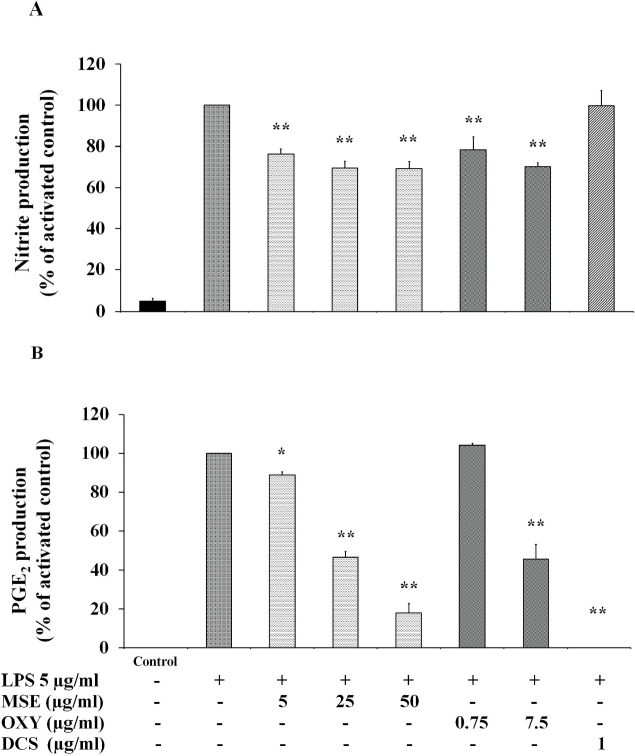
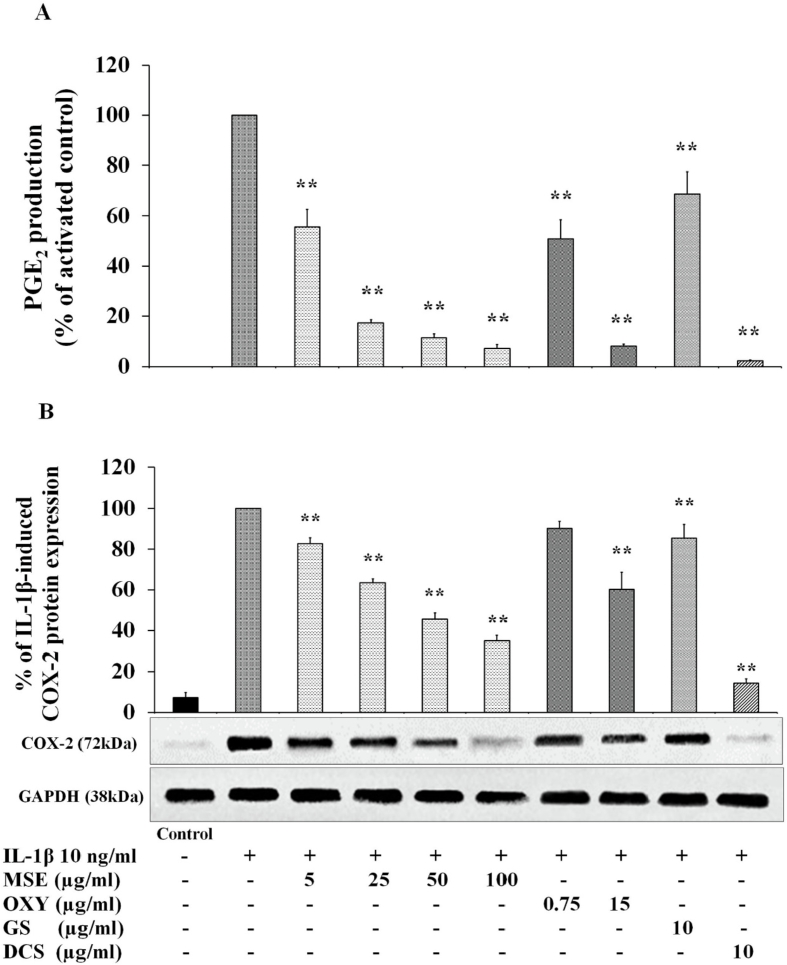
This study aimed to investigate the effects of stem extract (MSE) and oxyresveratrol on the suppression of pro-inflammatory mediators in LPS-stimulated RAW 264.7 macrophages and IL-1β-stimulated C28/I2 human chondrocyte cell line. The chondroprotective effect was also investigated using the chondrocyte cell line. First, MSE was prepared and analyzed for the amount of oxyresveratrol. The anti-inflammatory effects of MSE at various concentrations were evaluated through the inhibition of nitric oxide (NO), prostaglandin (PG)-E and cyclooxygenase (COX)-2 production. Oxyresveratrol at the equivalent amount found in the extract was investigated in the same manner. The chondroprotective effect was investigated through the suppression of MMP-13 production. The results showed that oxyresveratrol content in MSE was 15%. In RAW 264.7 cells, MSE (5-50 μg/mL) could inhibit the NO (24-30%) and PGE (11-82%) production. Oxyresveratrol at 0.75 and 7.5 μg/mL could suppress NO and also inhibited PGE but at only at high concentration. In the chondrocyte cell line, MSE at 5-100 μg/mL significantly decreased the PGE and COX-2 production by 44-93% and 17-65%, respectively. Again, oxyresveratrol at both concentrations could significantly inhibit PGE production by 50-92% but it inhibited COX-2 only at high concentration. In addition, MSE and oxyresveratrol was shown to significantly inhibit MMP-13 production by 14-57% and 16-56%, depending on their concentrations. The MSE demonstrates the potential to be used as an alternative treatment for reducing inflammation and preventing cartilage degradation. Its component, oxyresveratrol, may exert these effects to some extent.
本研究旨在探讨茎提取物(MSE)和氧化白藜芦醇对脂多糖刺激的RAW 264.7巨噬细胞及白细胞介素-1β刺激的C28/I2人软骨细胞系中促炎介质的抑制作用。同时利用软骨细胞系研究其软骨保护作用。首先,制备MSE并分析氧化白藜芦醇的含量。通过抑制一氧化氮(NO)、前列腺素(PG)-E和环氧化酶(COX)-2的产生来评估不同浓度MSE的抗炎作用。以提取物中发现的等量氧化白藜芦醇进行同样方式的研究。通过抑制基质金属蛋白酶-13(MMP-13)的产生来研究软骨保护作用。结果显示MSE中氧化白藜芦醇含量为15%。在RAW 264.7细胞中,MSE(5-50μg/mL)可抑制NO(24-30%)和PGE(11-82%)的产生。0.75和7.5μg/mL的氧化白藜芦醇可抑制NO,也能抑制PGE,但仅在高浓度时有效。在软骨细胞系中,5-100μg/mL的MSE分别使PGE和COX-2的产生显著降低44-93%和17-65%。同样,两种浓度的氧化白藜芦醇均可使PGE的产生显著抑制50-92%,但仅在高浓度时抑制COX-2。此外,MSE和氧化白藜芦醇根据其浓度可使MMP-13的产生显著抑制14-57%和16-56%。MSE显示出可作为减轻炎症和预防软骨降解的替代治疗方法的潜力。其成分氧化白藜芦醇可能在一定程度上发挥这些作用。