Park Dong-Ju, Kang Ju-Bin, Shah Fawad-Ali, Koh Phil-Ok
Department of Anatomy, College of Veterinary Medicine, Research Institute of Life Science, Gyeongsang National University, 501 Jinju-daero, Jinju, 52828 South Korea.
Lab Anim Res. 2019 Oct 15;35:18. doi: 10.1186/s42826-019-0019-8. eCollection 2019.
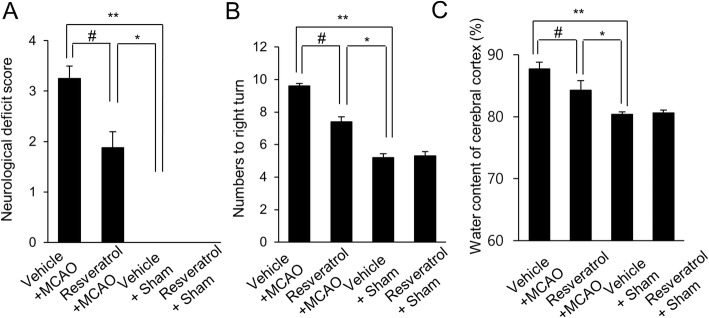
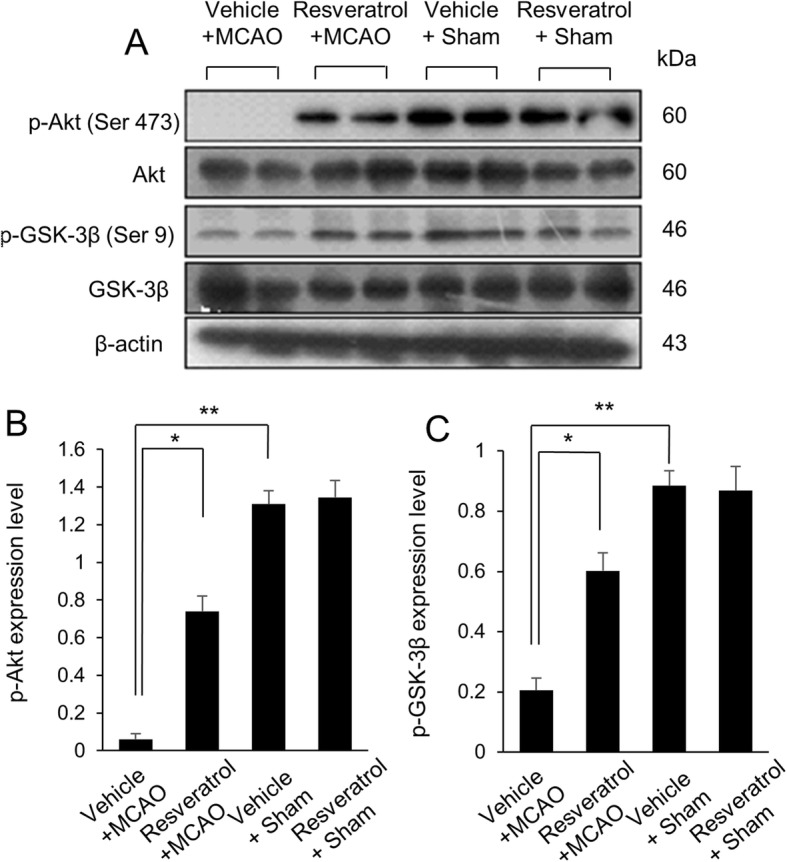
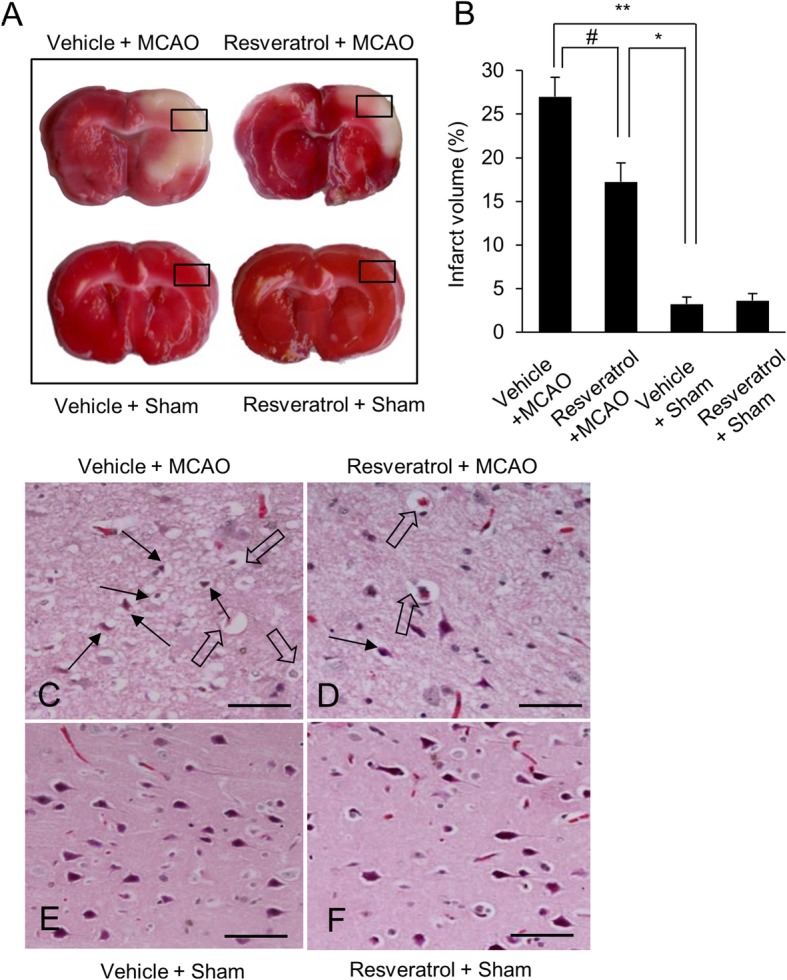
Cerebral ischemia is a major cause of neurodegenerative disease. It induces neuronal vulnerability and susceptibility, and leads to neuronal cell death. Resveratrol is a polyphenolic compound that acts as an anti-oxidant. It exerts a neuroprotective effect against focal cerebral ischemic injury. Akt signaling pathway is accepted as a representative cell survival pathway, including proliferation, growth, and glycogen synthesis. This study investigated whether resveratrol regulates Akt/glycogen synthase kinase-3β (GSK-3β) pathway in a middle cerebral artery occlusion (MCAO)-induced ischemic brain injury. Adult male rats were intraperitoneally injected with vehicle or resveratrol (30 mg/kg) and cerebral cortices were isolated 24 h after MCAO. Neurological behavior test, corner test, brain edema measurment, and 2,3,5-triphenyltetrazolium chloride staining were performed to elucidate the neuroprotective effects of resveratrol. Phospho-Akt and phospho-GSK-3β expression levels were measured using Western blot analysis. MCAO injury led to severe neurobehavioral deficit, infraction, and histopathological changes in cerebral cortex. However, resveratrol treatment alleviated these changes caused by MCAO injury. Moreover, MCAO injury induced decreases in phospho-Akt and phospho-GSK-3β protein levels, whereas resveratrol attenuated these decreases. Phosphorylations of Akt and GSK-3β act as a critical role for the suppression of apoptotic cell death. Thus, our finding suggests that resveratrol attenuates neuronal cell death in MCAO-induced cerebral ischemia and Akt/GSK-3β signaling pathway contributes to the neuroprotective effect of resveratrol.
脑缺血是神经退行性疾病的主要病因。它会导致神经元的脆弱性和易感性,并引发神经元细胞死亡。白藜芦醇是一种具有抗氧化作用的多酚类化合物。它对局灶性脑缺血损伤具有神经保护作用。Akt信号通路被认为是一条典型的细胞存活通路,包括细胞增殖、生长和糖原合成。本研究调查了白藜芦醇是否通过调控Akt/糖原合酶激酶-3β(GSK-3β)信号通路来发挥对大脑中动脉闭塞(MCAO)诱导的缺血性脑损伤的保护作用。成年雄性大鼠腹腔注射溶剂或白藜芦醇(30mg/kg),在MCAO术后24小时分离大脑皮层。通过神经行为学测试、转角试验、脑水肿测量以及2,3,5-三苯基氯化四氮唑染色来阐明白藜芦醇的神经保护作用。采用蛋白质免疫印迹分析检测磷酸化Akt和磷酸化GSK-3β的表达水平。MCAO损伤导致严重的神经行为缺陷、梗死以及大脑皮层的组织病理学改变。然而,白藜芦醇治疗减轻了MCAO损伤所引起的这些变化。此外,MCAO损伤导致磷酸化Akt和磷酸化GSK-3β蛋白水平降低,而白藜芦醇减弱了这种降低。Akt和GSK-3β的磷酸化在抑制凋亡性细胞死亡中起关键作用。因此,我们的研究结果表明白藜芦醇可减轻MCAO诱导的脑缺血中的神经元细胞死亡,且Akt/GSK-3β信号通路有助于白藜芦醇的神经保护作用。