Kızılay Fuat, Çelik Serdar, Sözen Sinan, Özveren Bora, Eskiçorapçı Saadettin, Özgen Mahir, Özen Haluk, Akdoğan Bülent, Aslan Güven, Narter Fehmi, Çal Çağ, Türkeri Levent
Ege University, Department of Urology, Izmir, Turkey.
Izmir Bozyaka Training and Research Hospital, Urology Clinic, Izmir, Turkey.
Prostate Int. 2020 Mar;8(1):10-15. doi: 10.1016/j.prnil.2020.01.001. Epub 2020 Feb 8.
Histopathological features after radical prostatectomy (RP) provide important information for the prognosis of prostate cancer (PCa). The possible correlations between Prostate-Imaging Reporting and Data Scoring System (PIRADS) scores in multiparametric magnetic resonance imaging (mpMRI) may also be predictive for prognosis. In this study, we aimed to evaluate the correlation of PIRADS scores with histopathological data.
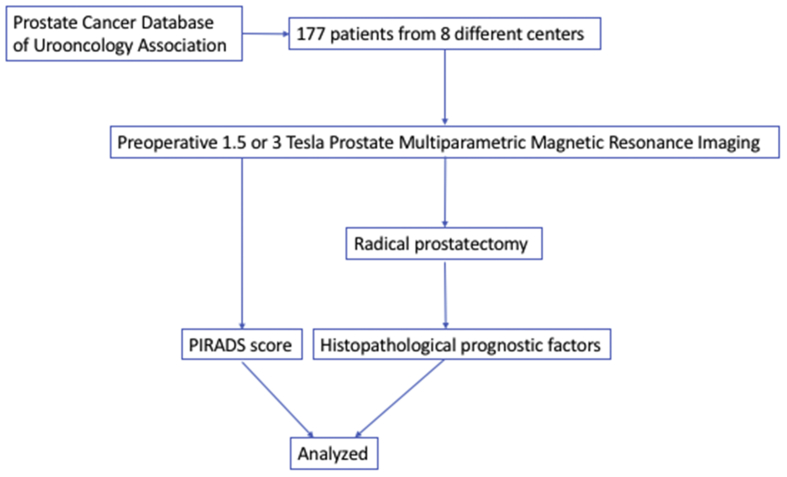
A total of 177 patients who underwent preoperative mpMRI and RP for PCa from eight institutions were included in the study. Correlation of PIRADS score in preoperative mpMRI with adverse histopathological factors in RP specimen was investigated using univariate and multivariate analyses.
The relationship between PIRADS score and postoperative extracapsular extension, lymphovascular invasion, and seminal vesicle involvement was significant ( < 0.001, = 0.032, and = 0.007, respectively). Although the PIRADS score was significantly correlated with the number of dissected lymph nodes (p = 0.026), it had no significant correlation with the number of positive nodes ( = 0.611). Total Gleason score, extracapsular extension, seminal vesicle invasion, and number of lymph nodes were found to be independent factors, which correlated with high PIRADS scores in ordinal logistic regression analysis.
PIRADS scoring system in mpMRI showed a statistically significant correlation with adverse histopathological factors in RP specimen. A higher PIRADS score may help to predict a higher Gleason score, indicating clinically important PCa as well as poor prognotic factors such as extracapsular extension, lymphovascular invasion, and seminal vesicle invasion that may indicate a higher risk of recurrence and the need for additional treatment.
根治性前列腺切除术(RP)后的组织病理学特征为前列腺癌(PCa)的预后提供了重要信息。多参数磁共振成像(mpMRI)中的前列腺影像报告和数据评分系统(PIRADS)评分之间的可能相关性也可能对预后具有预测作用。在本研究中,我们旨在评估PIRADS评分与组织病理学数据之间的相关性。
本研究纳入了来自8个机构的177例因PCa接受术前mpMRI和RP的患者。采用单因素和多因素分析研究术前mpMRI中的PIRADS评分与RP标本中不良组织病理学因素之间的相关性。
PIRADS评分与术后包膜外侵犯、淋巴管侵犯和精囊受累之间的关系具有显著性(分别为<0.001、=0.032和=0.007)。虽然PIRADS评分与清扫淋巴结数量显著相关(p = 0.026),但与阳性淋巴结数量无显著相关性(=0.611)。在有序逻辑回归分析中,总Gleason评分、包膜外侵犯、精囊侵犯和淋巴结数量被发现是与高PIRADS评分相关的独立因素。
mpMRI中的PIRADS评分系统与RP标本中的不良组织病理学因素在统计学上具有显著相关性。较高的PIRADS评分可能有助于预测较高的Gleason评分,提示临床上重要的PCa以及不良预后因素,如包膜外侵犯、淋巴管侵犯和精囊侵犯,这些可能表明复发风险较高且需要额外治疗。