Girmay Aderajew Mekonnen, Gari Sirak Robele, Alemu Bezatu Mengistie, Evans Martin R, Gebremariam Azage Gebreyohannes
Ethiopian Institute of Water Resources, Addis Ababa University, Addis Ababa, Ethiopia.
College of Health and Medical sciences, Haramaya University, Harar, Ethiopia.
AIMS Public Health. 2020 Feb 18;7(1):100-113. doi: 10.3934/publichealth.2020010. eCollection 2020.
Diarrheal diseases are threat everywhere, but its frequency and impact are more severe in developing countries. Diarrhea occurs world-wide and causes 4% of all deaths and 5% of health loss to disability. In 2016, it was the eighth leading cause of mortality. Moreover, data from the World Health Organization indicated that diarrheal diseases are causes for an estimated 2 million deaths annually. Therefore, this study aimed to assess diarrheal diseases and associated behavioural factors.
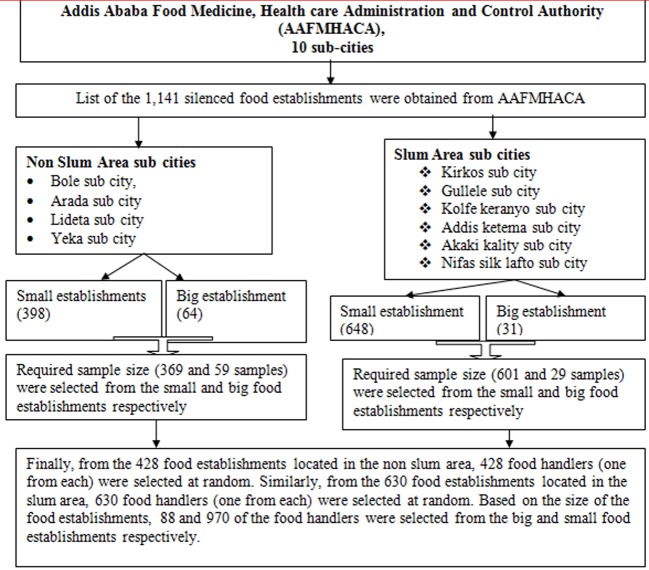
An institution based cross-sectional study was conducted. A stratified random sampling method was employed to select 1050 study participants. Participants were interviewed using structured questionnaire. To analysis the data, binary logistic regression and multivariable logistic regression analysis was conducted.
The two weeks prevalence of diarrhea was found to be 3.4%. Further, 1.6%, 10.5%, 10.7% and 9% of the food handlers had acute watery diarrhea, cough, an infection of runny nose and incidence of any fever respectively. Regular hand washing after toilet (AOR = 0.13 with 95% CI: 0.024, 0.72), using toilet while wearing protective clothes/gown (AOR = 5.39 with 95% CI; 1.59, 18.32), habit of eating raw beef and raw vegetables (AOR = 6.27 with 95% CI: 1.89-20.78), type of toilet (AOR = 4.07 with 95% CI: 0.29-6.67 were associated significantly with diarrhea.
This assessment proved to be an essential activity for reduction of community diarrheal diseases, as a significant number of food handlers had diarrhea. Good sanitation, hygiene practice and a healthy lifestyle behavior can prevent diarrhea. A strong political commitment with appropriate budgetary allocation is essential for the control of diarrheal diseases.
腹泻病在各地都是一种威胁,但在发展中国家其发病频率和影响更为严重。腹泻在全球范围内都有发生,导致所有死亡病例的4%以及5%的健康损失致残疾。2016年,它是第八大死亡原因。此外,世界卫生组织的数据表明,腹泻病每年估计导致200万人死亡。因此,本研究旨在评估腹泻病及相关行为因素。
进行了一项基于机构的横断面研究。采用分层随机抽样方法选取1050名研究参与者。使用结构化问卷对参与者进行访谈。为分析数据,进行了二元逻辑回归和多变量逻辑回归分析。
发现腹泻的两周患病率为3.4%。此外,食品处理人员中分别有1.6%、10.5%、10.7%和9%患有急性水样腹泻、咳嗽、流鼻涕感染和任何发热情况。便后经常洗手(调整后比值比[AOR]=0.13,95%置信区间[CI]:0.024,0.72)、穿着防护服/长袍上厕所(AOR = 5.39,95% CI;1.59,18.32)、食用生牛肉和生蔬菜的习惯(AOR = 6.27,95% CI:1.89 - 20.78)、厕所类型(AOR = 4.07,95% CI:0.29 - 6.67)与腹泻显著相关。
由于大量食品处理人员患有腹泻,该评估被证明是减少社区腹泻病的一项重要活动。良好的环境卫生、卫生习惯和健康的生活方式行为可以预防腹泻。强有力的政治承诺以及适当的预算分配对于控制腹泻病至关重要。