Sikder Ripon Kumar, Wang Xiangru, Zhang Hengheng, Gui Huiping, Dong Qiang, Jin Dingsha, Song Meizhen
State Key Laboratory of Cotton Biology, Institute of Cotton Research, Chinese Academy of Agricultural Sciences, Anyang 455000, Henan, China.
School of Agricultural Sciences, Zhengzhou University, Zhengzhou 450001, China.
Plants (Basel). 2020 Apr 3;9(4):450. doi: 10.3390/plants9040450.
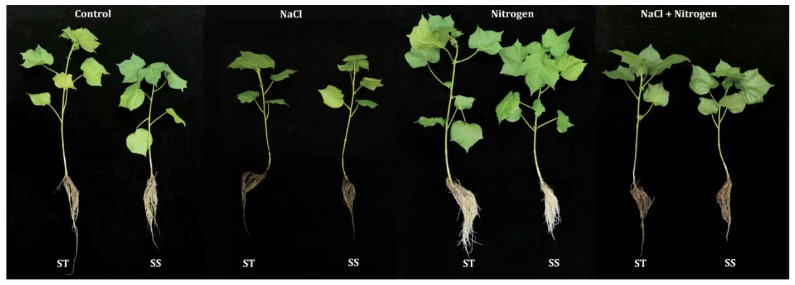
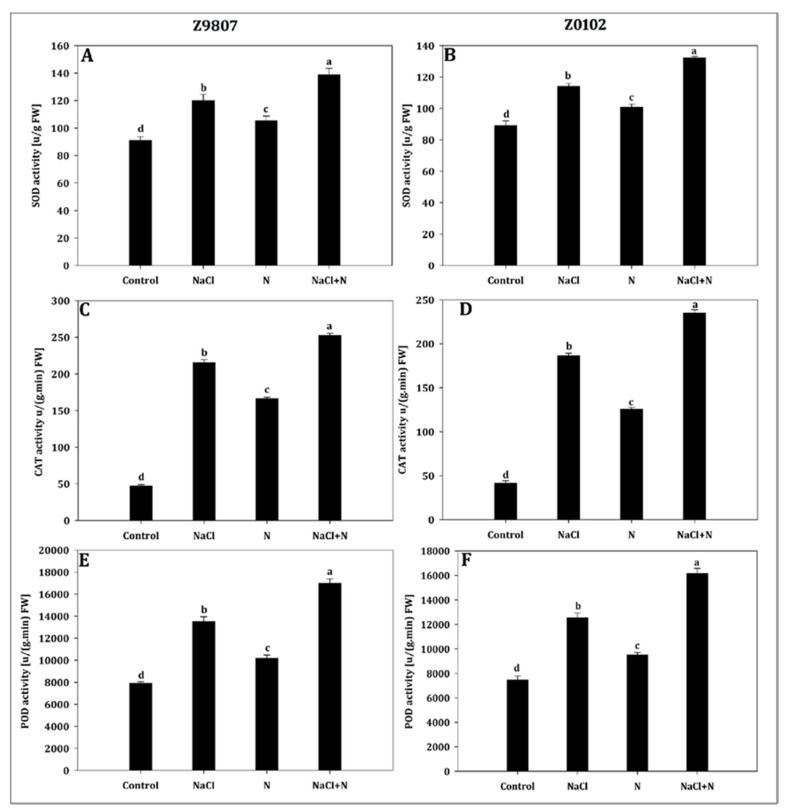
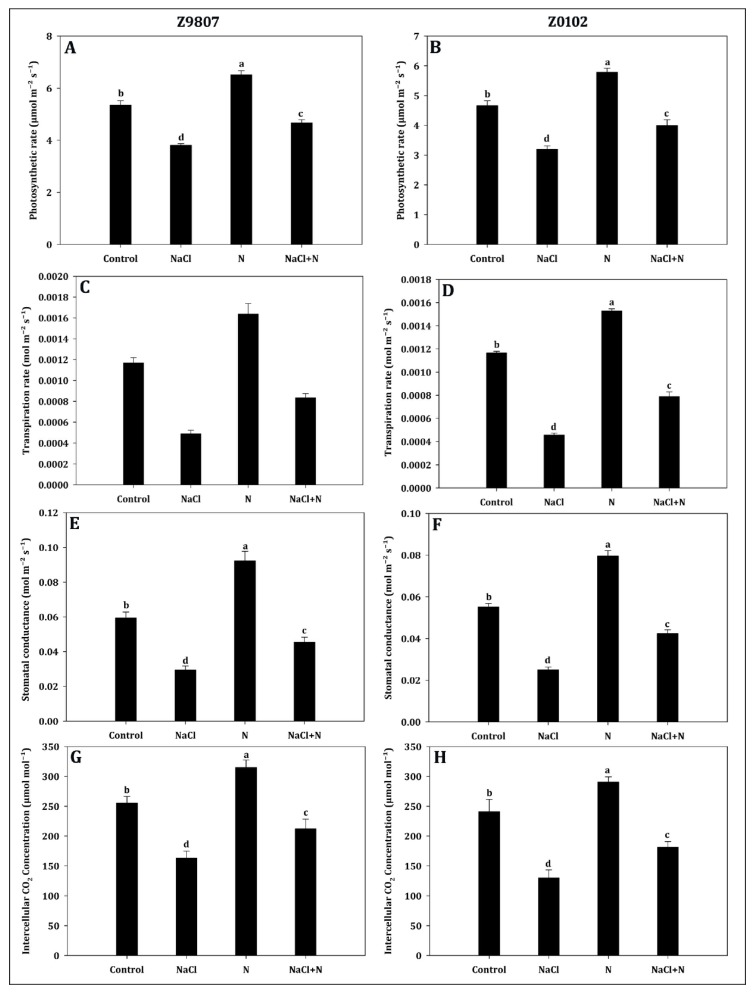
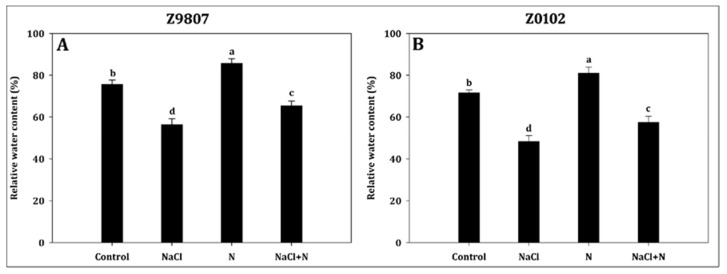
Increasing soil salinity suppresses both productivity and fiber quality of cotton, thus, an appropriate management approach needs to be developed to lessen the detrimental effect of salinity stress. This study assessed two cotton genotypes with different salt sensitivities to investigate the possible role of nitrogen supplementation at the seedling stage. Salt stress induced by sodium chloride (NaCl, 200 mmol·L) decreased the growth traits and dry mass production of both genotypes. Nitrogen supplementation increased the plant water status, photosynthetic pigment synthesis, and gas exchange attributes. Addition of nitrogen to the saline media significantly decreased the generation of lethal oxidative stress biomarkers such as hydrogen peroxide, lipid peroxidation, and electrolyte leakage ratio. The activity of the antioxidant defense system was upregulated in both saline and non-saline growth media as a result of nitrogen application. Furthermore, nitrogen supplementation enhanced the accumulation of osmolytes, such as soluble sugars, soluble proteins, and free amino acids. This established the beneficial role of nitrogen by retaining additional osmolality to uphold the relative water content and protect the photosynthetic apparatus, particularly in the salt-sensitive genotype. In summary, nitrogen application may represent a potential strategy to overcome the salinity-mediated impairment of cotton to some extent.
土壤盐分增加会抑制棉花的生产力和纤维品质,因此,需要制定适当的管理方法来减轻盐分胁迫的不利影响。本研究评估了两种对盐分敏感性不同的棉花基因型,以探讨苗期补充氮素的可能作用。氯化钠(NaCl,200 mmol·L)诱导的盐胁迫降低了两种基因型的生长性状和干物质产量。补充氮素提高了植株水分状况、光合色素合成和气体交换特性。向盐渍培养基中添加氮素显著降低了过氧化氢、脂质过氧化和电解质渗漏率等致死性氧化应激生物标志物的产生。由于施用氮素,抗氧化防御系统的活性在盐渍和非盐渍生长培养基中均上调。此外,补充氮素增强了渗透调节物质的积累,如可溶性糖、可溶性蛋白质和游离氨基酸。这通过保留额外的渗透压来维持相对含水量并保护光合机构,确立了氮素的有益作用,特别是在盐敏感基因型中。总之,施用氮素可能是在一定程度上克服盐分介导的棉花损伤的潜在策略。