Assaf-Balut Carla, Garcia de la Torre Nuria, Bordiu Elena, Del Valle Laura, Valerio Johanna, Jimenez Inés, Duran Alejandra, Fuentes Manuel, Herraiz Miguel Angel, Izquierdo Nuria, Runkle Isabelle, de Miguel Paz, Familiar Cristina, Montañez Maria Carmen, Barabash Ana, Melero Veronica, Cuesta Martín, Rubio Miguel, Calle-Pascual Alfonso Luis
Endocrinologia y Nutricion, Hospital Clínico Universitario San Carlos, Madrid, Spain.
Departamento de Medicina II, Facultad de Medicina, Universidad Complutense de Madrid, Madrid, Spain.
BMJ Open Diabetes Res Care. 2020 Apr;8(1). doi: 10.1136/bmjdrc-2019-001145.
The consumption of dairy products in pregnancy is widely extended. However, whether the consumption of low or high fat dairy produce is more beneficial for maternofetal health has yet to be established.
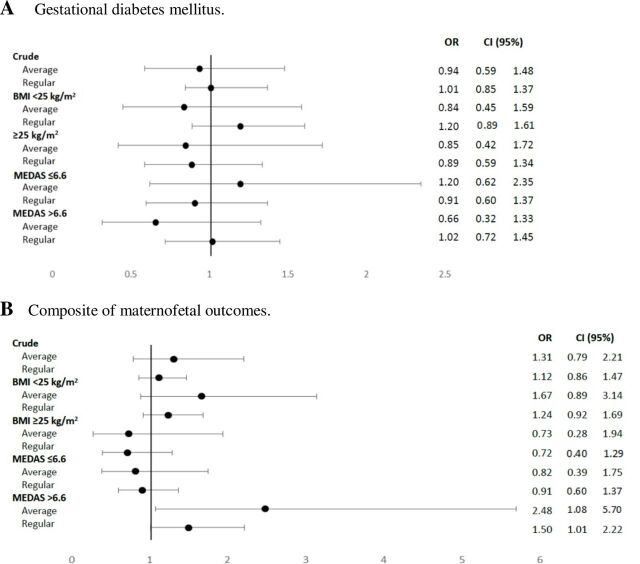
This prospective cohort study evaluated the effect of consumption of dairy products during pregnancy on the frequency of gestational diabetes mellitus (GDM) and a composite of adverse maternofetal outcomes (CMFO). Pregnant women receiving obstetric care between 2014 and 2017 were eligible. Those who consumed ≥3 servings/day of dairy products at 24-28 gestational weeks (GWs) were included and analyzed (n=2004). The population was stratified into three groups according to intake of fat-free dairy products-skimmed milk and fat-free yoghurt and cheese-(days/week): infrequent (1-2), average (3-6) and regular (7). Logistic regression analysis compared ORs (95% CI) for GDM and CMFO between the three groups (where the group of reference was the 'infrequent' intake group).
After adjusting for confounding factors, no significant associations were found between the degree of consumption of fat-free dairy products and the risk of GDM and a CMFO. Moreover, when categorized by the degree of adherence to the Mediterranean diet (above or below the median score), associations were found between the 'regular' intake group and an increased risk of having a CMFO in women with a high adherence to the Mediterranean diet (OR: 1.50; 95% CI: 1.01 to 2.22; p<0.05). Weight gain during pregnancy did not differ among groups.
The consumption of fat-free dairy products during pregnancy does not seem to be beneficial for maternofetal health.
孕期食用乳制品的情况很普遍。然而,低脂或高脂乳制品的食用对母婴健康是否更有益尚未明确。
这项前瞻性队列研究评估了孕期食用乳制品对妊娠期糖尿病(GDM)发生频率和母婴不良结局综合指标(CMFO)的影响。纳入了2014年至2017年接受产科护理的孕妇。将妊娠24 - 28周时每天食用≥3份乳制品的孕妇纳入并进行分析(n = 2004)。根据无脂乳制品(脱脂牛奶、无脂酸奶和奶酪)的摄入量(每周天数)将人群分为三组:不经常(1 - 2天)、平均(3 - 6天)和规律(7天)。采用逻辑回归分析比较三组之间GDM和CMFO的比值比(OR,95%可信区间)(以“不经常”摄入组为参照组)。
在调整混杂因素后,未发现无脂乳制品的食用程度与GDM风险和CMFO之间存在显著关联。此外,按遵循地中海饮食的程度(高于或低于中位数评分)分类时,发现“规律”摄入组与高遵循地中海饮食的女性发生CMFO的风险增加有关(OR:1.50;95%可信区间:1.01至2.22;p < 0.05)。各组间孕期体重增加无差异。
孕期食用无脂乳制品似乎对母婴健康无益处。