Department of Biomolecular Chemistry, Leibniz Institute for Natural Products and Infection Biology, Hans Knöll Institute, 07745 Jena, Germany.
Department of Biomolecular Chemistry, Leibniz Institute for Natural Products and Infection Biology, Hans Knöll Institute, 07745 Jena, Germany;
Proc Natl Acad Sci U S A. 2020 Apr 21;117(16):8850-8858. doi: 10.1073/pnas.1918759117. Epub 2020 Apr 7.
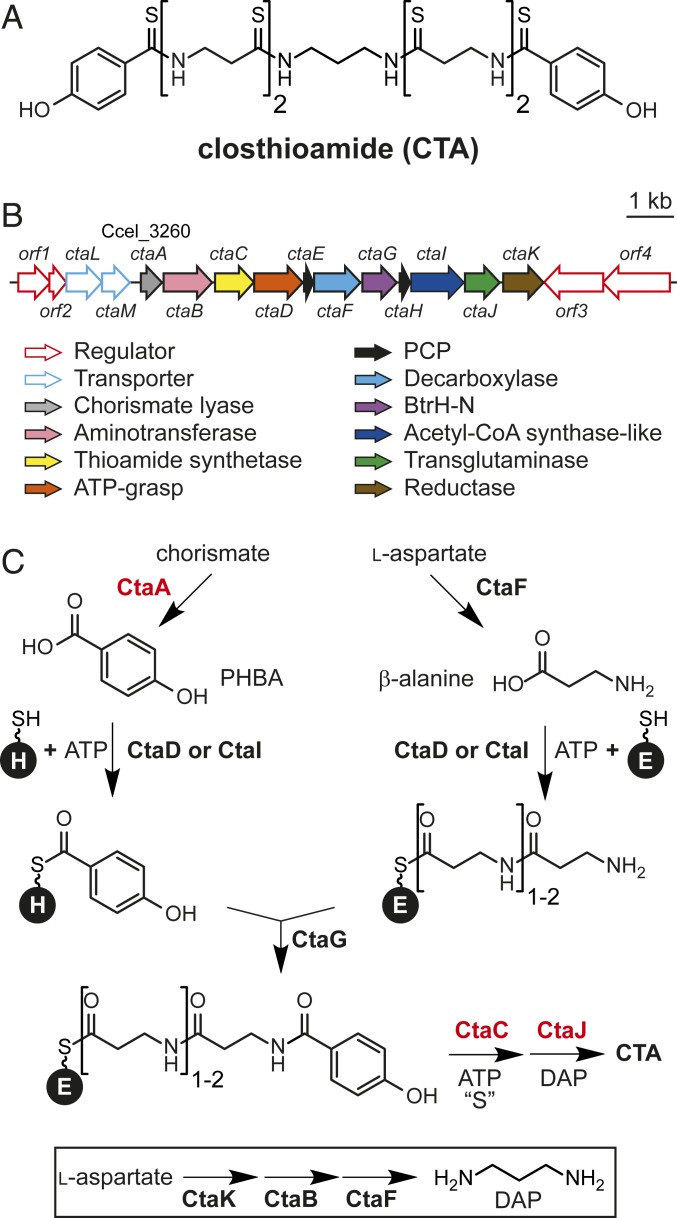
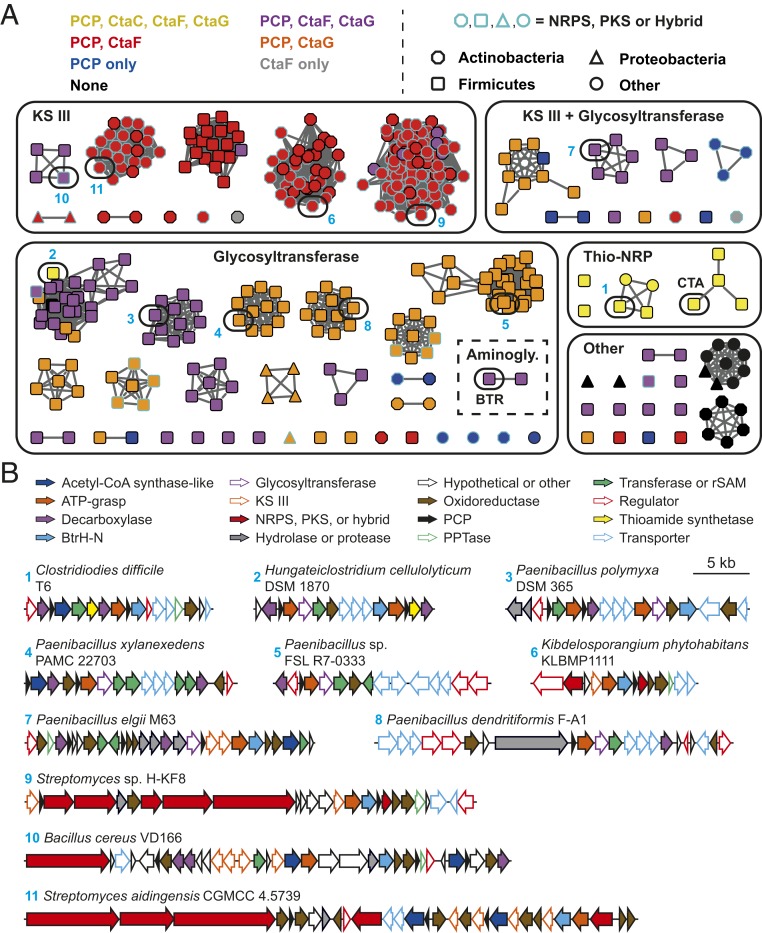
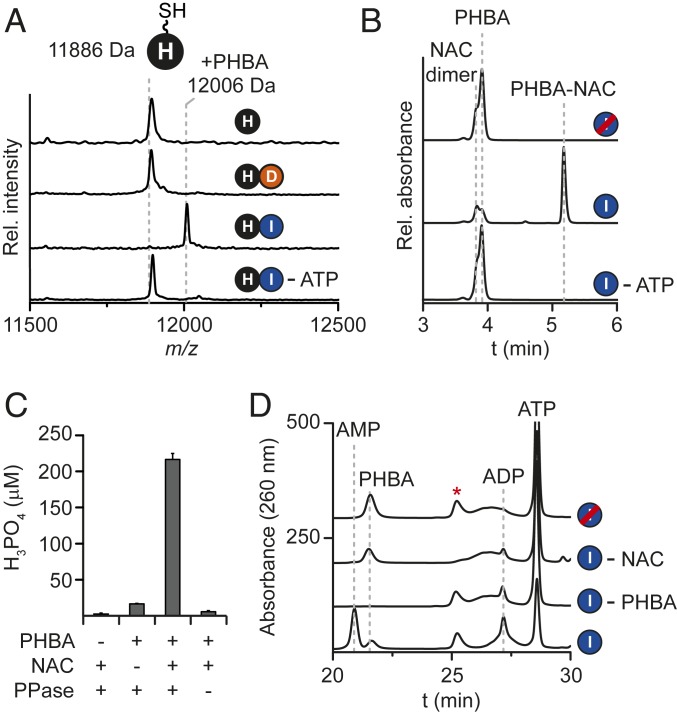
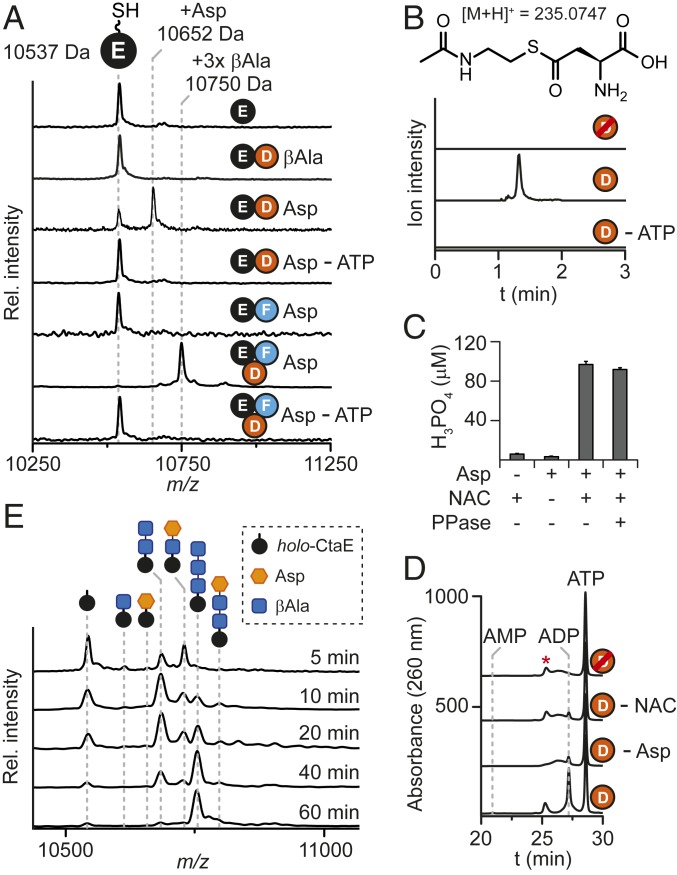
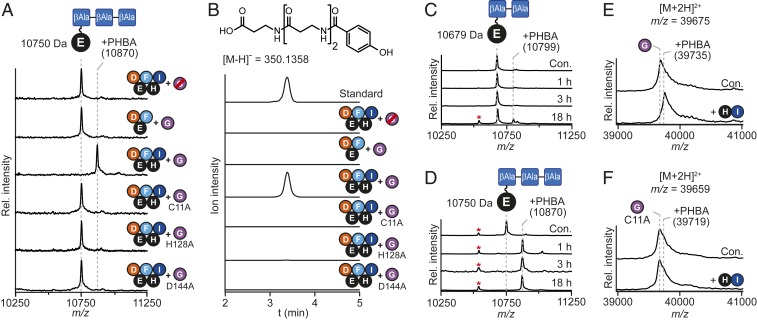
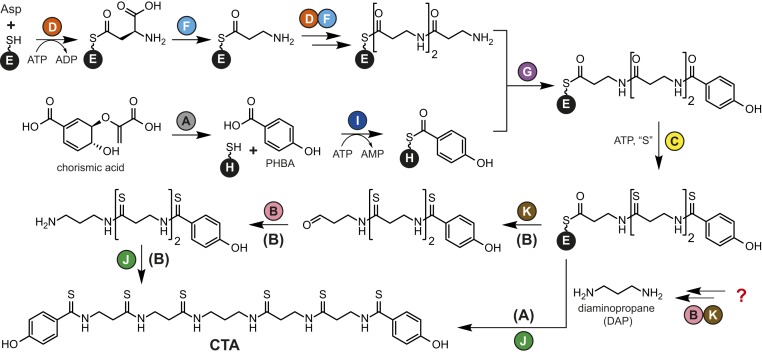
Closthioamide (CTA) is a rare example of a thioamide-containing nonribosomal peptide and is one of only a handful of secondary metabolites described from obligately anaerobic bacteria. Although the biosynthetic gene cluster responsible for CTA production and the thioamide synthetase that catalyzes sulfur incorporation were recently discovered, the logic for peptide backbone assembly has remained a mystery. Here, through the use of in vitro biochemical assays, we demonstrate that the amide backbone of CTA is assembled in an unusual thiotemplated pathway involving the cooperation of a transacylating member of the papain-like cysteine protease family and an iteratively acting ATP-grasp protein. Using the ATP-grasp protein as a bioinformatic handle, we identified hundreds of such thiotemplated yet nonribosomal peptide synthetase (NRPS)-independent biosynthetic gene clusters across diverse bacterial phyla. The data presented herein not only clarify the pathway for the biosynthesis of CTA, but also provide a foundation for the discovery of additional secondary metabolites produced by noncanonical biosynthetic pathways.
氯硫酰胺(CTA)是一种罕见的含硫酰胺的非核糖体肽,也是仅有的少数几种从严格厌氧细菌中描述的次级代谢产物之一。尽管最近发现了负责 CTA 产生的生物合成基因簇和催化硫掺入的硫酰胺合成酶,但肽骨架组装的逻辑仍然是一个谜。在这里,通过使用体外生化测定,我们证明 CTA 的酰胺骨架是通过半胱氨酸蛋白酶家族的转酰基成员和反复作用的 ATP 抓取蛋白的合作,以一种不寻常的硫模板途径组装的。使用 ATP 抓取蛋白作为生物信息学的把手,我们在不同的细菌门中鉴定了数百个这样的硫模板但非核糖体肽合酶(NRPS)独立的生物合成基因簇。本文所呈现的数据不仅阐明了 CTA 生物合成的途径,而且为发现通过非典型生物合成途径产生的其他次级代谢产物提供了基础。