Kim Mi Jeong, Cho Myung Eun, Jun Han Jong
School of Architecture, Hanyang University, Seoul, South Korea.
Construction Research Institute, Hanyang University, Seoul, South Korea.
Front Psychol. 2020 Mar 20;11:335. doi: 10.3389/fpsyg.2020.00335. eCollection 2020.
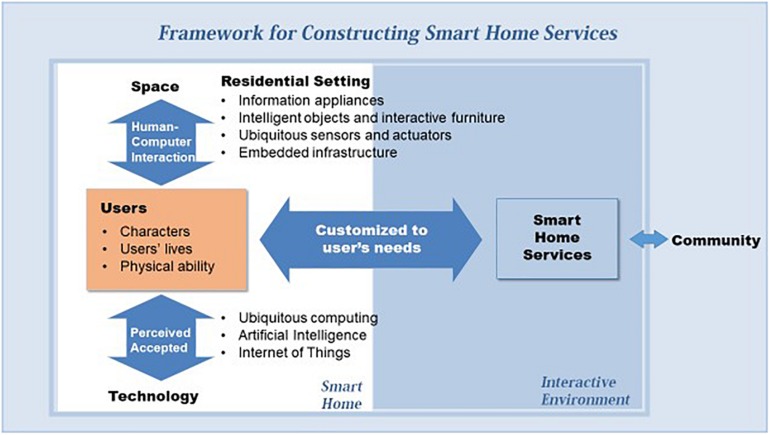
The success of smart homes is fundamentally dependent on their adoption and use by people in the context of daily life. This study investigated ways to control and adapt the technology to fulfill user daily needs, which are the active drivers of smart housing technology adoption. A framework of smart home services was developed by focusing on the practicability of each variable from the perspective of supporting user experience. By developing scenarios based on previous studies, we identified residents' behaviors and intentions regarding smart home technology and its use. Their issues were identified through the health problems and daily activities identified in the scenarios, and customized smart home services were developed for each resident based on technical solutions, space requirements, and design solutions. The main strength of this study is the adoption of user-centered methods to build a rich picture of the issues that affect households and the community related to the design, installation, and use of technology.
智能家居的成功从根本上取决于人们在日常生活中对其的采用和使用。本研究调查了控制和调整技术以满足用户日常需求的方法,这些需求是智能家居技术采用的积极驱动因素。通过从支持用户体验的角度关注每个变量的实用性,开发了一个智能家居服务框架。通过基于先前研究开发场景,我们确定了居民对智能家居技术及其使用的行为和意图。通过场景中确定的健康问题和日常活动识别出他们的问题,并基于技术解决方案、空间要求和设计解决方案为每个居民开发定制的智能家居服务。本研究的主要优势在于采用以用户为中心的方法,以全面了解与技术设计、安装和使用相关的影响家庭和社区的问题。