Wang Ning, Shang Jian, Jiang Shibo, Du Lanying
Lindsley F. Kimball Research Institute, New York Blood Center, New York, NY, United States.
Department of Veterinary and Biomedical Sciences, College of Veterinary Medicine, University of Minnesota, Saint Paul, MN, United States.
Front Microbiol. 2020 Feb 28;11:298. doi: 10.3389/fmicb.2020.00298. eCollection 2020.
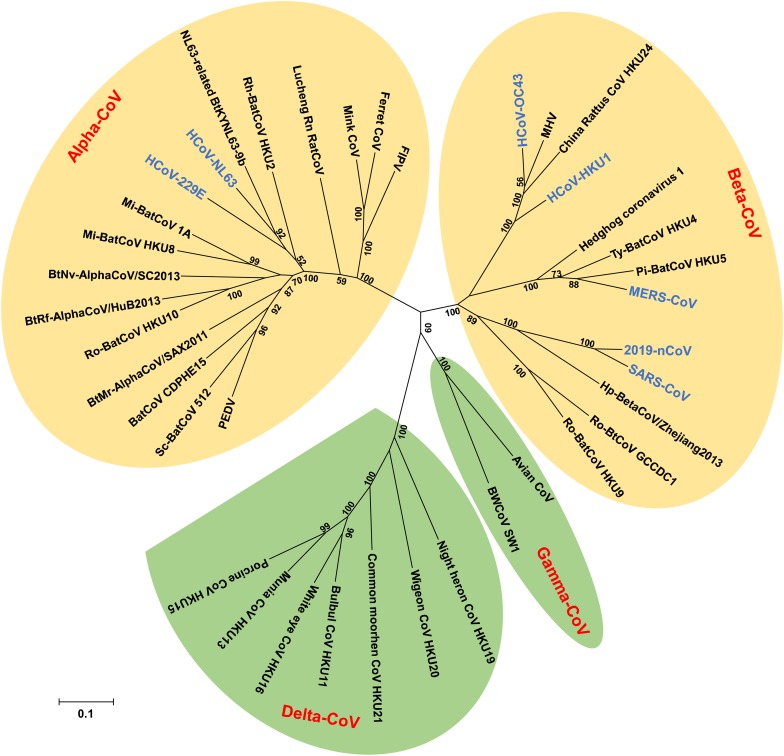
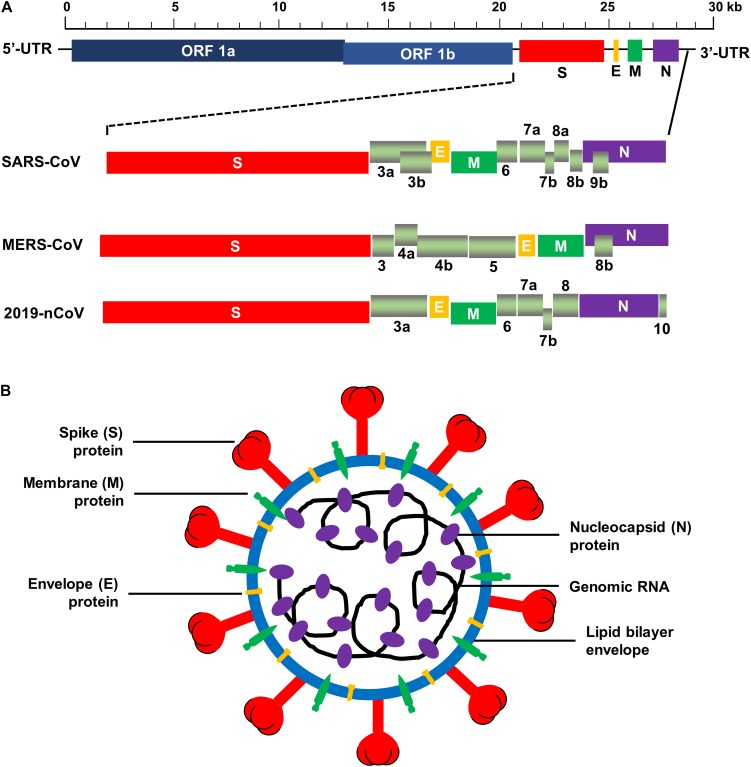
Seven coronaviruses (CoVs) have been isolated from humans so far. Among them, three emerging pathogenic CoVs, including severe acute respiratory syndrome coronavirus (SARS-CoV), Middle East respiratory syndrome coronavirus (MERS-CoV), and a newly identified CoV (2019-nCoV), once caused or continue to cause severe infections in humans, posing significant threats to global public health. SARS-CoV infection in humans (with about 10% case fatality rate) was first reported from China in 2002, while MERS-CoV infection in humans (with about 34.4% case fatality rate) was first reported from Saudi Arabia in June 2012. 2019-nCoV was first reported from China in December 2019, and is currently infecting more than 70000 people (with about 2.7% case fatality rate). Both SARS-CoV and MERS-CoV are zoonotic viruses, using bats as their natural reservoirs, and then transmitting through intermediate hosts, leading to human infections. Nevertheless, the intermediate host for 2019-nCoV is still under investigation and the vaccines against this new CoV have not been available. Although a variety of vaccines have been developed against infections of SARS-CoV and MERS-CoV, none of them has been approved for use in humans. In this review, we have described the structure and function of key proteins of emerging human CoVs, overviewed the current vaccine types to be developed against SARS-CoV and MERS-CoV, and summarized recent advances in subunit vaccines against these two pathogenic human CoVs. These subunit vaccines are introduced on the basis of full-length spike (S) protein, receptor-binding domain (RBD), non-RBD S protein fragments, and non-S structural proteins, and the potential factors affecting these subunit vaccines are also illustrated. Overall, this review will be helpful for rapid design and development of vaccines against the new 2019-nCoV and any future CoVs with pandemic potential. This review was written for the topic of in the section of .
迄今为止,已从人类身上分离出七种冠状病毒。其中,三种新出现的致病性冠状病毒,包括严重急性呼吸综合征冠状病毒(SARS-CoV)、中东呼吸综合征冠状病毒(MERS-CoV)和一种新发现的冠状病毒(2019-nCoV),曾引发或仍在引发人类严重感染,对全球公共卫生构成重大威胁。2002年,中国首次报告人类感染SARS-CoV(病死率约为10%),而2012年6月,沙特阿拉伯首次报告人类感染MERS-CoV(病死率约为34.4%)。2019年12月,中国首次报告2019-nCoV感染,目前已感染超过7万人(病死率约为2.7%)。SARS-CoV和MERS-CoV都是人畜共患病毒,以蝙蝠为天然宿主,然后通过中间宿主传播,导致人类感染。然而,2019-nCoV的中间宿主仍在调查中,针对这种新型冠状病毒的疫苗尚未问世。尽管已经开发出多种针对SARS-CoV和MERS-CoV感染的疫苗,但均未获批准用于人类。在本综述中,我们描述了新出现的人类冠状病毒关键蛋白的结构和功能,概述了目前针对SARS-CoV和MERS-CoV开发的疫苗类型,并总结了针对这两种致病性人类冠状病毒的亚单位疫苗的最新进展。这些亚单位疫苗是基于全长刺突(S)蛋白、受体结合域(RBD)、非RBD S蛋白片段和非结构蛋白介绍的,还阐述了影响这些亚单位疫苗的潜在因素。总体而言,本综述将有助于快速设计和开发针对新型2019-nCoV以及未来任何具有大流行潜力的冠状病毒的疫苗。本综述是为 部分的 主题撰写的。