Melo José Pedro, Kalyna Maria, Duque Paula
Instituto Gulbenkian de Ciência (IGC), Oeiras, Portugal.
Department of Applied Genetics and Cell Biology, BOKU - University of Natural Resources and Life Sciences, Vienna, Austria.
Front Plant Sci. 2020 Mar 24;11:286. doi: 10.3389/fpls.2020.00286. eCollection 2020.
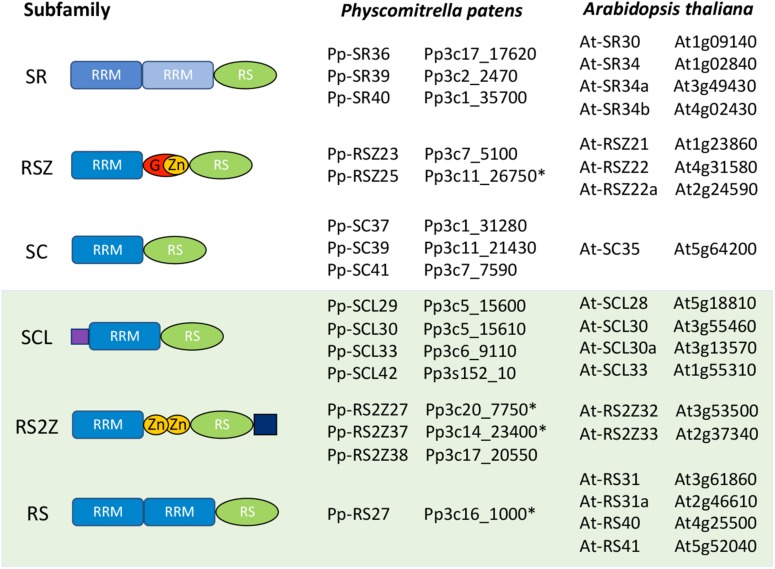
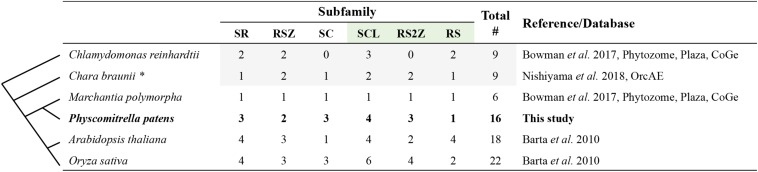
To colonize different terrestrial habitats, early land plants had to overcome the challenge of coping with harsh new environments. Alternative splicing - an RNA processing mechanism through which splice sites are differentially recognized, originating multiple transcripts and potentially different proteins from the same gene - can be key for plant stress tolerance. Serine/arginine-rich (SR) proteins constitute an evolutionarily conserved family of major alternative splicing regulators that in plants subdivides into six subfamilies. Despite being well studied in animals and a few plant species, such as the model angiosperm and the crop , little is known of these splicing factors in early land plants. Establishing the whole complement of SR proteins in different species is essential to understand the functional and evolutionary significance of alternative splicing. An search for SR proteins in the extant moss revealed inconsistencies both in the published data and available databases, likely arising from automatic annotation lacking adequate manual curation. These misannotations interfere with the description not only of the number and subfamily classification of Physcomitrella SR proteins but also of their domain architecture, potentially hindering the elucidation of their molecular functions. We therefore advise caution when looking into genomic resources. Our systematic survey nonetheless confidently identified 16 SR proteins that fall into the six described subfamilies and represent counterparts of well-established members in and rice. Intensified research efforts should disclose whether SR proteins were already determining alternative splicing modulation and stress tolerance in early land plants.
为了在不同的陆地生境中定殖,早期陆地植物必须克服应对恶劣新环境的挑战。可变剪接——一种RNA加工机制,通过该机制剪接位点被差异识别,从同一基因产生多个转录本以及潜在的不同蛋白质——可能是植物胁迫耐受性的关键。富含丝氨酸/精氨酸(SR)的蛋白质构成了一个进化上保守的主要可变剪接调节因子家族,在植物中可细分为六个亚家族。尽管在动物和一些植物物种(如模式被子植物和农作物)中已对其进行了充分研究,但对于早期陆地植物中的这些剪接因子却知之甚少。确定不同物种中SR蛋白质的完整组成对于理解可变剪接的功能和进化意义至关重要。在现存的苔藓中对SR蛋白质进行的搜索揭示了已发表数据和现有数据库中存在的不一致性,这可能是由于缺乏充分人工校正的自动注释所致。这些错误注释不仅干扰了对小立碗藓SR蛋白质数量和亚家族分类的描述,还干扰了对其结构域结构的描述,可能会阻碍对其分子功能的阐明。因此,在查阅小立碗藓基因组资源时我们建议谨慎行事。尽管如此,我们的系统调查还是可靠地鉴定出了16种小立碗藓SR蛋白质,它们属于所描述的六个亚家族,代表了拟南芥和水稻中成熟成员的对应物。加强研究力度应该能够揭示SR蛋白质是否已经在早期陆地植物中决定了可变剪接调控和胁迫耐受性。