Division of Pharmacy Practice & Administrative Sciences, James L. Winkle College of Pharmacy, University of Cincinnati, Cincinnati, OH, USA.
Department of Clinical Pharmacy, College of Pharmacy, Prince Sattam Bin Abdulaziz University, Al-Kharj, Saudi Arabia.
J Gynecol Oncol. 2020 Jul;31(4):e52. doi: 10.3802/jgo.2020.31.e52. Epub 2020 Mar 6.
This study estimated nationally representative medical expenditures of gynecologic cancers, described treatment patterns and assessed key risk factors associated with the economic burden in the United States.
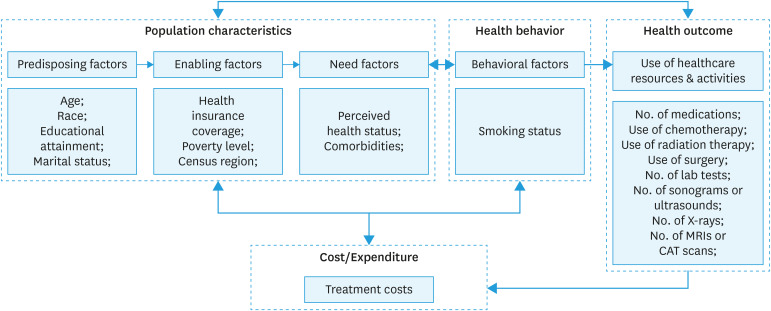
A retrospective repeated measures design was used to estimate the effect of gynecologic cancers on medical expenditures and utilization among women. Data were extracted from the Medical Expenditure Panel Survey (weighted sample of 609,787 US adults) from 2007 to 2014. Using the behavioral model of health services utilization, characteristics of cancer patients were examined and compared among uterine, cervical, and ovarian cancer patients. Multivariable linear regression models were conducted on medical expenditure with a prior logarithmic transformation.
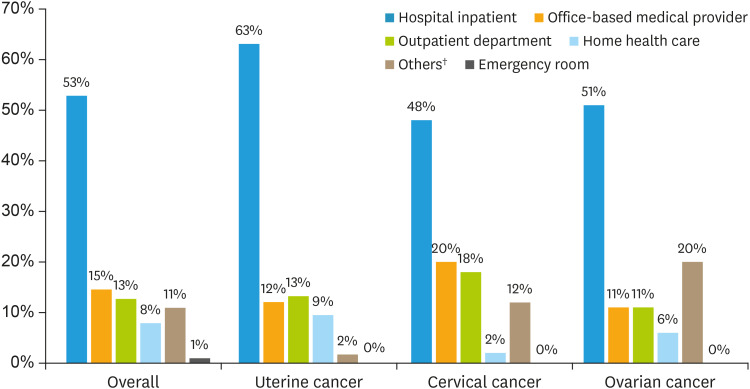
The estimated annual medical expenditure attributed to gynecologic cancers was $3.8 billion, with an average cost of $6,293 per patient. The highest annual cost per person was ovarian cancer ($13,566), followed by uterine cancer ($6,852), and cervical cancer ($2,312). The major components of medical costs were hospital inpatient stays (53%, $2.03 billion), followed by office-based visits (15%, $559 million), and outpatient visits (13%, $487 million). Two key prescription expenditures were antineoplastic hormones (10.3%) and analgesics (9.2%). High expenditures were significantly associated with being a married woman (p<0.001), having private health insurance (p<0.001), being from a low- and middle-income family (p<0.001), or living in the Midwest or the South (p<0.001).
The key risk factors and components were well described for the economic burden of gynecologic cancers. With a growing population of cancer patients, efforts to reduce the burden of gynecologic cancers are warranted.
本研究旨在估算美国妇科癌症的全国代表性医疗支出,描述治疗模式,并评估与经济负担相关的关键风险因素。
采用回顾性重复测量设计,估算妇科癌症对女性医疗支出和利用的影响。数据来自 2007 年至 2014 年的医疗支出面板调查(609787 名美国成年人的加权样本)。利用健康服务利用行为模型,检查癌症患者的特征,并比较子宫癌、宫颈癌和卵巢癌患者的特征。采用对数变换对医疗支出进行多变量线性回归模型分析。
估计归因于妇科癌症的年度医疗支出为 38 亿美元,每位患者的平均费用为 6293 美元。人均年费用最高的是卵巢癌(13566 美元),其次是子宫癌(6852 美元)和宫颈癌(2312 美元)。医疗费用的主要构成部分是住院治疗(53%,20.3 亿美元),其次是门诊(15%,5590 万美元)和门诊(13%,4870 万美元)。两种主要的处方药支出是抗肿瘤激素(10.3%)和镇痛药(9.2%)。高支出与已婚女性(p<0.001)、有私人医疗保险(p<0.001)、来自中低收入家庭(p<0.001)或居住在中西部或南部(p<0.001)显著相关。
本研究很好地描述了妇科癌症经济负担的关键风险因素和构成。随着癌症患者人数的增加,有必要努力减轻妇科癌症的负担。