Care and Public Health Research Institute, Department of Health Services Research, Maastricht University, Maastricht, the Netherlands.
Neuroscience Research Australia, School of Public Health and Community Medicine, UNSW, Randwick, New South Wales, Australia.
Gerontologist. 2021 Aug 13;61(6):e269-e282. doi: 10.1093/geront/gnaa021.
Fear of falling (FoF) is associated with decreased physical functioning and an increased fall risk. Interventions generally demonstrate moderate effects and optimized interventions are needed. Intervention characteristics, such as setting or delivery method may vary. We investigated which overarching intervention characteristics are associated with a reduction in FoF in community-dwelling older people.
A systematic review and meta-analysis of randomized controlled trials (RCTs) in community-dwelling older people without specific diseases was performed. Associations between intervention characteristics and standardized mean differences (SMD) were determined by univariate meta-regression. Sensitivity analyses were performed.
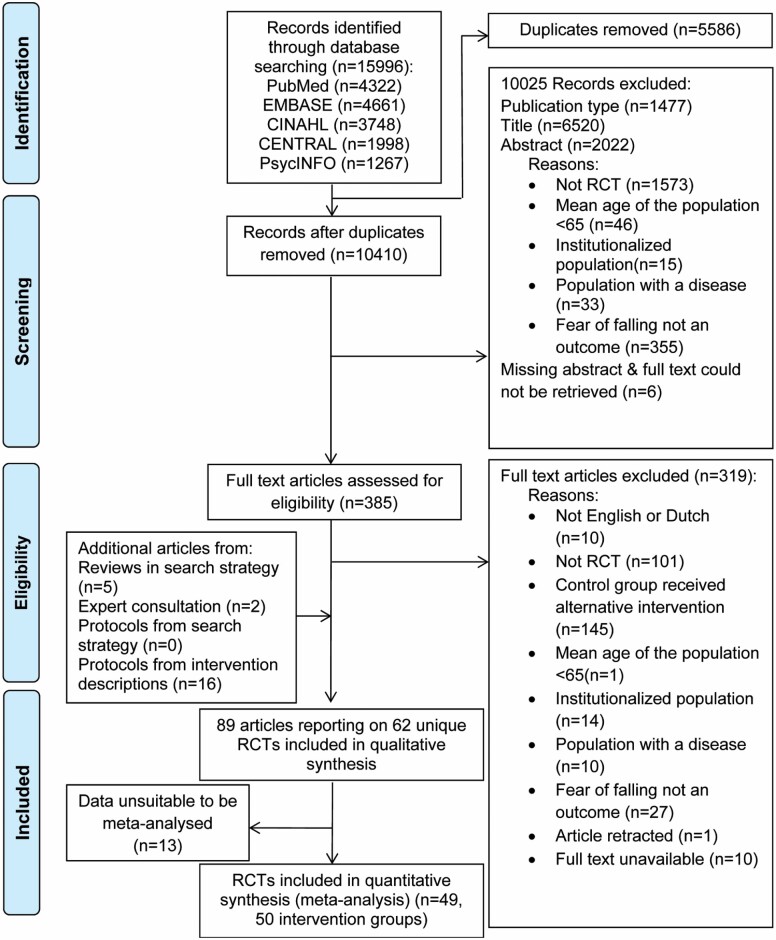
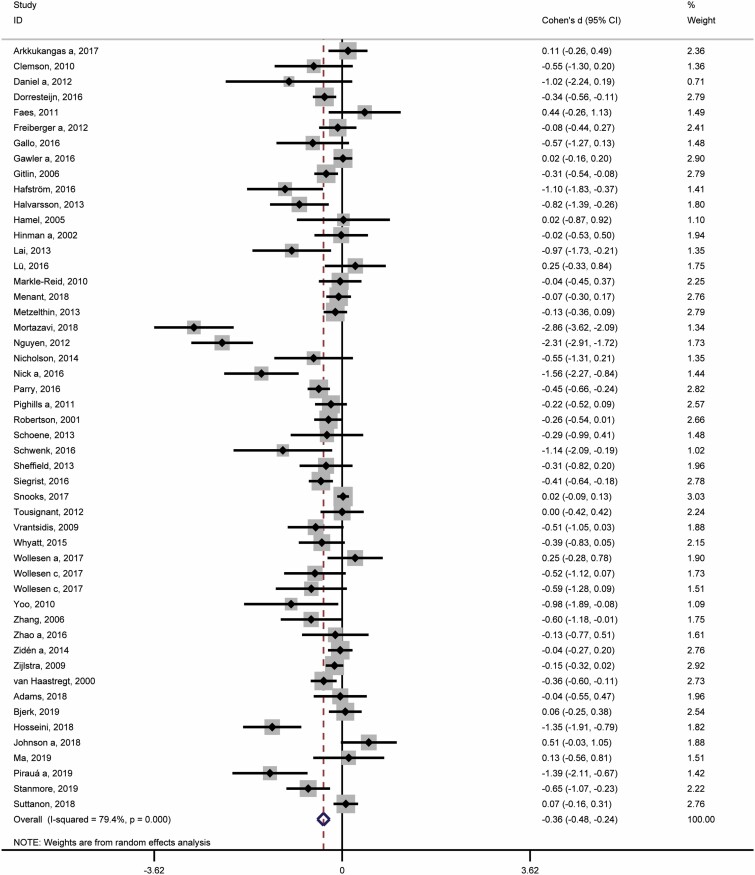
Data on 62 RCTs were extracted, 50 intervention groups were included in the meta-analysis. Most intervention characteristics and intervention types were not associated with the intervention effect. Supervision by a tai chi instructor (SMD: -1.047, 95% confidence interval [CI]: -1.598; -0.496) and delivery in a community setting (SMD: -0.528, 95% CI: -0.894; -0.161) were-compared to interventions without these characteristics-associated with a greater reduction in FoF. Holistic exercise, such as Pilates or yoga (SMD: -0.823, 95% CI: -1.255; -0.392), was also associated with a greater reduction in FoF. Delivery at home (SMD: 0.384, 95% CI: 0.002; 0.766) or with written materials (SMD: 0.452, 95% CI: 0.088; 0.815) and tailoring were less effective in reducing FoF (SMD: 0.687, 95% CI: 0.364; 1.011).
Holistic exercise, delivery with written materials, the setting and tailoring potentially represent characteristics to take into account when designing and improving interventions for FoF in community-dwelling older people. PROSPERO international prospective register of systematic reviews, registration ID CRD42018080483.
对跌倒的恐惧(FoF)与身体机能下降和跌倒风险增加有关。干预措施通常效果中等,需要优化干预措施。干预措施的特点,如设置或交付方式可能有所不同。我们调查了哪些总体干预特征与社区居住的老年人 FoF 减少有关。
对无特定疾病的社区居住老年人进行了随机对照试验(RCT)的系统评价和荟萃分析。通过单变量荟萃回归确定干预特征与标准化均数差(SMD)之间的关联。进行了敏感性分析。
提取了 62 项 RCT 的数据,50 个干预组纳入荟萃分析。大多数干预特征和干预类型与干预效果无关。与无这些特征的干预相比,由太极拳教练监督(SMD:-1.047,95%置信区间[CI]:-1.598;-0.496)和在社区环境中进行交付(SMD:-0.528,95%CI:-0.894;-0.161)与 FoF 更大幅度的降低相关。整体运动,如普拉提或瑜伽(SMD:-0.823,95%CI:-1.255;-0.392),也与 FoF 的更大幅度降低相关。在家中交付(SMD:0.384,95%CI:0.002;0.766)或使用书面材料(SMD:0.452,95%CI:0.088;0.815)和量身定制的效果较差(SMD:0.687,95%CI:0.364;1.011)。
整体运动、使用书面材料交付、设置和量身定制可能是设计和改进社区居住老年人 FoF 干预措施时需要考虑的特征。PROSPERO 国际前瞻性系统评价注册,注册号 CRD42018080483。