Rocchetti Gabriele, Senizza Biancamaria, Giuberti Gianluca, Montesano Domenico, Trevisan Marco, Lucini Luigi
Department for Sustainable Food Process, Università Cattolica del Sacro Cuore, Via Emilia Parmense 84, 29122 Piacenza, Italy.
Department of Pharmaceutical Sciences, Section of Food Science and Nutrition, University of Perugia, via San Costanzo, 06126 Perugia, Italy.
Antioxidants (Basel). 2020 Apr 6;9(4):302. doi: 10.3390/antiox9040302.
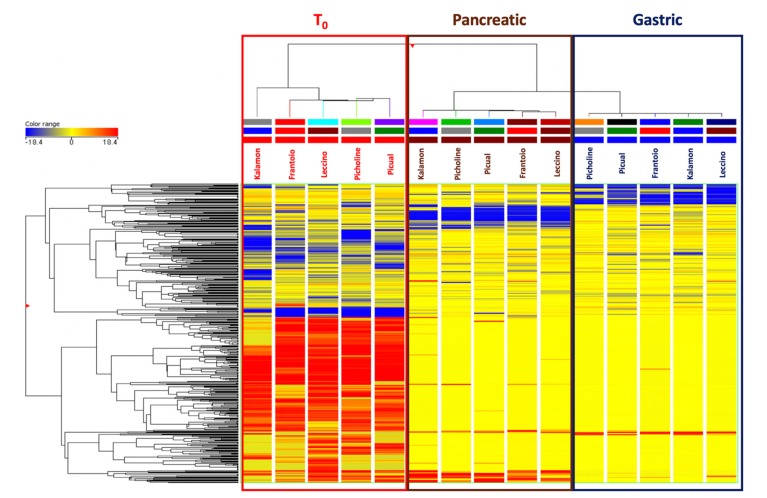
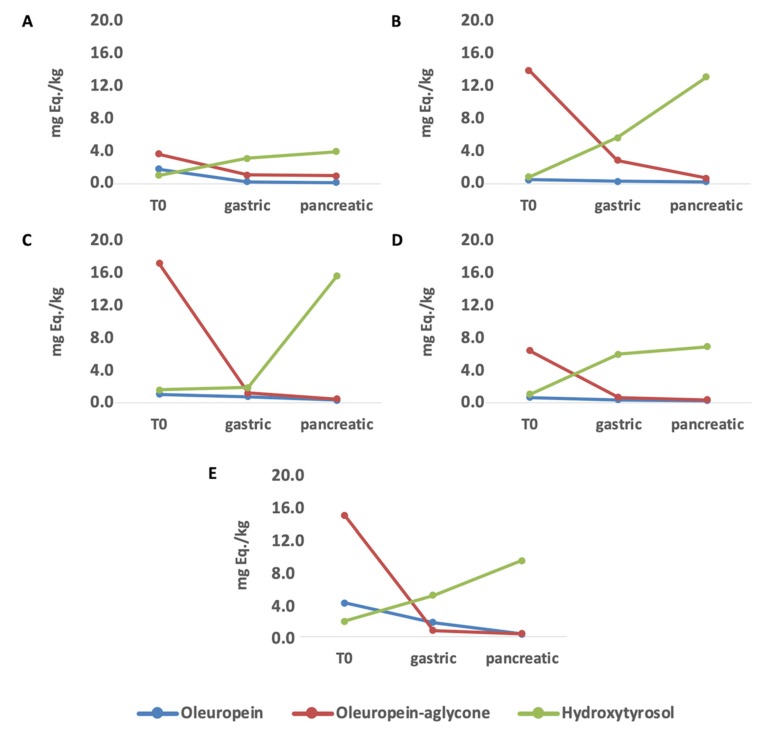
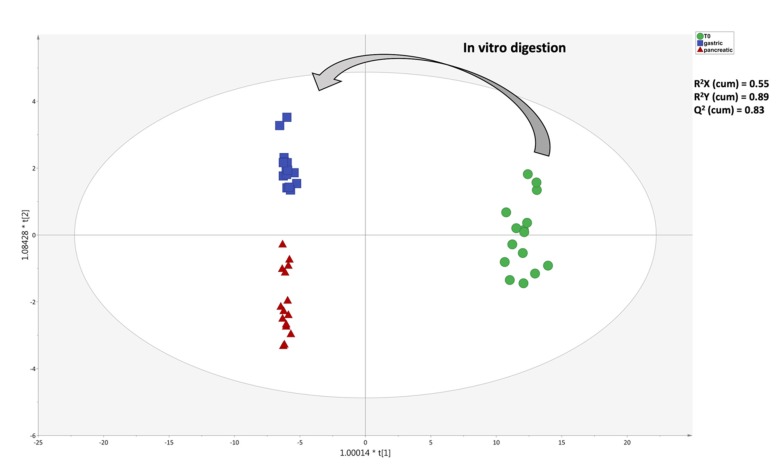
In this work, different commercial extra-virgin olive oils (EVOO) were subjected to in vitro gastrointestinal digestion and the changes in bioactive compounds were evaluated by ultra-high-pressure liquid chromatography coupled with quadrupole-time-of-flight mass spectrometry, using untargeted metabolomics. As expected, raw EVOO samples were abundant in total sterols (on average: 3007.4 mg equivalents/kg) and tyrosol equivalents (on average: 334.1 mg equivalents/kg). However, the UHPLC-QTOF screening allowed us to annotate 310 compounds, with a large abundance of sterols (219 compounds), followed by polyphenols (67 compounds) and terpenoids. The in vitro gastrointestinal digestion was found to affect the phytochemical composition of the different EVOO samples. In particular, both unsupervised and supervised statistics depicted the modifications of the bioactive profile following gastric and pancreatic phases. Overall, the compounds which resulted as the most affected by the in vitro digestion were flavonoids (cyanidin and luteolin equivalents), whilst relatively high % bioaccessibility values were recorded for tyrosol equivalents during the pancreatic phase (on average, 66%). In this regard, oleuropein-aglycone (i.e., the major phenolic compound in EVOO) was converted to hydroxytyrosol, moving from an average value of 1.3 (prior to the in vitro digestion) up to 9.7 mg equivalents/kg during the pancreatic step. As proposed in the literature, the increase in hydroxytyrosol might be the result of the combined effect of lipase(s) activity and acidic conditions. Taken together, the present findings corroborate the suitability of untargeted metabolomics coupled to in vitro digestion methods to investigate the bioaccessibility of phenolic compounds. In this regard, a significant impact of in vitro gastrointestinal digestion on polyphenolic profiles has been detected, thus suggesting the need to account for actual bioaccessibility values rather than just considering the amounts in the raw commodity.
在本研究中,对不同的市售特级初榨橄榄油(EVOO)进行体外胃肠道消化,并采用非靶向代谢组学方法,通过超高压液相色谱-四极杆-飞行时间质谱联用技术评估生物活性化合物的变化。正如预期的那样,未加工的EVOO样品中总甾醇含量丰富(平均:3007.4毫克当量/千克),酪醇当量也很丰富(平均:334.1毫克当量/千克)。然而,超高效液相色谱-四极杆-飞行时间质谱筛选使我们能够注释310种化合物,其中甾醇含量丰富(219种化合物),其次是多酚(67种化合物)和萜类化合物。发现体外胃肠道消化会影响不同EVOO样品的植物化学成分。特别是,无监督和有监督统计均描述了胃和胰腺阶段后生物活性谱的变化。总体而言,体外消化影响最大的化合物是黄酮类化合物(花青素和木犀草素当量),而在胰腺阶段酪醇当量的生物可及性值相对较高(平均66%)。在这方面,橄榄苦苷配基(即EVOO中的主要酚类化合物)转化为羟基酪醇,在胰腺阶段从体外消化前的平均值1.3上升至9.7毫克当量/千克。正如文献中所提出的,羟基酪醇的增加可能是脂肪酶活性和酸性条件共同作用的结果。综上所述,本研究结果证实了非靶向代谢组学与体外消化方法相结合用于研究酚类化合物生物可及性的适用性。在这方面,已检测到体外胃肠道消化对多酚谱有显著影响,因此表明需要考虑实际的生物可及性值,而不仅仅是考虑未加工商品中的含量。