Trinidad Alfonso, Veiga Santiago, Navarro Enrique, Lorenzo Alberto
Facultad de Educación y Humanidades, Francisco de Vitoria Universidad, Pozuelo de Alarcón-Madrid, Spain.
Departamento de Salud y Rendimiento Humano, Universidad Politécnica de Madrid, Madrid, Spain.
J Hum Kinet. 2020 Mar 31;72:61-67. doi: 10.2478/hukin-2019-0125. eCollection 2020 Mar.
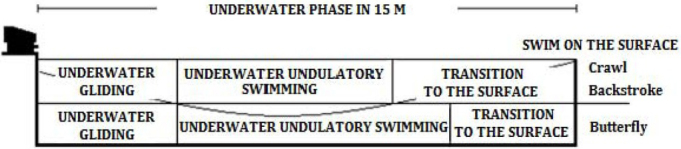
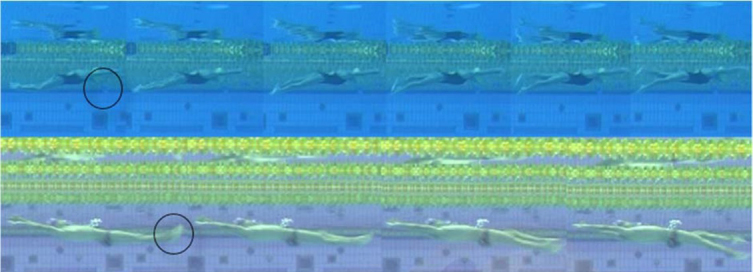
The objective of the present study was to analyze (based on gender and the style of swimming) the kinematic parameters of the transition phase between underwater swimming and surface swimming after the push-off start in competitive national swimmers. Seventy-four swimmers participating in the Spanish Swimming Championships were filmed and analyzed by DLT-2D photogrammetry during the start with the push-off in crawl, backstroke and butterfly styles. Between genders there were small differences in the distance and speed of transition. The male swimmers travelled greater distances (0.84 ± 0.04 vs. 0.66 ± 0.04 m, η2 = 0.05, F = 10.34, p < 0.001) and they were faster (1.59 ± 0.03 vs. 1.38 ± 0.03 m/s, η2 = 0.08, F = 19.54, p < 0.001) in the transition phase than female swimmers. Among styles there were greater differences in time (η2 = 0.47, F = 94.50, p < 0.001) and transition distance (η2 = 0.38, F = 67.08, p < 0.001), than in speed (η2 = 0.05, F = 5.63, p < 0.001). During the backstroke push-off, swimmers spent more time (0.88 ± 0.04 s) and distance (1.17 ± 0.05 m), this being the slowest style (1.37 ± 0.04 m/s). In butterfly, athletes used less time (0.26 ± 0.03 s) and distance (0.39 ± 0.05 m) whereas crawl was the fastest of all (1.57 ± 0.04 m/s). These results allow the phase of transition from underwater to surface swimming to be characterized and to provide useful data for competitive swimmers and coaches to improve performance.
本研究的目的是分析(基于性别和游泳方式)在出发蹬离池壁后,竞技国家游泳运动员从水下游泳过渡到水面游泳阶段的运动学参数。对74名参加西班牙游泳锦标赛的游泳运动员在出发蹬离池壁时采用爬泳、仰泳和蝶泳姿势进行了拍摄,并通过DLT - 2D摄影测量法进行分析。在性别之间,过渡阶段的距离和速度存在细微差异。男游泳运动员在过渡阶段游得更远(0.84±0.04米对0.66±0.04米,η2 = 0.05,F = 10.34,p < 0.001),且速度更快(1.59±0.03米/秒对1.38±0.03米/秒,η2 = 0.08,F = 19.54,p < 0.001)。在不同游泳方式之间,时间(η2 = 0.47,F = 94.50,p < 0.001)和过渡距离(η2 = 0.38,F = 67.08,p < 0.001)的差异大于速度(η2 = 0.05,F = 5.63,p < 0.001)。在仰泳蹬离池壁时,游泳运动员花费的时间(0.88±0.04秒)和距离(1.17±0.05米)更多,这是最慢的一种方式(1.37±0.04米/秒)。在蝶泳中,运动员花费的时间(0.26±0.03秒)和距离(0.39±0.05米)更少,而爬泳是所有方式中最快的(1.57±0.04米/秒)。这些结果有助于描述从水下游泳到水面游泳的过渡阶段,并为竞技游泳运动员和教练提高成绩提供有用数据。