Advanced Technology Center for Aging Research, IRCCS INRCA, 60121 Ancona, Italy.
Mitochondrial Medicine Laboratory, Department of Medical Biotechnology and Translational Medicine, University of Milan, 20133 Milan, Italy.
Cells. 2020 Apr 8;9(4):909. doi: 10.3390/cells9040909.
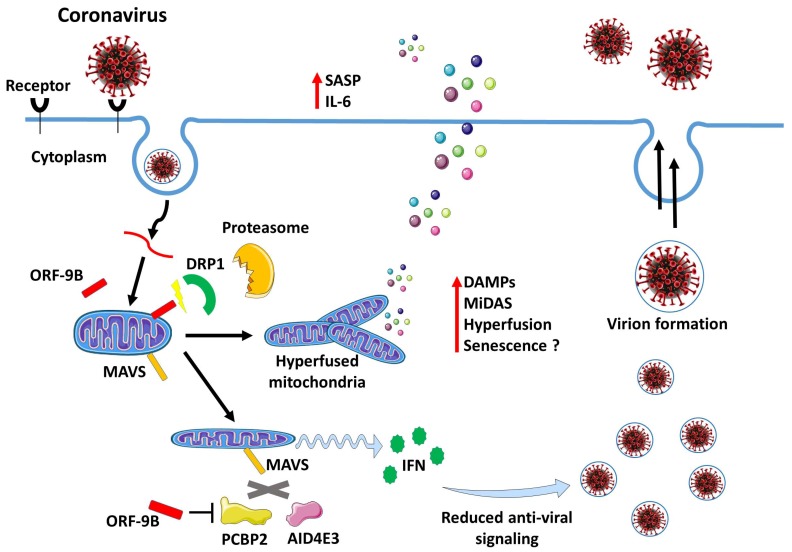
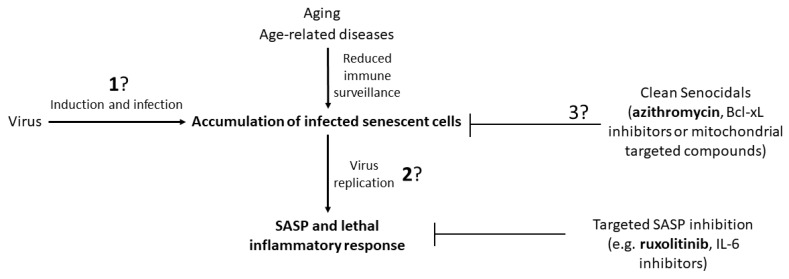
The higher death rate caused by COVID-19 in older people, especially those with comorbidities, is a challenge for biomedical aging research. Here we explore the idea that an exacerbated inflammatory response, in particular that mediated by IL-6, may drive the deleterious consequences of the infection. Data shows that other RNA viruses, such as influenza virus, can display enhanced replication efficiency in senescent cells, suggesting that the accumulation of senescent cells with aging and age-related diseases may play a role in this phenomenon. However, at present, we are completely unaware of the response to SARS-CoV and SARS-COV-2 occurring in senescent cells. We deem that this is a priority area of research because it could lead to the development of several therapeutic strategies based on senotherapeutics or prevent unsuccessful attempts. Two of these senotherapeutics, azithromycin and ruxolitinib, are currently undergoing testing for their efficacy in treating COVID-19. The potential of these strategies is not only for ameliorating the consequences of the current emergence of SARS-CoV-2, but also for the future emergence of new viruses or mutated ones for which we are completely unprepared and for which no vaccines are available.
COVID-19 在老年人中(尤其是患有合并症的老年人)导致的死亡率较高,这是生物医学衰老研究面临的挑战。在这里,我们探讨了这样一种观点,即过度的炎症反应(特别是由 IL-6 介导的炎症反应)可能是导致感染产生有害后果的原因。有数据表明,其他 RNA 病毒(如流感病毒)在衰老细胞中的复制效率更高,这表明随着年龄的增长和与年龄相关的疾病而积累的衰老细胞可能在这一现象中起作用。然而,目前我们对 SARS-CoV 和 SARS-COV-2 在衰老细胞中的反应一无所知。我们认为这是一个优先研究领域,因为它可能会促使我们基于衰老细胞疗法开发出几种治疗策略,或者防止不成功的尝试。目前正在对两种衰老细胞疗法(阿奇霉素和鲁索利替尼)进行测试,以评估它们在治疗 COVID-19 方面的疗效。这些策略的潜力不仅在于减轻当前 SARS-CoV-2 出现的后果,还在于应对未来可能出现的我们完全没有准备、且没有可用疫苗的新病毒或突变病毒。