Tomczak Wirginia, Gryta Marek
Faculty of Chemical Technology and Engineering, West Pomeranian University of Technology in Szczecin, ul. Pułaskiego 10, 70-322 Szczecin, Poland.
Membranes (Basel). 2020 Apr 8;10(4):67. doi: 10.3390/membranes10040067.
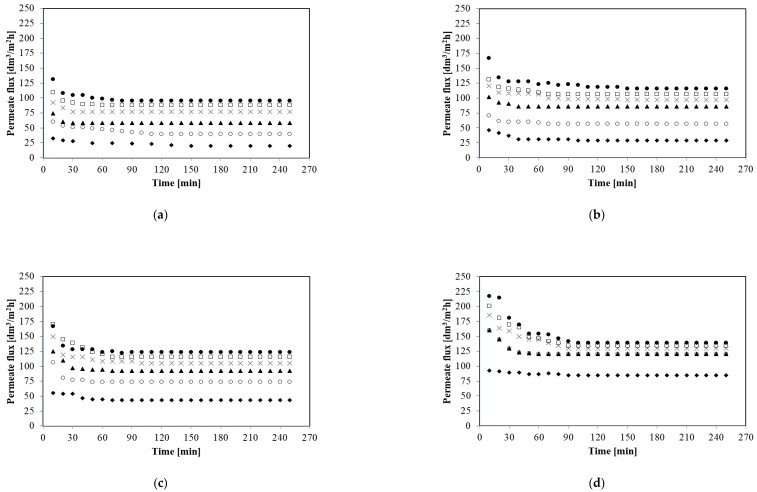
This paper reports the study of the cross-flow microfiltration (MF) of glycerol fermentation broths with bacteria. A single channel tubular ceramic membrane with a nominal pore size of 0.14 µm was used. It has been demonstrated that the MF ceramic membrane has been successfully applied to bacteria cell removal and to effectively eliminate colloidal particles from glycerol fermentation broths. However, due to fouling, the significant reduction of the MF performance has been demonstrated. In order to investigate the impact of transmembrane pressure (TMP) and feed flow rate (Q) on MF performance, 24 experiments have been performed. The highest steady state permeate flux (138.97 dm/mh) was achieved for 0.12 MPa and 1000 dm/h. Fouling analysis has been studied based on the resistance-in series model. It has been found that the percentage of irreversible fouling resistance during the MF increases with increasing TMP and Q. The permeate flux regeneration has been achieved by membrane cleaning with 3 wt % NaOH and 3 wt % HPO at 45 °C. The results of this study are expected to be useful in industrially employing the MF process as the first step of glycerol fermentation broth purification.
本文报道了对含细菌的甘油发酵液进行错流微滤(MF)的研究。使用了标称孔径为0.14 µm的单通道管状陶瓷膜。已证明MF陶瓷膜已成功应用于去除细菌细胞,并有效去除甘油发酵液中的胶体颗粒。然而,由于污染,已证明MF性能显著下降。为了研究跨膜压力(TMP)和进料流速(Q)对MF性能的影响,进行了24次实验。在0.12 MPa和1000 dm/h条件下实现了最高稳态渗透通量(138.97 dm/mh)。基于串联阻力模型研究了污染分析。发现MF过程中不可逆污染阻力的百分比随TMP和Q的增加而增加。通过在45°C下用3 wt%的NaOH和3 wt%的HPO进行膜清洗实现了渗透通量的再生。本研究结果有望在工业上采用MF工艺作为甘油发酵液纯化的第一步时发挥作用。