Department of Mechanical Engineering of Biosystems, Faculty of Agriculture, Shahrekord University, PO Box 115, Shahrekord, 88186-34141, Iran.
Environ Sci Pollut Res Int. 2020 Jun;27(17):21836-21846. doi: 10.1007/s11356-020-08576-9. Epub 2020 Apr 12.
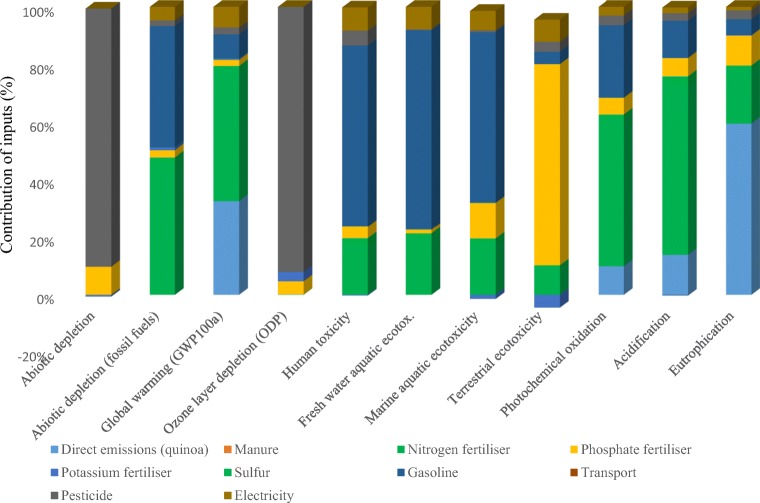
Quinoa is an adaptable plant that is rich in terms of nutritional properties. Currently, the promotion and cultivation of quinoa are expanding in Iran. The present study aimed to investigate the energy consumption of quinoa grain production and its environmental impacts through life cycle assessment. In this regard, in order to evaluate the environmental and energy indices, required data were collected from quinoa farmers in Isfahan. The high energy ratio (ER > 1) and positive net energy show that quinoa cultivation is efficient. Based on the results, irrigation water and nitrate fertilizer were identified as the major contributors to energy consumption. Based on the normalization method, the highest and lowest environmental impacts during the production process were related to the indices of marine aquatic ecotoxicity and ozone layer depletion, respectively. Results showed that in the global warming potential impact, 354 kg CO were emitted per production of 1 tonne of quinoa grain. Diesel fuel and nitrogen fertilizer had a significant effect on most environmental impacts. Proper management of chemical fertilizers and agricultural machinery are key factors for sustainable cultivation of quinoa.
藜麦是一种适应性强的植物,在营养方面具有丰富的特性。目前,藜麦在伊朗的推广和种植正在扩大。本研究旨在通过生命周期评估研究藜麦谷物生产的能源消耗及其环境影响。为此,为了评估环境和能源指标,从伊斯法罕的藜麦种植者那里收集了所需的数据。高能量比(ER > 1)和正净能量表明藜麦种植是高效的。根据结果,灌溉水和硝酸盐肥料被确定为能源消耗的主要贡献者。根据归一化方法,在生产过程中,海洋水生生态毒性和臭氧层消耗的指数与环境影响的最高和最低水平相关。结果表明,在全球变暖潜势影响方面,每生产 1 吨藜麦谷物,排放了 354 千克二氧化碳。柴油燃料和氮肥对大多数环境影响有显著影响。合理管理化肥和农业机械是藜麦可持续种植的关键因素。