Liang Zhongjie, Zhu Yu, Long Jie, Ye Fei, Hu Guang
Center for Systems Biology, Department of Bioinformatics, School of Biology and Basic Medical Sciences, Soochow University, Suzhou 215123, China.
College of Life Sciences and Medicine, Zhejiang Sci-Tech University, Hangzhou 310018, China.
Comput Struct Biotechnol J. 2020 Mar 23;18:749-764. doi: 10.1016/j.csbj.2020.03.016. eCollection 2020.
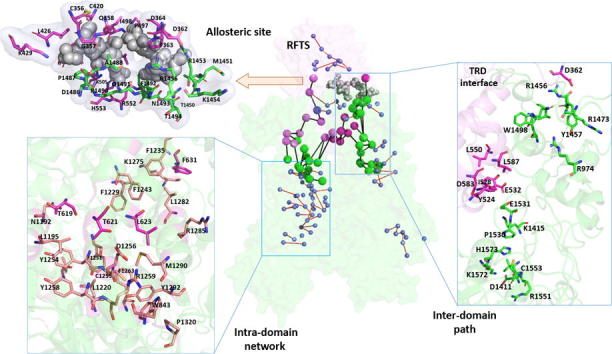
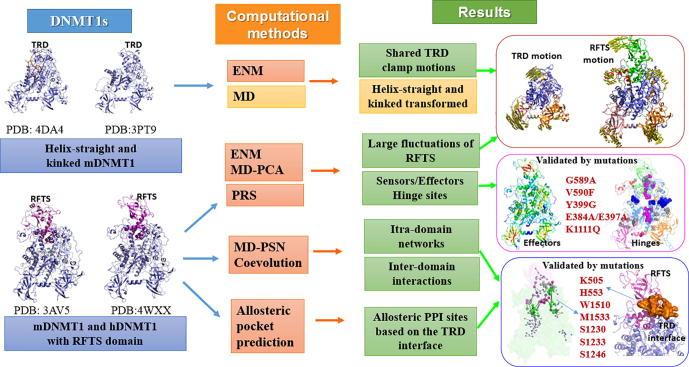
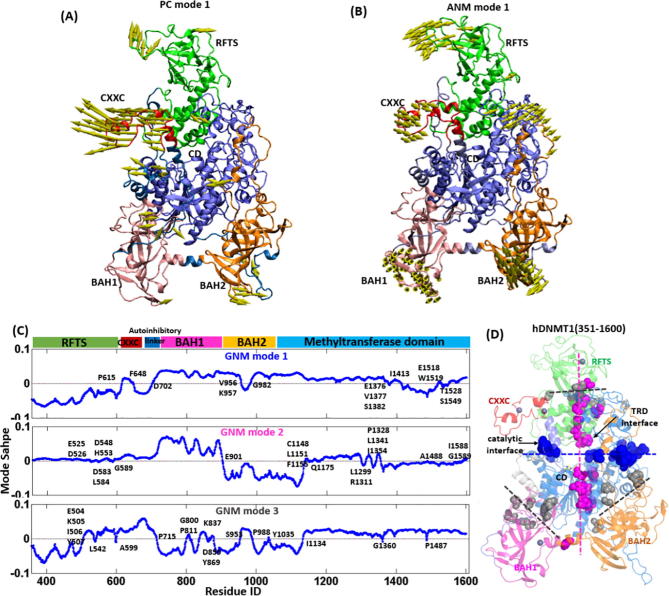
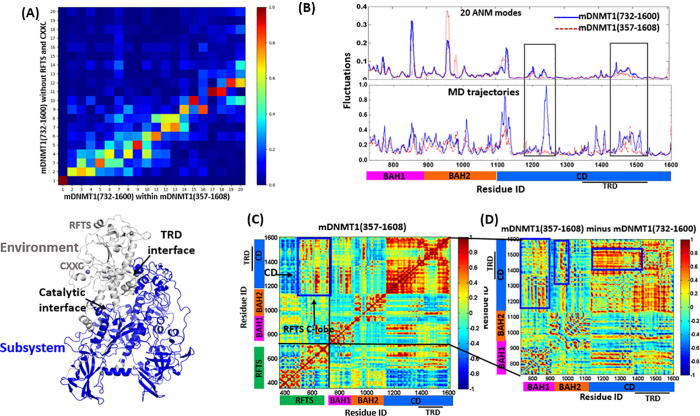
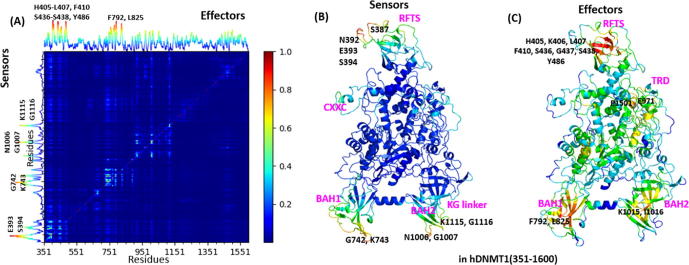
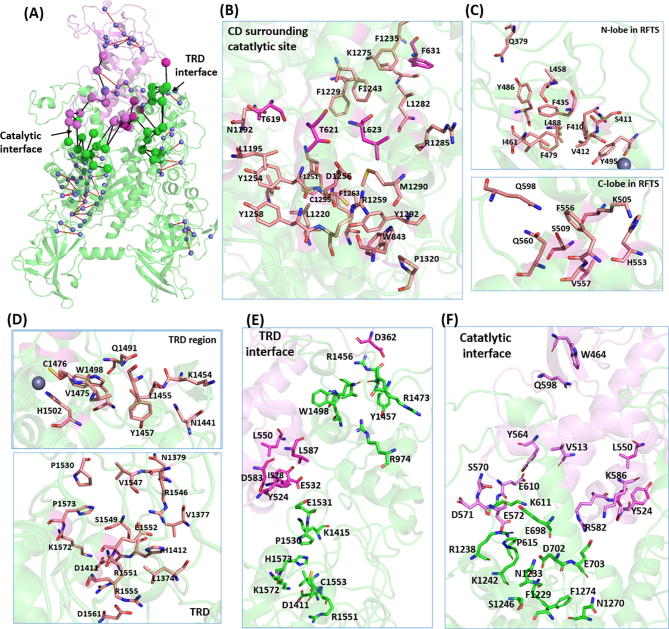
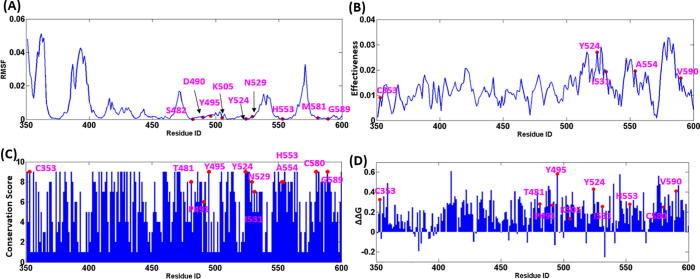
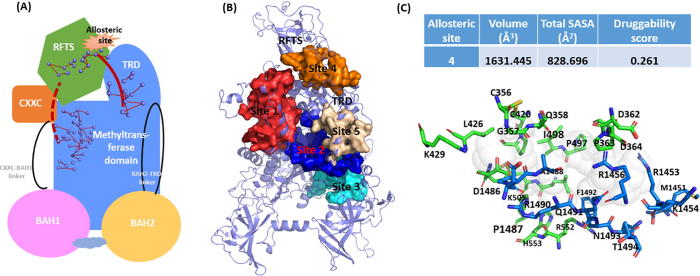
DNA methyltransferase 1 (DNMT1), a large multidomain enzyme, is believed to be involved in the passive transmission of genomic methylation patterns via methylation maintenance. Yet, the molecular mechanism of interaction networks underlying DNMT1 structures, dynamics, and its biological significance has yet to be fully characterized. In this work, we used an integrated computational strategy that combined coarse-grained and atomistic simulations with coevolution information and network modeling of the residue interactions for the systematic investigation of allosteric dynamics in DNMT1. The elastic network modeling has proposed that the high plasticity of RFTS has strengthened the correlated behaviors of DNMT1 structures through the hinge sites located at the RFTS-CD interface, which mediate the collective motions between domains. The perturbation response scanning (PRS) analysis combined with the enrichment analysis of disease mutations have further highlighted the allosteric potential of the RFTS domain. Furthermore, the long-range paths connect the intra-domain interactions through the TRD interface and catalytic interface, emphasizing some key inter-domain interactions as the bridges in the global allosteric regulation of DNMT1. The observed interplay between conserved intra-domain networks and dynamical plasticity encoded by inter-domain interactions provides insights into the intrinsic dynamics and functional evolution, as well as the design of allosteric modulators of DNMT1 based on the TRD interface.
DNA甲基转移酶1(DNMT1)是一种大型多结构域酶,被认为通过甲基化维持参与基因组甲基化模式的被动传递。然而,DNMT1结构、动力学及其生物学意义背后的相互作用网络的分子机制尚未完全阐明。在这项工作中,我们使用了一种综合计算策略,将粗粒度和原子模拟与共进化信息以及残基相互作用的网络建模相结合,以系统研究DNMT1中的变构动力学。弹性网络建模表明,RFTS的高可塑性通过位于RFTS-CD界面的铰链位点增强了DNMT1结构的相关行为,这些铰链位点介导了结构域之间的协同运动。扰动响应扫描(PRS)分析与疾病突变的富集分析相结合,进一步突出了RFTS结构域的变构潜力。此外,长程路径通过TRD界面和催化界面连接结构域内的相互作用,强调了一些关键的结构域间相互作用作为DNMT1全局变构调节中的桥梁。在保守的结构域内网络与由结构域间相互作用编码的动态可塑性之间观察到的相互作用,为DNMT1的内在动力学和功能进化以及基于TRD界面的变构调节剂的设计提供了见解。