Shokouhi Sepideh, Taylor Warren D, Albert Kimberly, Kang Hakmook, Newhouse Paul A
Center for Cognitive Medicine Department of Psychiatry and Behavioral Sciences Vanderbilt University Medical Center Nashville Tennessee.
Geriatric Research Education and Clinical Center Tennessee Valley Veterans Affairs Medical Center Nashville Tennessee.
Alzheimers Dement (Amst). 2020 Apr 9;12(1):e12016. doi: 10.1002/dad2.12016. eCollection 2020.
We examined networks of tau connectivity between brain regions based on correlations of their [F]flortaucipir positron emission tomography (PET) uptake to evaluate sex-specific differences in brain-wide tau propagation.
PET data of clinically normal and mild cognitive impairment (MCI) subjects from the Alzheimer's Disease Neuroimaging Initiative (ADNI) were used to examine differences in network architectures across the groups.
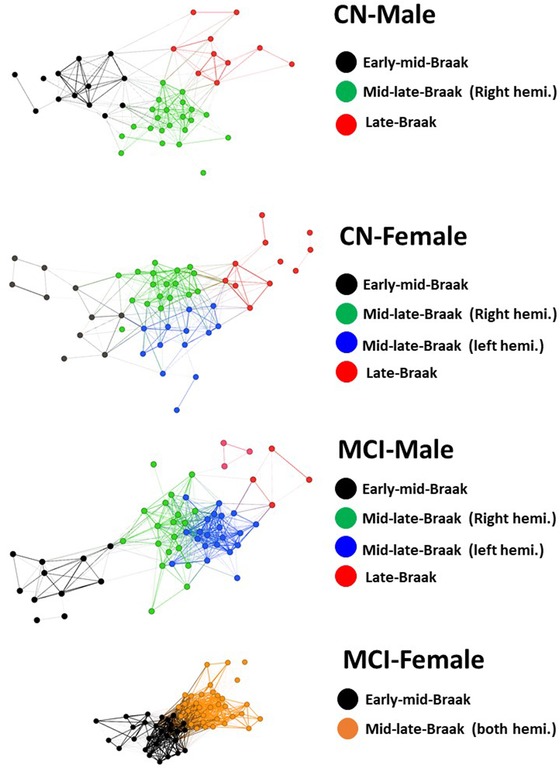
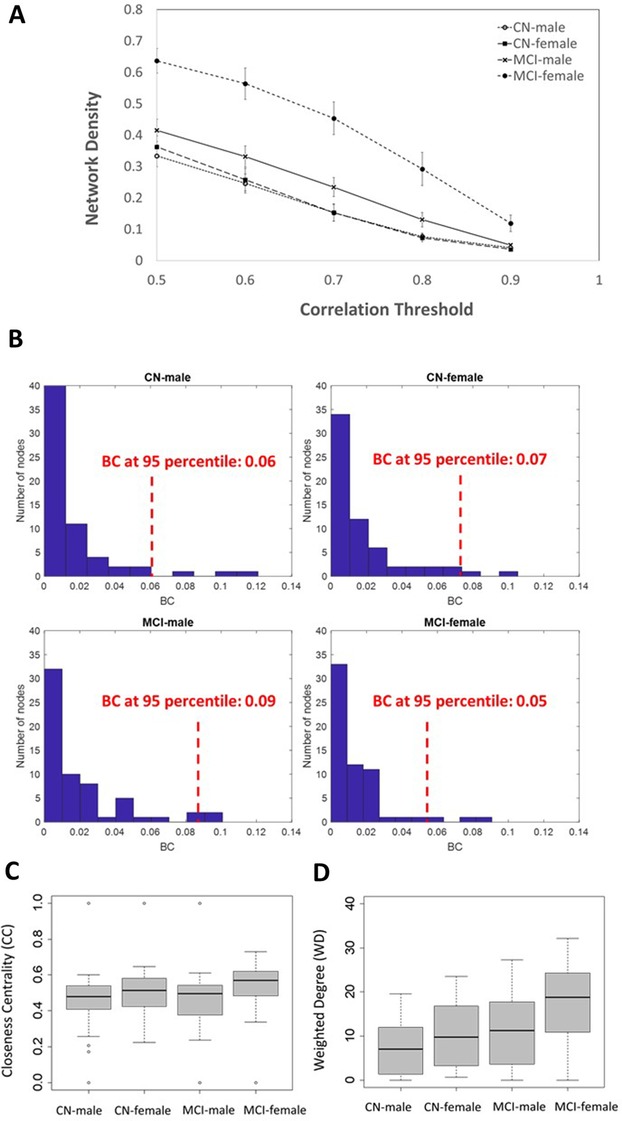
The tau-based network architecture resembled progression of tauopathy from Braak stage I to VI regions. Compared to men, women had higher network density and an increased number of direct regional connections in co-occurrence with increased brain-wide tau burden, particularly at MCI. Several regions, including superior parietal lobe and parahippocampus served as connecting bridges between communities at different Braak stages.
Network characteristics in women may favor an accelerated brain-wide tau spread leading to a higher tau burden in women than men with MCI with implications for the greater female preponderance in Alzheimer's disease diagnosis.
我们基于脑区[F]氟代tau蛋白正电子发射断层扫描(PET)摄取的相关性,研究了脑区之间的tau蛋白连接网络,以评估全脑tau蛋白传播中的性别差异。
来自阿尔茨海默病神经影像倡议(ADNI)的临床正常和轻度认知障碍(MCI)受试者的PET数据用于研究各组网络结构的差异。
基于tau蛋白的网络结构类似于tau蛋白病从Braak I期到VI期区域的进展。与男性相比,女性具有更高的网络密度和更多的直接区域连接,同时全脑tau蛋白负担增加,尤其是在MCI阶段。包括顶上叶和海马旁回在内的几个区域在不同Braak阶段的脑区之间起到了连接桥梁的作用。
女性的网络特征可能有利于全脑tau蛋白传播加速,导致MCI女性比男性有更高的tau蛋白负担,这对阿尔茨海默病诊断中女性占比更高具有启示意义。