Dou Lin, Reynolds Dan, Wallace Lindsey, O'Horo John, Kashyap Rahul, Gajic Ognjen, Yadav Hemang
Division of Critical Care Medicine, Tianjin First Center Hospital, China.
Department of Internal Medicine, Mayo Clinic, Rochester, MN.
Mayo Clin Proc Innov Qual Outcomes. 2020 Apr 6;4(2):176-182. doi: 10.1016/j.mayocpiqo.2019.12.005. eCollection 2020 Apr.
To evaluate the effects of timely oseltamivir administration in patients hospitalized with seasonal influenza.
We performed a single-center retrospective cohort study for hospitalized patients who tested positive for influenza between December 1, 2010, and July 1, 2014. We compared outcomes for patients who received antivirals within 48 hours of symptoms to those of patients who either received oseltamivir after 48 hours or never received oseltamivir. Hospital length of stay (LOS) and 90-day mortality were compared using Cox regression models. Antiviral administration was analyzed as a time-varying covariate.
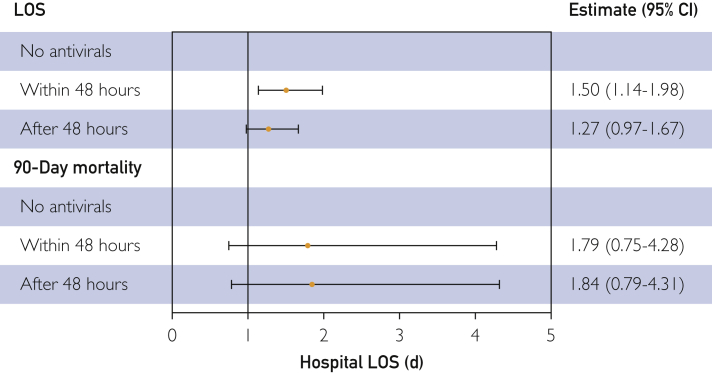
During the study period, 433 patients were hospitalized with laboratory-confirmed influenza. Of these patients, 146 (33.7%) received oseltamivir within 48 hours of symptoms, 202 (46.7%) received oseltamivir after 48 hours of symptoms, and 85 (19.6%) did not receive antivirals. Baseline characteristics were similar among these patient groups. Receiving oseltamivir within 48 hours was associated with shorter hospital LOS (5.9 days vs 7.2 days; =.03) but no significant difference in 90-day mortality (13.7% vs 11.5%; =.51). In a Cox regression analysis, patients who received antivirals within 48 hours had a 50% higher chance of being discharged (hazard ratio, 1.50; 95% CI, 1.14-1.98) on any given day during hospital stay.
In patients hospitalized with laboratory-confirmed influenza, timely administration of oseltamivir was associated with shorter hospital LOS.
评估及时给予奥司他韦对季节性流感住院患者的影响。
我们对2010年12月1日至2014年7月1日期间流感检测呈阳性的住院患者进行了一项单中心回顾性队列研究。我们将症状出现后48小时内接受抗病毒药物治疗的患者与症状出现48小时后接受奥司他韦治疗或从未接受奥司他韦治疗的患者的结局进行了比较。使用Cox回归模型比较住院时间(LOS)和90天死亡率。抗病毒药物的使用作为一个随时间变化的协变量进行分析。
在研究期间,433例患者因实验室确诊的流感住院。在这些患者中,146例(33.7%)在症状出现后48小时内接受了奥司他韦治疗,202例(46.7%)在症状出现48小时后接受了奥司他韦治疗,85例(19.6%)未接受抗病毒药物治疗。这些患者组的基线特征相似。在症状出现后48小时内接受奥司他韦治疗与较短的住院时间相关(5.9天对7.2天;P = 0.03),但90天死亡率无显著差异(13.7%对11.5%;P = 0.51)。在Cox回归分析中,症状出现后48小时内接受抗病毒药物治疗的患者在住院期间任何一天出院的可能性高50%(风险比,1.50;95%可信区间,1.14 - 1.98)。
在实验室确诊为流感的住院患者中,及时给予奥司他韦与较短的住院时间相关。