Max-Planck Institute for Marine Microbiology, Celsiusstraße 1, 28359 Bremen, Germany.
Life Sciences and Chemistry, Campus Ring 1, 28759 Bremen, Germany.
Database (Oxford). 2020 Jan 1;2020. doi: 10.1093/database/baaa014.
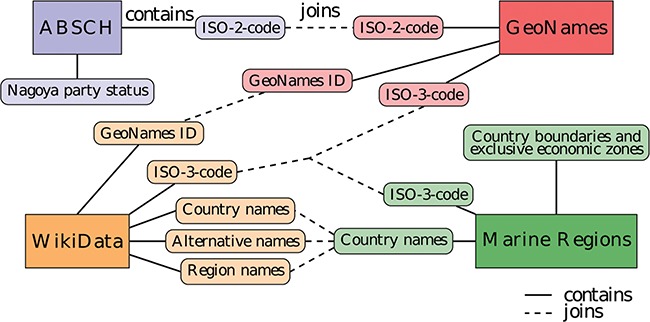
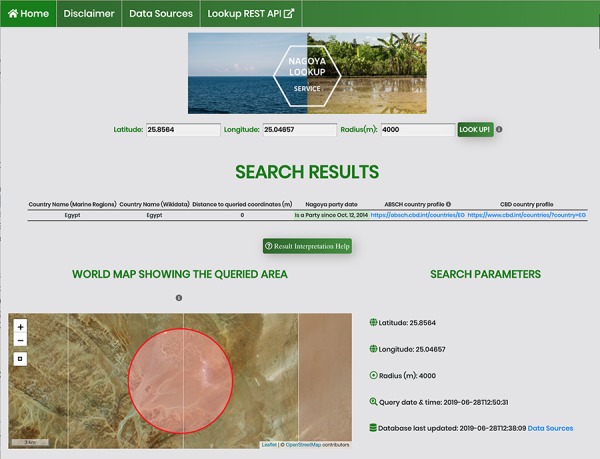
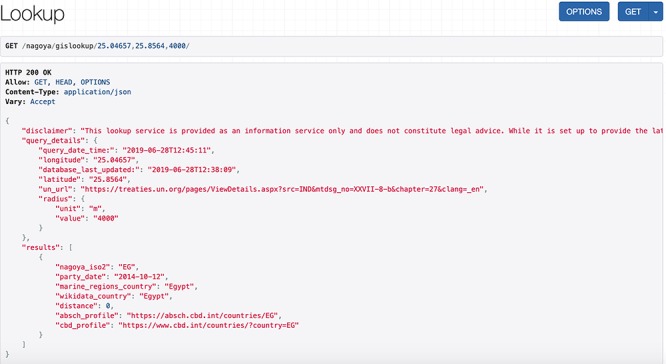
The Nagoya Protocol on Access and Benefit Sharing is a transparent legal framework, which governs the access to genetic resources and the fair and equitable sharing of benefits arising from their utilization. Complying with the Nagoya regulations ensures legal use and re-use of data from genetic resources. Providing detailed provenance information and clear re-usage conditions plays a key role in ensuring the re-usability of research data according to the FAIR (findable, accessible, interoperable and re-usable) Guiding Principles for scientific data management and stewardship. Even with the framework provided by the ABS (access and benefit sharing) Clearing House and the support of the National Focal Points, establishing a direct link between the research data from genetic resources and the relevant Nagoya information remains a challenge. This is particularly true for re-using publicly available data. The Nagoya Lookup Service was developed for stakeholders in biological sciences with the aim at facilitating the legal and FAIR data management, specifically for data publication and re-use. The service provides up-to-date information on the Nagoya party status for a geolocation provided by GPS coordinates, directing the user to the relevant local authorities for further information. It integrates open data from the ABS Clearing House, Marine Regions, GeoNames and Wikidata. The service is accessible through a REST API and a user-friendly web form. Stakeholders include data librarians, data brokers, scientists and data archivists who may use this service before, during and after data acquisition or publication to check whether legal documents need to be prepared, considered or verified. The service allows researchers to estimate whether genetic data they plan to produce or re-use might fall under Nagoya regulations or not, within the limits of the technology and without constituting legal advice. It is implemented using portable Docker containers and can easily be deployed locally or on a cloud infrastructure. The source code for building the service is available under an open-source license on GitHub, with a functional image on Docker Hub and can be used by anyone free of charge.
《名古屋议定书》是一个透明的法律框架,它规范了获取遗传资源的途径以及利用遗传资源所产生的惠益的公平公正分享。遵守《名古屋议定书》的规定可确保遗传资源数据的合法使用和再利用。提供详细的来源信息和明确的再利用条件,对于根据科学数据管理和管理的 FAIR(可发现、可访问、可互操作和可重复使用)指导原则确保研究数据的可再用性至关重要。即使有 ABS(获取和惠益分享)信息交换中心提供的框架和国家联络点的支持,在遗传资源研究数据和相关的名古屋信息之间建立直接联系仍然是一个挑战。对于再利用公开可用的数据尤其如此。名古屋查询服务是为生物科学利益相关者开发的,旨在促进合法和 FAIR 数据管理,特别是针对数据发布和再利用。该服务提供了有关特定 GPS 坐标地理位置的名古屋缔约方状态的最新信息,将用户引导至相关的地方当局以获取更多信息。它集成了 ABS 信息交换中心、海洋区域、GeoNames 和 Wikidata 的开放数据。该服务可通过 REST API 和用户友好的网络表单访问。利益相关者包括数据图书馆员、数据经纪人、科学家和数据档案管理员,他们可能在数据获取或发布之前、期间和之后使用此服务来检查是否需要准备、考虑或验证法律文件。该服务允许研究人员估计他们计划生成或再利用的遗传数据是否可能受《名古屋议定书》的约束,其范围限于技术,且不构成法律建议。它使用便携式 Docker 容器实现,可以轻松在本地或云基础设施上部署。构建服务的源代码可在 GitHub 上获得开源许可证,在 Docker Hub 上提供功能映像,任何人都可以免费使用。