Gong Mengchun, Liu Li, Sun Xin, Yang Yue, Wang Shuang, Zhu Hong
Institute of Health Management, Southern Medical University, Guangzhou, China.
Nanfang Hospital, Southern Medical University, Guangzhou, China.
J Med Internet Res. 2020 Apr 22;22(4):e18948. doi: 10.2196/18948.
Coronavirus disease (COVID-19) has been an unprecedented challenge to the global health care system. Tools that can improve the focus of surveillance efforts and clinical decision support are of paramount importance.
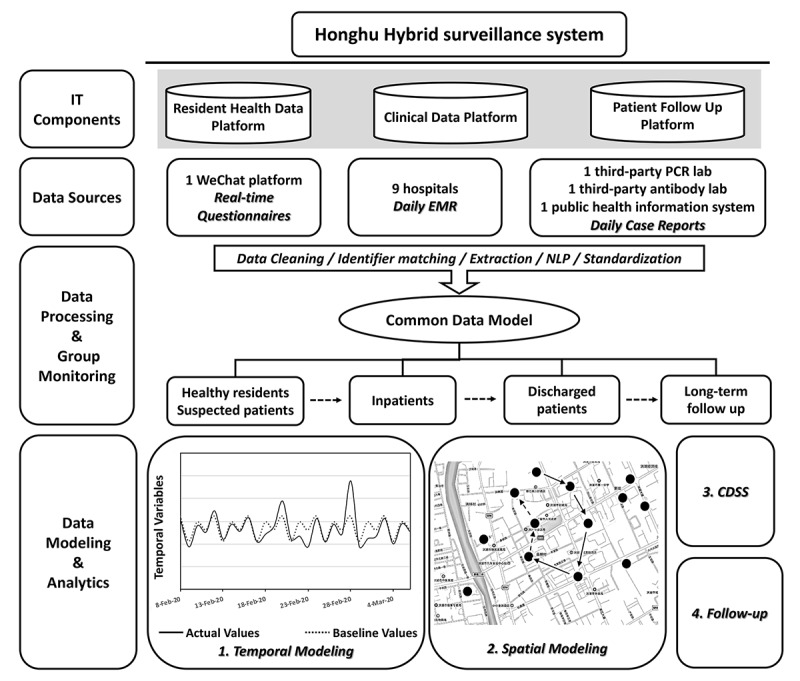
The aim of this study was to illustrate how new medical informatics technologies may enable effective control of the pandemic through the development and successful 72-hour deployment of the Honghu Hybrid System (HHS) for COVID-19 in the city of Honghu in Hubei, China.
The HHS was designed for the collection, integration, standardization, and analysis of COVID-19-related data from multiple sources, which includes a case reporting system, diagnostic labs, electronic medical records, and social media on mobile devices.
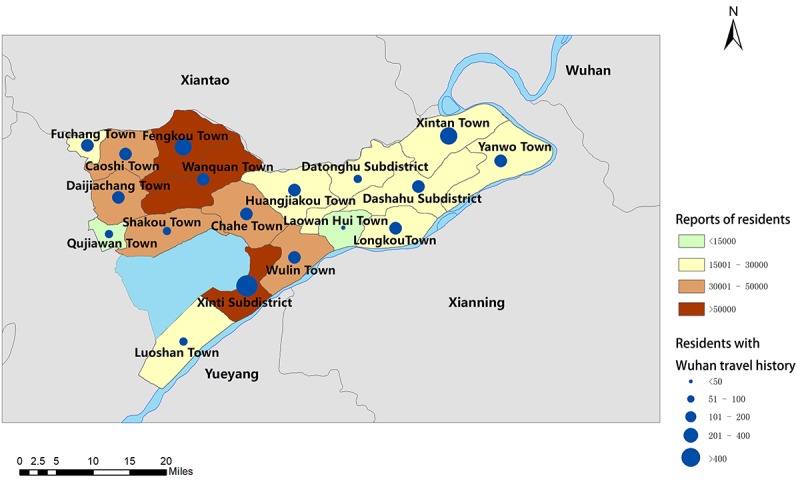
HHS supports four main features: syndromic surveillance on mobile devices, policy-making decision support, clinical decision support and prioritization of resources, and follow-up of discharged patients. The syndromic surveillance component in HHS covered over 95% of the population of over 900,000 people and provided near real time evidence for the control of epidemic emergencies. The clinical decision support component in HHS was also provided to improve patient care and prioritize the limited medical resources. However, the statistical methods still require further evaluations to confirm clinical effectiveness and appropriateness of disposition assigned in this study, which warrants further investigation.
The facilitating factors and challenges are discussed to provide useful insights to other cities to build suitable solutions based on cloud technologies. The HHS for COVID-19 was shown to be feasible and effective in this real-world field study, and has the potential to be migrated.
冠状病毒病(COVID-19)对全球医疗保健系统构成了前所未有的挑战。能够改善监测工作重点和临床决策支持的工具至关重要。
本研究旨在说明新的医学信息技术如何通过开发并成功在72小时内部署用于中国湖北省洪湖市COVID-19的洪湖混合系统(HHS),实现对这一疫情的有效控制。
HHS旨在收集、整合、标准化和分析来自多个来源的COVID-19相关数据,这些来源包括病例报告系统、诊断实验室、电子病历以及移动设备上的社交媒体。
HHS支持四个主要功能:移动设备上的症状监测、决策支持、临床决策支持和资源优先级排序以及出院患者随访。HHS中的症状监测组件覆盖了90多万人中的95%以上人口,并为控制疫情紧急情况提供了近乎实时的证据。HHS中的临床决策支持组件也用于改善患者护理并对有限的医疗资源进行优先级排序。然而,统计方法仍需进一步评估,以确认本研究中分配处置的临床有效性和适当性,这值得进一步研究。
讨论了促进因素和挑战,为其他城市基于云技术构建合适的解决方案提供有用的见解。在这项实际现场研究中,用于COVID-19的HHS被证明是可行且有效的,并且具有迁移的潜力。