Murray Tomás E, Coffey Mary F, Kehoe Eamonn, Horgan Finbarr G
Teagasc, Oak Park Research Centre, Oak Park, Carlow, Co. Carlow, Ireland.
Martin-Luther University Halle-Wittenberg, Institute for Biology, Department of Zoology, D-06120 Halle (Saale), Germany.
Biol Conserv. 2013 Mar;159:269-276. doi: 10.1016/j.biocon.2012.10.021. Epub 2013 Jan 21.
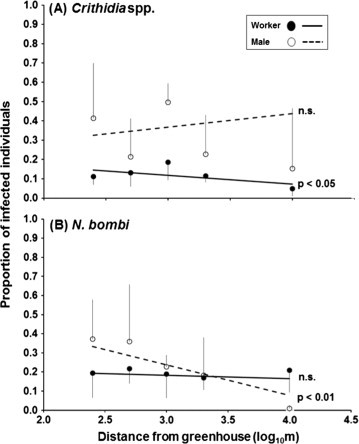
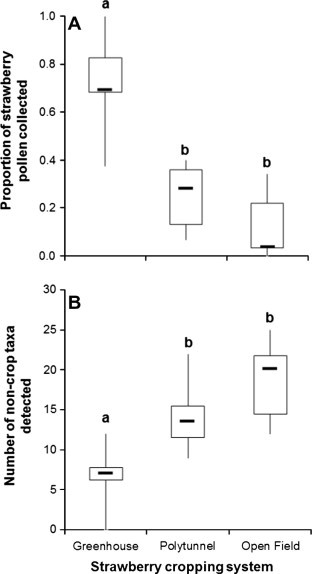
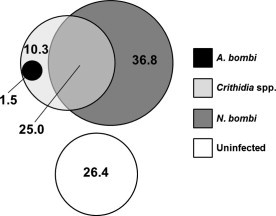
Worldwide, wild bumble bees ( spp.) are experiencing marked declines, with potentially up to 11% of species currently under threat. Recent studies from North America suggest that disease transmission from commercially reared bumble bees to wild populations has led to marked range contractions in some species. In Europe, data on the prevalence of pathogen spillover from commercial to wild bumble bee populations is lacking, despite the widespread production and transport of hives within the EU since the early 1980s. We determined the permeability of cropping systems to commercial bumble bees, and quantified the prevalence of four pathogens in commercial hives and adjacent conspecific populations at increasing distances from greenhouses in Ireland. Commercial bumble bees collected from 31% to 97% of non-crop pollen, depending on the cropping system, and hives had markedly higher frequencies of two gut parasites, spp. and , compared to adjacent populations, but were free of tracheal mites. The highest prevalence of was observed within 2 km of greenhouses and the probability of infection declined in a host sex- and pathogen-specific manner up to 10 km. We suggest implementing measures that prevent the interaction of commercially reared and wild bumble bees by integrating the enforcement of national best management practices for users of commercial pollinators with international legislation that regulates the sanitation of commercial hives in production facilities.
在全球范围内,野生大黄蜂(多种物种)数量正在显著减少,目前可能有高达11%的物种受到威胁。北美最近的研究表明,商业饲养的大黄蜂将疾病传播给野生种群,已导致一些物种的分布范围明显缩小。在欧洲,尽管自20世纪80年代初以来欧盟境内蜂箱的生产和运输十分普遍,但缺乏关于病原体从商业大黄蜂种群溢出到野生大黄蜂种群的流行数据。我们确定了种植系统对商业大黄蜂的通透性,并对爱尔兰温室周围不同距离的商业蜂箱及相邻同种蜂群中四种病原体的流行情况进行了量化。根据种植系统的不同,商业大黄蜂采集了31%至97%的非作物花粉,与相邻蜂群相比,蜂箱中两种肠道寄生虫(分别为某物种和另一物种)的感染频率明显更高,但未发现气管螨。在温室2公里范围内观察到某病原体的最高流行率,感染概率以宿主性别和病原体特异性的方式下降,直至10公里处。我们建议实施相关措施,通过将商业传粉者使用者的国家最佳管理实践的执行与规范生产设施中商业蜂箱卫生的国际立法相结合,防止商业饲养的大黄蜂与野生大黄蜂相互接触。