Gummow B
School of Veterinary and Biomedical Sciences, James Cook University, Townsville 4811, Queensland, Australia.
Livest Sci. 2010 May;130(1):41-46. doi: 10.1016/j.livsci.2010.02.009. Epub 2010 Mar 11.
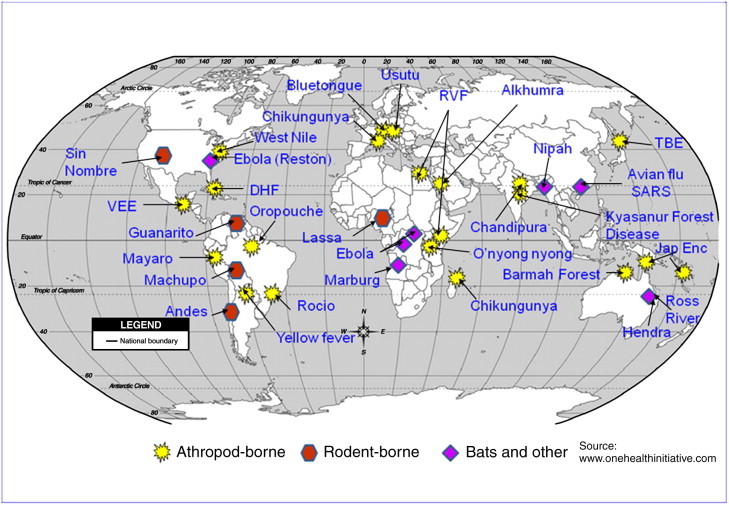
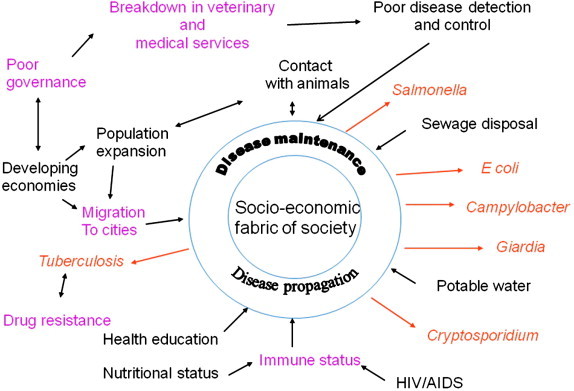
In today's world, emerging and re-emerging diseases have a significant impact on global economies and public health, and with bioterrorism a constant threat this has become a very topical subject in recent years. Bernard Vallat, director general of the OIE, made the statement, "As a result of globalisation and climate change we are currently facing an unprecedented worldwide impact of emerging and re-emerging animal diseases and zoonoses". He is not alone in this thinking, but are we facing an unprecedented impact of diseases and are globalisation and climate change the main driving forces? This paper examines some historical disease outbreaks and the factors that played a role in their emergence and compares these with recent emerging diseases. In doing so it highlights certain challenges that face livestock producers and decision makers today as they grapple with emerging diseases. One of the driving forces for the emergence of diseases is translocation of people and their livestock and this has often been coupled with invading armies or peoples, political unrest and a concurrent environment of socio-economic upheaval. Contact between wild animals, domestic animals and people is another driving force involving the interaction between naïve population groups that induces the emergence of new diseases. Pandemics are not new to human society and nor are many of the driving forces that caused them to occur in the past; what has changed is our increased knowledge and awareness of disease dynamics, allowing identification of challenges for the future and ways of addressing these. Modern farming practices often serve to amplify emerging infectious diseases and modern trade and transport mechanisms and routes have served to sometimes accelerate the spread of disease. How can we reduce the risks and should we only be worried about emerging infectious diseases or are emerging non-communicable diseases just as important in our modern society? This paper serves to explain some of the reasons for the emergence of diseases and to try and answer some of the pressing questions that confront livestock producers today.
在当今世界,新出现和再次出现的疾病对全球经济和公共卫生产生了重大影响,并且由于生物恐怖主义始终构成威胁,近年来这已成为一个非常热门的话题。世界动物卫生组织总干事贝尔纳·瓦拉特表示:“由于全球化和气候变化,我们目前正面临新出现和再次出现的动物疾病及人畜共患病在全球范围内前所未有的影响”。并非只有他持有这种观点,但是我们真的面临着疾病的前所未有的影响吗?全球化和气候变化是主要驱动力吗?本文研究了一些历史上的疾病暴发以及在其出现过程中发挥作用的因素,并将这些与近期新出现的疾病进行比较。这样做凸显了当今畜牧生产者和决策者在应对新出现疾病时所面临的某些挑战。疾病出现的驱动力之一是人员及其牲畜的迁移,这常常与入侵的军队或民族、政治动荡以及同时出现的社会经济动荡环境相关联。野生动物、家畜和人类之间的接触是另一个驱动力,涉及易感人群群体之间的相互作用,从而引发新疾病的出现。大流行对人类社会来说并不新鲜,过去导致大流行发生的许多驱动力也不新鲜;所改变的是我们对疾病动态的认识和了解有所增加,这使我们能够确定未来的挑战以及应对这些挑战的方法。现代养殖方式往往会加剧新出现的传染病,而现代贸易和运输机制及路线有时会加速疾病的传播。我们如何降低风险?我们是否只应担心新出现的传染病,还是新出现的非传染性疾病在我们现代社会中同样重要?本文旨在解释疾病出现的一些原因,并尝试回答当今畜牧生产者面临的一些紧迫问题。