Zou Tengyue, Huang Chuanhui, Wu Pengfei, Ge Long, Xu Yong
College of Mechanical and Electronic Engineering, Fujian Agriculture and Forestry University, Fuzhou 350002, China.
Plants (Basel). 2020 Apr 10;9(4):490. doi: 10.3390/plants9040490.
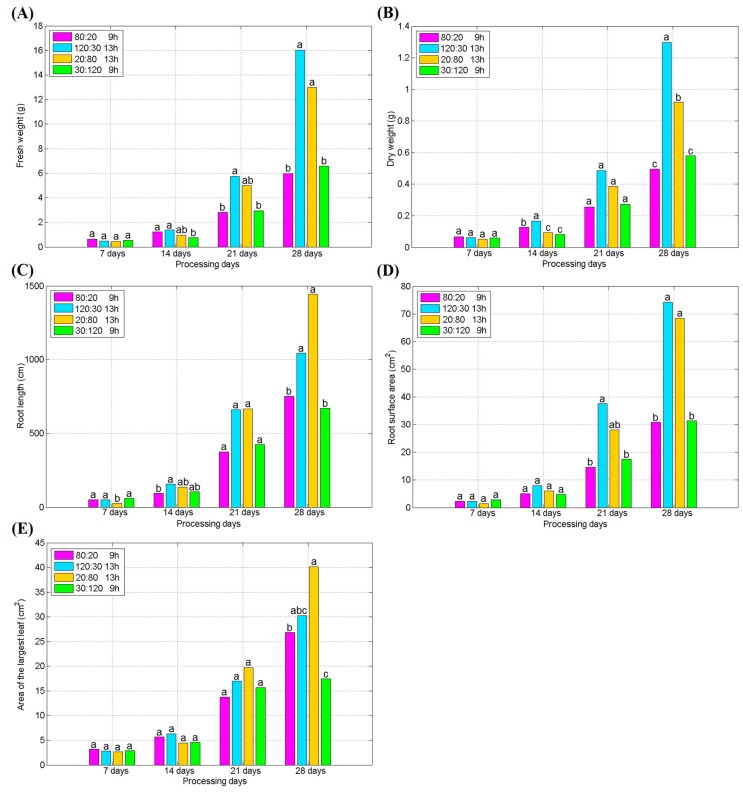
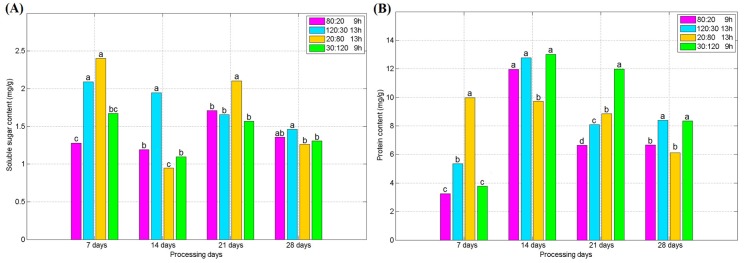
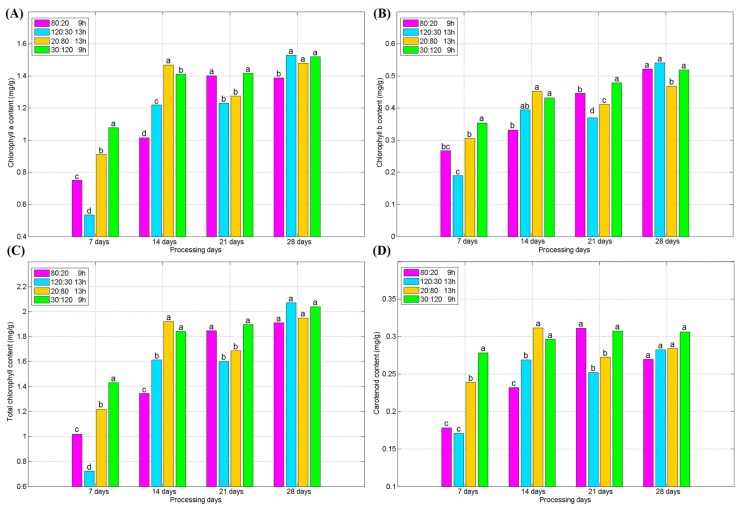
Artificial LED source provides the possibility to regulate the lighting environment in plant factorys that use limited space to plant, aiming at high throughput and good quality. However, different parameters of light intensity, quality, and photoperiod will influence the growth and accumulation of bio-compounds in plants. In order to find the optimal setting of LED light for spinach planting, four group experiments were designed using the orthogonal testing method. According to the experimental results, for growth indexes including fresh weight, dry weight, root length and so on, photoperiod is the most influential factor, light intensity is the second, and light quality is the least. The best light mode (R:B = 4:1, photosynthetic photon flux density (PPFD) = 100 μmol∙m∙s and 13/11 h) among all eight possible combinations in the range was also determined. Furthermore, for quality indexes, including the soluble sugar content, protein content and so on, a new scoring method was introduced to make a comprehensive score for evaluating. Then, the light combination (R:B = 4:1, PPFD = 150 μmol∙m∙s and 9/15 h) in the range was found as the optimal scheme for spinach quality under those parameters. As there is trade-off between the optimal light parameters for growth and quality, it is necessary to achieve a balance between yield and quality of the plant during production. If farmers want to harvest spinach with larger leaf area and higher yield, they need to pay attention to the adjustment of the photoperiod and use a lower light intensity and a longer lighting time. If they do not mind the yield of the vegetable but want to improve the taste and nutrition of spinach products, they should pay more attention to the light intensity and use a higher light intensity and a shorter lighting time.
人造LED光源为在利用有限空间种植的植物工厂中调节光照环境提供了可能性,目标是实现高产量和高质量。然而,光强、光质和光周期的不同参数会影响植物中生物化合物的生长和积累。为了找到菠菜种植的LED光最佳设置,采用正交试验法设计了四组实验。根据实验结果,对于鲜重、干重、根长等生长指标,光周期是最具影响力的因素,光强其次,光质影响最小。还确定了该范围内所有八种可能组合中的最佳光照模式(红:蓝 = 4:1,光合光子通量密度(PPFD)= 100 μmol∙m∙s且光周期为13/11小时)。此外,对于可溶性糖含量、蛋白质含量等品质指标,引入了一种新的评分方法进行综合评分评估。然后,发现该范围内的光照组合(红:蓝 = 4:1,PPFD = 150 μmol∙m∙s且光周期为9/15小时)是这些参数下菠菜品质的最佳方案。由于生长和品质的最佳光照参数之间存在权衡,因此在生产过程中有必要在植物的产量和品质之间取得平衡。如果农民想收获叶面积更大、产量更高的菠菜,他们需要注意光周期的调整,并使用较低的光强和较长的光照时间。如果他们不介意蔬菜的产量,但想改善菠菜产品的口感和营养,他们应该更关注光强,并使用较高的光强和较短的光照时间。