Pierro Luisa, Arrigo Alessandro, Aragona Emanuela, Cavalleri Michele, Bandello Francesco
Department of Ophthalmology, Scientific Institute San Raffaele, Vita-Salute University, 20132 Milan, Italy.
J Clin Med. 2020 Apr 12;9(4):1094. doi: 10.3390/jcm9041094.
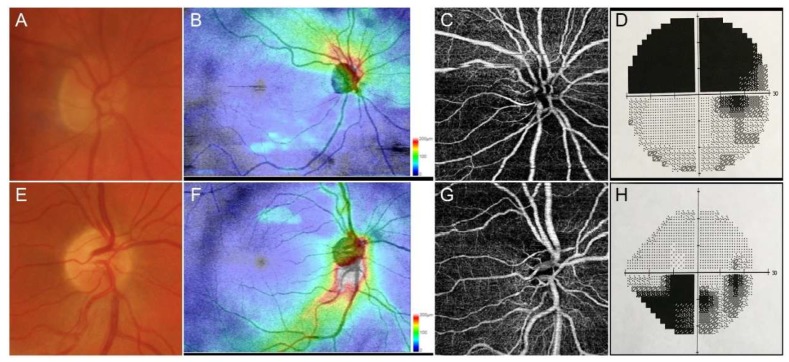
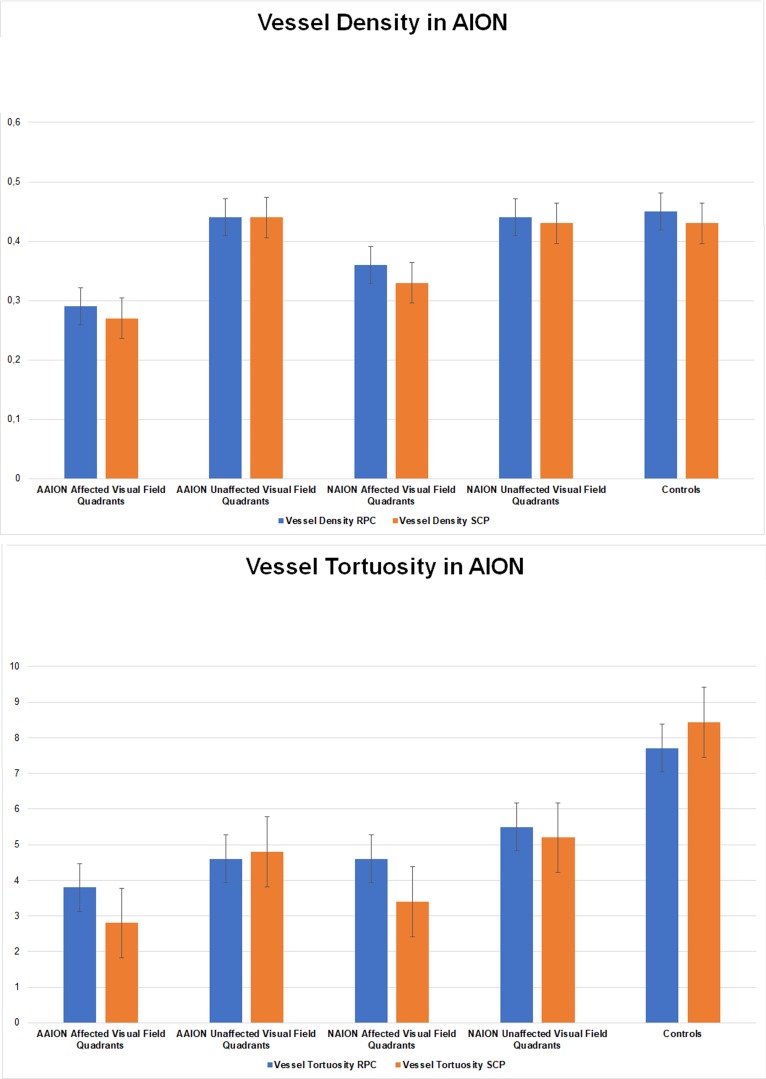
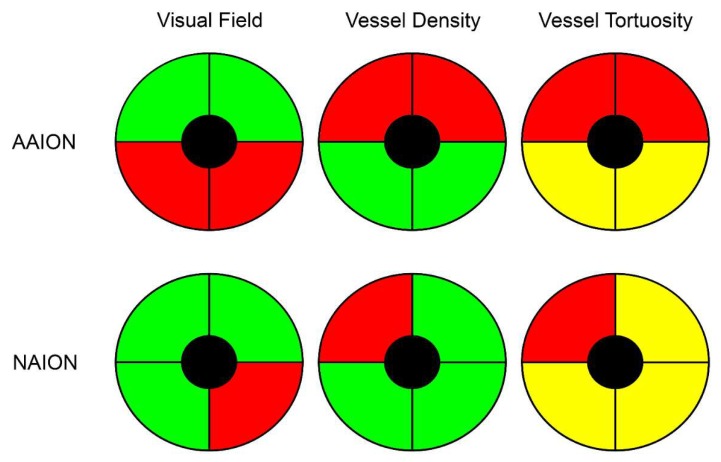
The aim of this study was to perform quantitative optical coherence tomography angiography (OCTA) assessment of arteritic and non-arteritic anterior ischemic optic neuropathies (AION; NAION). The study was designed as an observational, cross-sectional case series. All patients underwent complete ophthalmologic evaluation including LogMAR best-corrected visual acuity (BCVA), structural optical coherence tomography (OCT) and OCTA images, and dye-based angiography. Retinal nerve fiber layer (RNFL) thickness was obtained from structural OCT, and vessel density (VD) and vessel tortuosity (VT) were measured for each optic nerve head vascular plexus. After selecting the quadrants showing visual field defects, measured by Humphrey 30.2 perimetry (Zeiss Meditec, Dublin, CA, USA), we assessed the correlation between the localization of visual field defects and the quadrants showing impairments of RNFL, VD, and VT. Thirty naïve AION patients (15 arteritic AION (AAION) and 15 non-arteritic AION (NAION)) were included. LogMAR BCVA was 0.6 ± 0.2 for AAION and 0.3 ± 0.3 for NAION ( < 0.01). AAION and NAION eyes showed significant differences in terms of visual field involvement as well as VD and VT values, with remarkably worse alterations affecting AAION eyes. VD values perfectly matched with the quadrants showing RNFL and visual field defects. On the contrary, VT resulted remarkably decreased in all the quadrants, with even worse values in the quadrants showing RNFL and visual field alterations. The present study showed that AAION eyes are more injured than NAION ones. VD represents a good parameter for the detection of the main site on vascular impairment. Remarkably, VT resulted in a more sensitive parameter for the quantitative detection of blood flow impairment in AION disease.
本研究旨在对动脉炎性和非动脉炎性前部缺血性视神经病变(AION;NAION)进行定量光学相干断层扫描血管造影(OCTA)评估。该研究设计为一项观察性横断面病例系列研究。所有患者均接受了全面的眼科评估,包括LogMAR最佳矫正视力(BCVA)、结构性光学相干断层扫描(OCT)和OCTA图像以及染料血管造影。从结构性OCT获取视网膜神经纤维层(RNFL)厚度,并测量每个视神经乳头血管丛的血管密度(VD)和血管迂曲度(VT)。在选择通过Humphrey 30.2视野计(蔡司医疗技术公司,美国加利福尼亚州都柏林)测量显示视野缺损的象限后,我们评估了视野缺损的定位与显示RNFL、VD和VT受损的象限之间的相关性。纳入了30例初发AION患者(15例动脉炎性AION(AAION)和15例非动脉炎性AION(NAION))。AAION的LogMAR BCVA为0.6±0.2,NAION为0.3±0.3(<0.01)。AAION和NAION眼在视野受累以及VD和VT值方面存在显著差异,AAION眼的改变明显更严重。VD值与显示RNFL和视野缺损的象限完全匹配。相反,所有象限的VT均显著降低,在显示RNFL和视野改变的象限中值甚至更差。本研究表明,AAION眼比NAION眼损伤更严重。VD是检测血管损伤主要部位的一个良好参数。值得注意的是,VT是AION疾病中血流损伤定量检测的一个更敏感参数。