Department of Ophthalmology, Massachusetts Eye and Ear Infirmary, Harvard Medical School, Boston, MA, United States of America.
Schepens Eye Research Institute, Harvard Medical School, Boston, MA, United States of America.
PLoS One. 2018 Jun 28;13(6):e0199793. doi: 10.1371/journal.pone.0199793. eCollection 2018.
Non-arteritic anterior ischemic optic neuropathy (NAION) is the most common cause of non-glaucomatous optic neuropathy in older adults. Optical coherence tomographic angiography (OCT-A) is an emerging, non-invasive method to study the microvasculature of the posterior pole, including the optic nerve head. The goal of this study was to assess the vascular changes in the optic nerve head and peripapillary area associated with NAION using OCT-A.
Retrospective comparative case series.
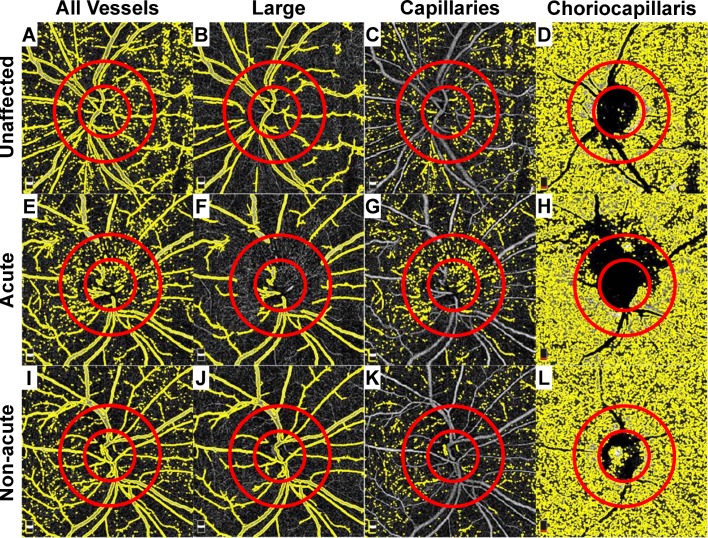
We performed OCT-A in 25 eyes (7 acute and 18 non-acute) in 19 patients with NAION. Fellow, unaffected eyes were analyzed for comparison. Patent macro- and microvascular densities were quantified in the papillary and peripapillary regions of unaffected, acutely affected, and non-acutely affected eyes and compared across these groups according to laminar segment and capillary sampling region, and with respect to performance on automated visual field testing.
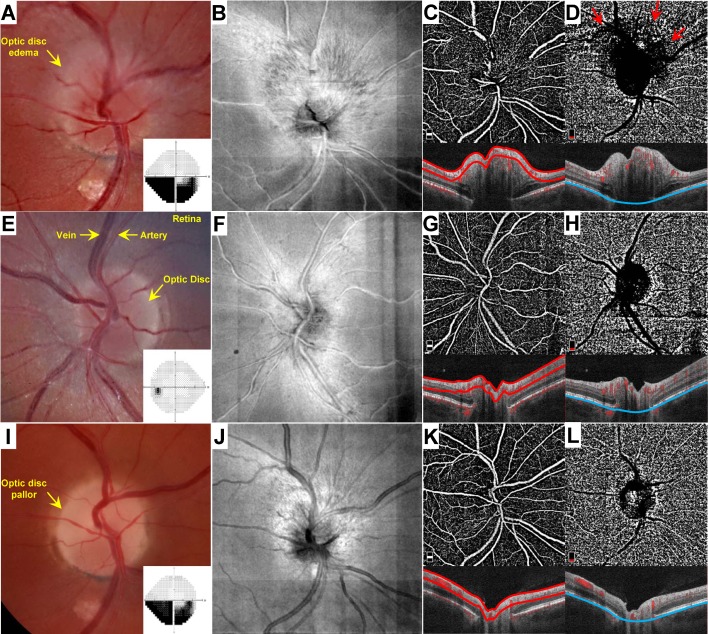
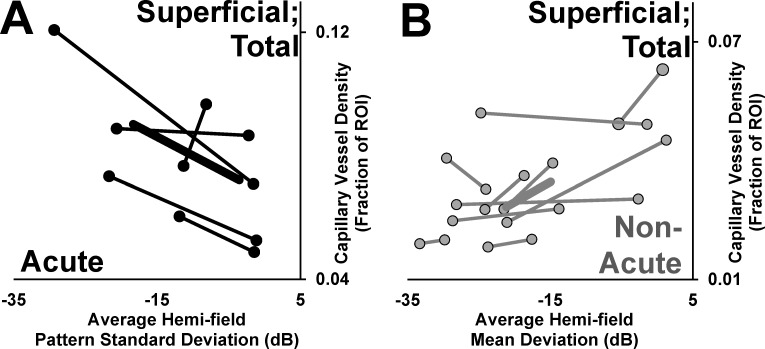
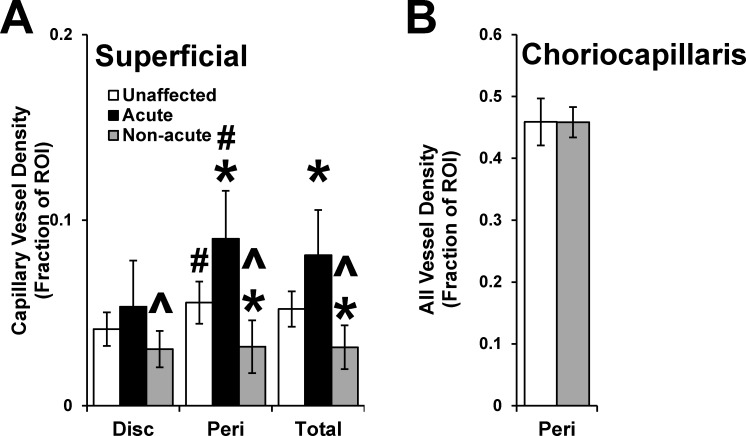
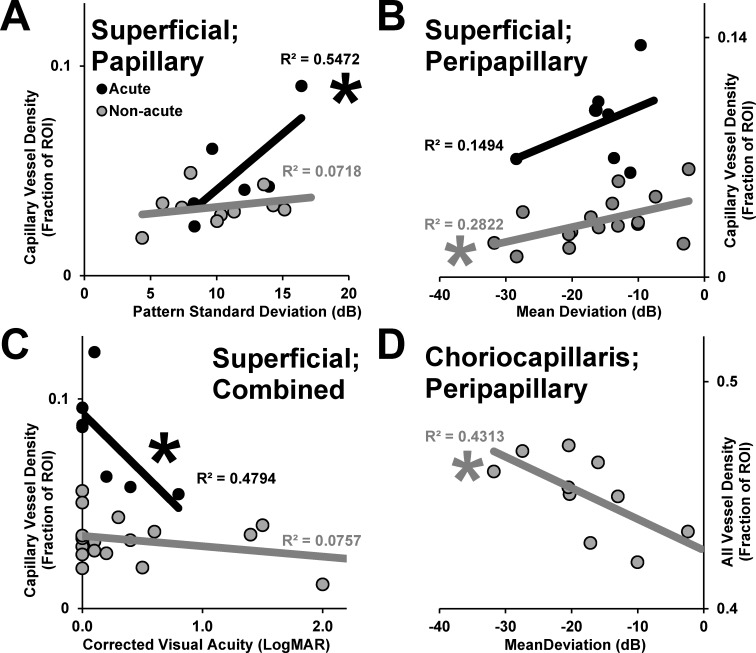
In acutely affected eyes, OCT-A revealed a reduction in the signal from the major retinal vessels and dilation of patent superficial capillaries in the peripapillary area. By contrast, non-acutely affected eyes showed attenuation of patent capillaries. The peripapillary choriocapillaris was obscured by edema in acute cases, but was similar between non-acute and unaffected eyes. The degree of dilation of the superficial microvasculature in the acute phase and attenuation in the non-acute phase each correlated inversely with visual field performance. The region of reduced patent capillary density correlated with the location of visual field defects in 80% of acute cases and 80% of non-acute cases.
OCT-A reveals a dynamic shift in the superficial capillary network of the optic nerve head with strong functional correlates in both the acute and non-acute phases of NAION. Further study may validate OCT-A as a useful adjunctive diagnostic tool in the evaluation of ischemic optic neuropathy.
非动脉炎性前部缺血性视神经病变(NAION)是老年人中最常见的非青光眼性视神经病变。光学相干断层血管造影术(OCT-A)是一种新兴的、非侵入性的方法,用于研究后极部的微血管,包括视神经头。本研究的目的是使用 OCT-A 评估与 NAION 相关的视神经头和视盘周围区域的血管变化。
回顾性比较病例系列。
我们对 19 例 NAION 患者的 25 只眼(7 只急性和 18 只非急性)进行了 OCT-A 检查。为了比较,还分析了对侧未受影响的眼睛。在未受影响、急性受影响和非急性受影响的眼中,对乳头和视盘周围区域的显性宏观和微观血管密度进行了量化,并根据层段和毛细血管采样区域对这些组进行了比较,并与自动视野测试的表现进行了比较。
在急性受影响的眼中,OCT-A 显示主要视网膜血管的信号减少,视盘周围区域的显性浅层毛细血管扩张。相比之下,非急性受影响的眼睛显示显性毛细血管衰减。急性病例中,视盘周围脉络膜毛细血管因水肿而模糊,但在非急性和未受影响的眼中相似。在急性期浅层微血管扩张的程度和非急性期的衰减程度均与视野表现呈负相关。显性毛细血管密度降低的区域与 80%的急性病例和 80%的非急性病例的视野缺损部位相关。
OCT-A 显示视神经头浅层毛细血管网络的动态变化,在 NAION 的急性和非急性阶段均与强烈的功能相关性相关。进一步的研究可能会验证 OCT-A 作为评估缺血性视神经病变的有用辅助诊断工具。