Zhang Wenping, Lin Ziqiu, Pang Shimei, Bhatt Pankaj, Chen Shaohua
State Key Laboratory for Conservation and Utilization of Subtropical Agro-bioresources, Guangdong Province Key Laboratory of Microbial Signals and Disease Control, Integrative Microbiology Research Centre, South China Agricultural University, Guangzhou, China.
Guangdong Laboratory for Lingnan Modern Agriculture, Guangzhou, China.
Front Microbiol. 2020 Mar 27;11:522. doi: 10.3389/fmicb.2020.00522. eCollection 2020.
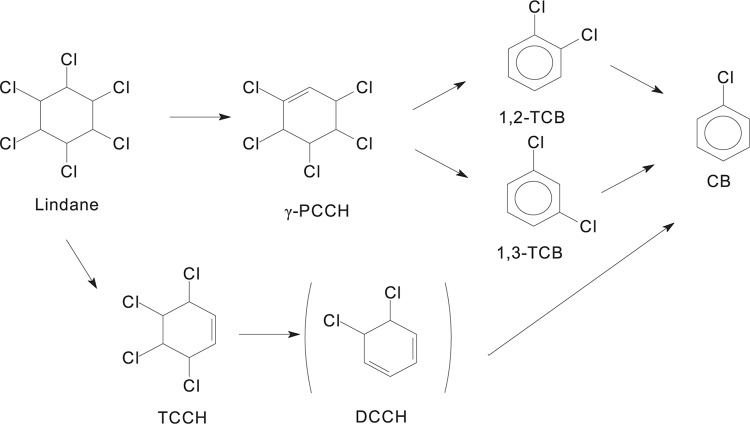
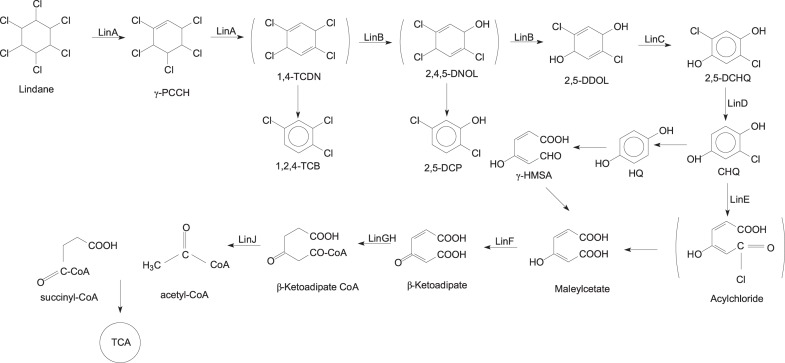
Lindane (γ-hexachlorocyclohexane) is an organochlorine pesticide that has been widely used in agriculture over the last seven decades. The increasing residues of lindane in soil and water environments are toxic to humans and other organisms. Large-scale applications and residual toxicity in the environment require urgent lindane removal. Microbes, particularly Gram-negative bacteria, can transform lindane into non-toxic and environmentally safe metabolites. Aerobic and anaerobic microorganisms follow different metabolic pathways to degrade lindane. A variety of enzymes participate in lindane degradation pathways, including dehydrochlorinase (LinA), dehalogenase (LinB), dehydrogenase (LinC), and reductive dechlorinase (LinD). However, a limited number of reviews have been published regarding the biodegradation and bioremediation of lindane. This review summarizes the current knowledge regarding lindane-degrading microbes along with biodegradation mechanisms, metabolic pathways, and the microbial remediation of lindane-contaminated environments. The prospects of novel bioremediation technologies to provide insight between laboratory cultures and large-scale applications are also discussed. This review provides a theoretical foundation and practical basis to use lindane-degrading microorganisms for bioremediation.
林丹(γ-六氯环己烷)是一种有机氯农药,在过去七十年里被广泛应用于农业。土壤和水环境中林丹残留量的增加对人类和其他生物有毒害作用。林丹在环境中的大规模应用及其残留毒性使得其去除成为当务之急。微生物,尤其是革兰氏阴性菌,能够将林丹转化为无毒且对环境安全的代谢产物。需氧微生物和厌氧微生物通过不同的代谢途径降解林丹。多种酶参与林丹的降解途径,包括脱氯化氢酶(LinA)、脱卤酶(LinB)、脱氢酶(LinC)和还原脱氯酶(LinD)。然而,关于林丹生物降解和生物修复的综述文章数量有限。本综述总结了目前有关林丹降解微生物的知识,以及生物降解机制、代谢途径和林丹污染环境的微生物修复情况。还讨论了新型生物修复技术在实验室培养与大规模应用之间提供见解的前景。本综述为利用林丹降解微生物进行生物修复提供了理论基础和实践依据。