College of Animal Medicine, Yunnan Agricultural University, Kunming, 650201, China.
BMC Vet Res. 2020 Mar 23;16(1):96. doi: 10.1186/s12917-020-02304-8.
Porcine circovirus type 2 (PCV2) is the causative agent of porcine circovirus-associated disease (PCVAD). Its prevalence in swine herds was first reported in China in 2000. PCV2 infection causes immunosuppression that leads to multiple diseases, causing serious economic problems for the swine industry in China. Since information on the genetic variation of PCV2 in Yunnan province is limited, this study aims to investigate the molecular epidemiological and evolutionary characteristics of PCV2 from 2016 to 2019.
A total of 279 clinical samples were collected from different regions of Yunnan between 2016 to 2019, and PCV2 was detected by PCR. We then amplified full genomes from the positive samples, and the sequences were analysed for homology and genetic evolution.
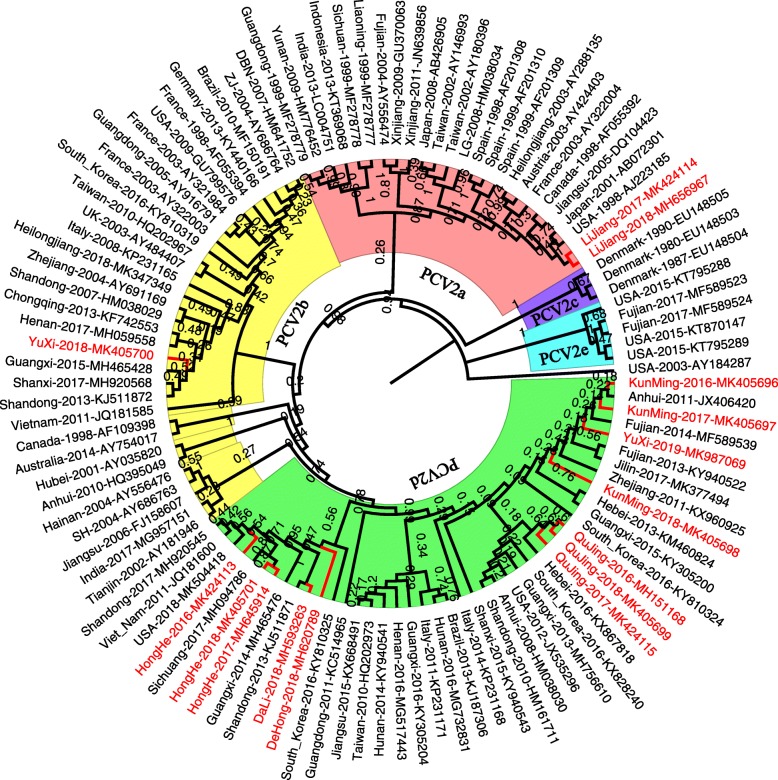
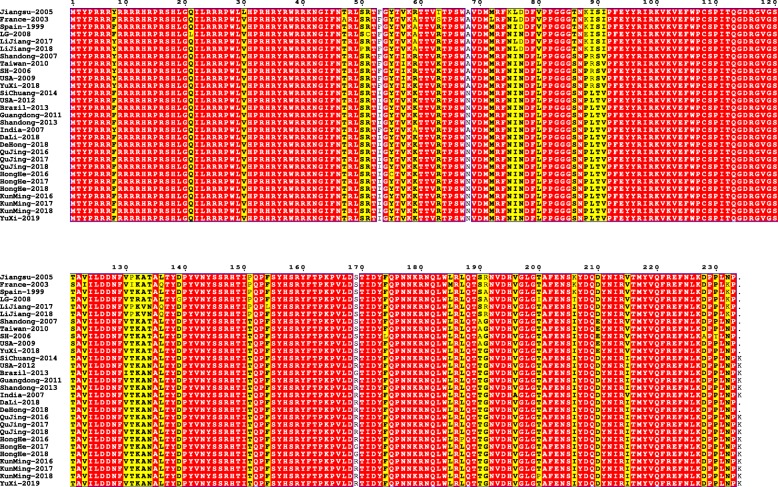
Overall, 60.93% (170/279) of the screened swine herd samples were positive for PCV2. We sequenced 15 Yunnan province PCV2 strains from positive samples. Analyses of the complete genomes and Cap genes led to the classification of the 15 Yunnan PCV2 strains into PCV2a (2 of 15), PCV2b (1of 15) and PCV2d (12 of 15). All strains shared 94.3-99.9% of their identities with the nucleotide sequences of complete genomes in this study and shared 94.2-99.9% identity with the reference sequences. All strains share 89.4-100% and 86.8-100% of their identities with the nucleotide and amino acid (aa) sequences of Cap, respectively.
The results of this study provide evidence that PCV2a, PCV2b and PCV2d genotypes coexisted in Yunnan Province from 2016 to 2019, and the priority prevalence genotype was PCV2d. The data provide evidence for the increased genetic diversity and insights into the molecular epidemiology of PCV2. This study also provides basic data for the Yunnan province PCV2 molecular epidemiological survey and accumulates effective materials for the development of PCV2 vaccines.
猪圆环病毒 2 型(PCV2)是猪圆环病毒相关疾病(PCVAD)的病原体。其在猪群中的流行于 2000 年在中国首次报道。PCV2 感染导致免疫抑制,从而引发多种疾病,给中国的养猪业造成严重的经济问题。由于云南省关于 PCV2 遗传变异的信息有限,本研究旨在调查 2016 年至 2019 年期间 PCV2 的分子流行病学和进化特征。
2016 年至 2019 年期间,从云南省不同地区共采集 279 份临床样本,通过 PCR 检测 PCV2。然后,从阳性样本中扩增全基因组,并对序列进行同源性和遗传进化分析。
总体而言,279 份筛查猪群样本中 60.93%(170/279)为 PCV2 阳性。我们从阳性样本中测序了 15 株云南省 PCV2 株。对完整基因组和 Cap 基因的分析将 15 株云南 PCV2 株分为 PCV2a(2 株)、PCV2b(1 株)和 PCV2d(12 株)。所有菌株与本研究全基因组核苷酸序列的同源性为 94.3-99.9%,与参考序列的同源性为 94.2-99.9%。所有菌株与 Cap 的核苷酸和氨基酸(aa)序列的同源性分别为 89.4-100%和 86.8-100%。
本研究结果表明,2016 年至 2019 年云南省同时存在 PCV2a、PCV2b 和 PCV2d 基因型,优势流行基因型为 PCV2d。该数据为 PCV2 遗传多样性的增加提供了证据,并深入了解了 PCV2 的分子流行病学。本研究还为云南省 PCV2 分子流行病学调查提供了基础数据,并为 PCV2 疫苗的开发积累了有效材料。