Department of Kinesiology, Faculty of Applied Health Sciences, Brock University, 1812 Sir Isaac Brock Way, St. Catharines, Ontario, L2S 3A1, Canada.
Children's Health and Exercise Research Centre, College of Life and Environmental Sciences, University of Exeter, Exeter, UK.
J Int Soc Sports Nutr. 2020 Apr 15;17(1):20. doi: 10.1186/s12970-020-00350-z.
This study examined the effects of whey protein supplementation, compared with an isocaloric carbohydrate beverage and water, consumed immediately following an intense swimming trial on bone turnover in adolescent swimmers.
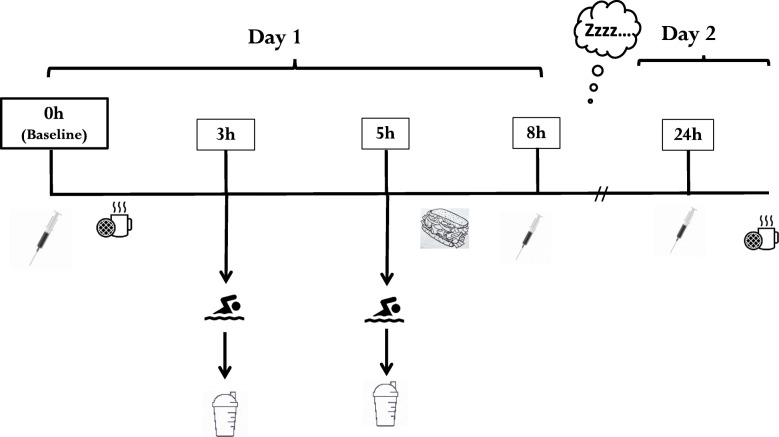
Fifty-eight (31 female, 27 male) swimmers (14.1 ± 0.4 years) were stratified into three groups matched for age, sex and body mass. The protein and carbohydrate groups consumed two isocaloric post-exercise beverages each containing 0.3 gkg of whey protein (with ~ 6 mg of calcium) or maltodextrin while the control group consumed water. Participants provided a morning, fasted, resting blood sample, then performed an intense swimming trial consisting of a maximal 200 m swim followed by a high intensity interval swimming protocol (5x100m, 5x50m and 5x25m; 1:1 work-to-rest ratio). Following swimming, they consumed their first respective post-exercise beverage, and 2 h later, they performed a second maximal swim immediately followed by the second beverage. Approximately 3 h after the second beverage, two post-consumption blood samples were collected at 8 h and 24 h from baseline. Procollagen type 1 intact N-terminal propeptide (PINP) and carboxy-terminal collagen crosslinks (CTXI) were measured in serum. The multiples of medians of PINP and CTXI were also used to calculate bone turnover rate and balance.
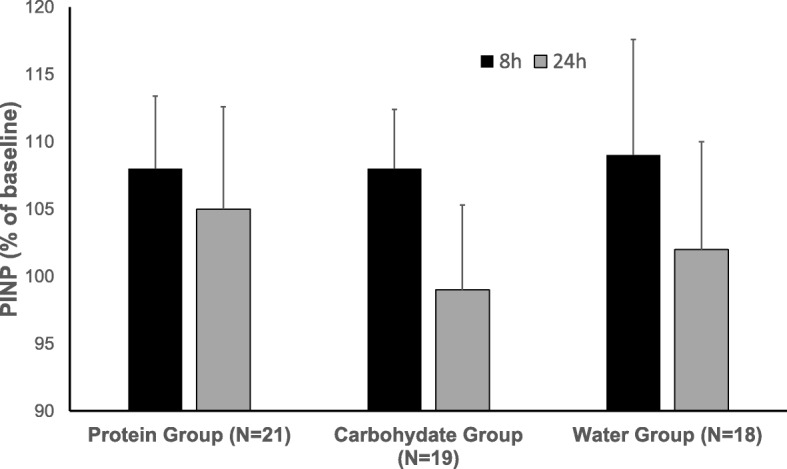
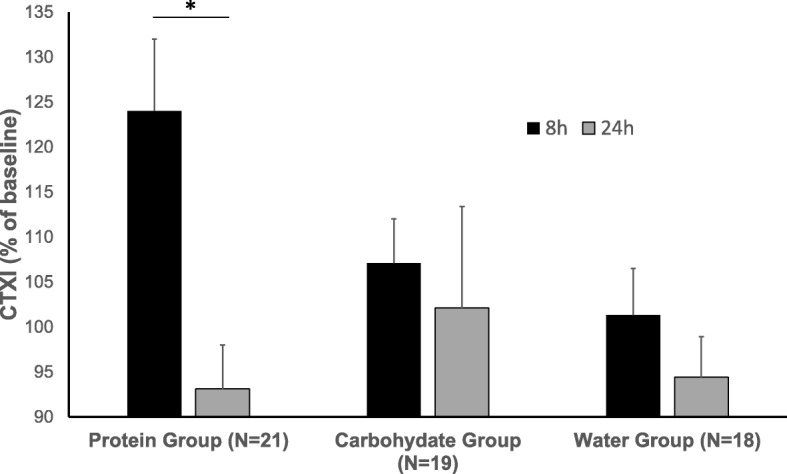
No significant changes were observed in PINP. CTXI increased (+ 11%) at 8 h in all groups, but then significantly decreased (- 22%) at 24 h in the protein group only. The protein group also had a significantly higher calculated rate of bone turnover at 8 h and 24 h compared to baseline, which was not observed in the other groups.
These results shed light on the potential importance of protein consumed shortly after intense swimming in promoting positive bone turnover responses up to 24 h following exercise in adolescent athletes.
ClinicalTrials.gov PRS; NCT04114045. Registered 1 October 2019 - Retrospectively registered.
本研究考察了在剧烈游泳试验后立即补充乳清蛋白与等热量碳水化合物饮料和水对青少年游泳运动员骨转换的影响。
58 名(31 名女性,27 名男性)游泳运动员(14.1±0.4 岁)按年龄、性别和体重分为三组。蛋白质组和碳水化合物组分别摄入两种等热量运动后饮料,每种饮料均含有 0.3g/kg 的乳清蛋白(含有~6mg 的钙)或麦芽糊精,而对照组则摄入水。参与者提供了一个早晨、禁食、休息时的血液样本,然后进行了一次剧烈的游泳试验,包括一次最大的 200 米游泳,然后是高强度间歇游泳方案(5x100m、5x50m 和 5x25m;1:1 工作与休息比)。游泳后,他们饮用了第一份运动后饮料,2 小时后,他们立即进行了第二次最大游泳,然后饮用了第二份饮料。大约在第二份饮料后 3 小时,从基线处采集了两次餐后血液样本,时间分别为 8 小时和 24 小时。血清中测定了原胶原型 1 完整 N 端前肽(PINP)和羧基端胶原交联(CTX I)。还使用 PINP 和 CTXI 的倍数中位数来计算骨转换率和平衡。
PINP 无明显变化。所有组的 CTXI 在 8 小时时均增加(+11%),但仅在蛋白质组中,24 小时时显著降低(-22%)。与基线相比,蛋白质组在 8 小时和 24 小时的骨转换率也明显更高,而其他组则没有观察到这种情况。
这些结果表明,在剧烈游泳后立即摄入蛋白质可能对促进青少年运动员运动后 24 小时内的积极骨转换反应具有重要意义。
ClinicalTrials.gov PRS;NCT04114045。2019 年 10 月 1 日注册;回顾性注册。