• 文献检索
  • 文档翻译
  • 深度研究
  • 学术资讯
  • Suppr Zotero 插件Zotero 插件
  • 邀请有礼
  • 套餐&价格
  • 历史记录
应用&插件
Suppr Zotero 插件Zotero 插件浏览器插件Mac 客户端Windows 客户端微信小程序
定价
高级版会员购买积分包购买API积分包
服务
文献检索文档翻译深度研究API 文档MCP 服务
关于我们
关于 Suppr公司介绍联系我们用户协议隐私条款
关注我们

Suppr 超能文献

核心技术专利:CN118964589B侵权必究
粤ICP备2023148730 号-1Suppr @ 2026

文献检索

告别复杂PubMed语法,用中文像聊天一样搜索,搜遍4000万医学文献。AI智能推荐,让科研检索更轻松。

立即免费搜索

文件翻译

保留排版,准确专业,支持PDF/Word/PPT等文件格式,支持 12+语言互译。

免费翻译文档

深度研究

AI帮你快速写综述,25分钟生成高质量综述,智能提取关键信息,辅助科研写作。

立即免费体验

无糖含氨基酸电解质饮料对 5 公里运动表现、血液电解质和运动后抽筋的影响与传统碳水化合物电解质运动饮料和水的对比。

The effects of a sugar-free amino acid-containing electrolyte beverage on 5-kilometer performance, blood electrolytes, and post-exercise cramping versus a conventional carbohydrate-electrolyte sports beverage and water.

机构信息

Nutrabolt Applied and Molecular Sciences Laboratory, Auburn University, School of Kinesiology, Auburn, AL, USA.

Nutrabolt, Austin, TX, USA.

出版信息

J Int Soc Sports Nutr. 2024 Dec;21(1):2296888. doi: 10.1080/15502783.2023.2296888. Epub 2023 Dec 22.

DOI:10.1080/15502783.2023.2296888
PMID:38131124
原文链接:https://pmc.ncbi.nlm.nih.gov/articles/PMC10763896/
Abstract

OBJECTIVE

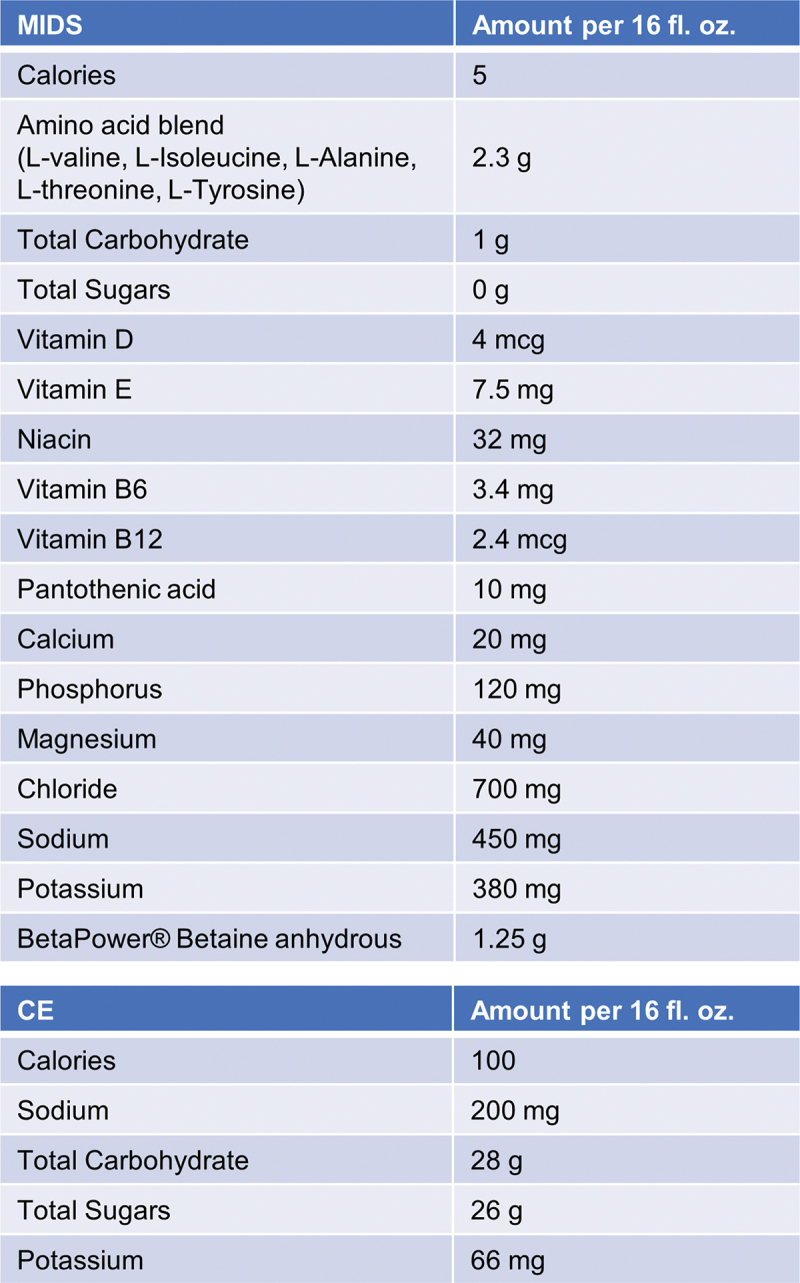
The purpose of this study was to examine the acute effects of a multi-ingredient, low calorie dietary supplement (MIDS, XTEND® Healthy Hydration) on 5-kilometer (5-km) time trial performance and blood electrolyte concentrations compared to a carbohydrate-electrolyte beverage (CE, GATORADE® Thirst Quencher) and distilled water (W).

METHODS

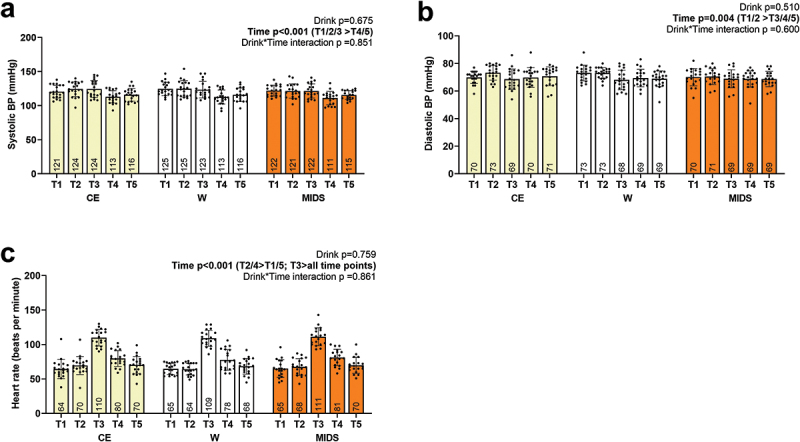
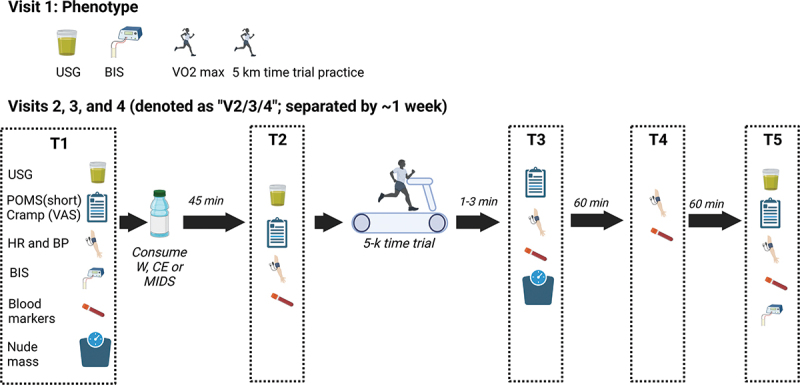
During visit 1 (V1), participants (10 men and 10 women, 20-35 years old, BMI ≤ 29 kg/m, recreationally active) reported to the laboratory whereby the following tests were performed: i) height and weight measurements, ii) body composition analysis, iii) treadmill testing to measure maximal aerobic capacity, and iv) 5-km time trial familiarization. The second visit (V2) was one week after V1 in the morning (0600 - 0900) and participants arrived 12-14 h fasted (no food or drink). The first battery of assessments (V2-T1) included nude body mass, urine specific gravity (USG), a profile of mood states (POMS) questionnaire, and the completion of a visual analogue scale (VAS) questionnaire to quantify cramping. Then heart rate (HR), blood pressure (BP), total body hydration (via bioelectrical impedance spectroscopy [BIS]) were examined. Finally, a measurement of blood markers via finger stick was performed. Participants consumed a randomized beverage (16 fl. oz. of MIDS, 16 fl. oz. of W, or 16 fl. oz. of CE) within 3 min followed by a 45-min rest. Following the rest period, a second battery (V2-T2) was performed whereby participants' USG was assessed and they completed the POMS and VAS questionnaires, and HR, BP, and blood markers were measured. The participants then performed a 5-km treadmill time trial. Immediately following the 5-km time trial, participants completed a third testing battery (V2-T3) that began with blood markers, HR and BP assessments, followed by nude body weight assessment, and the POMS and VAS questionnaires. After 60 min, a fourth battery (V2-T4) was performed that included HR, BP, and blood markers. After sitting quietly for another 60 min a fifth battery assessment was performed (V2-T5) that included participants' USG, POMS and VAS questionnaires, HR, BP, blood markers, and total body hydration. Visits 3 (V3) and 4 (V4) followed the same protocol except a different randomized drink (16 oz. of CE, MIDS, or W) was consumed; all of which were separated by approximately one week.

RESULTS

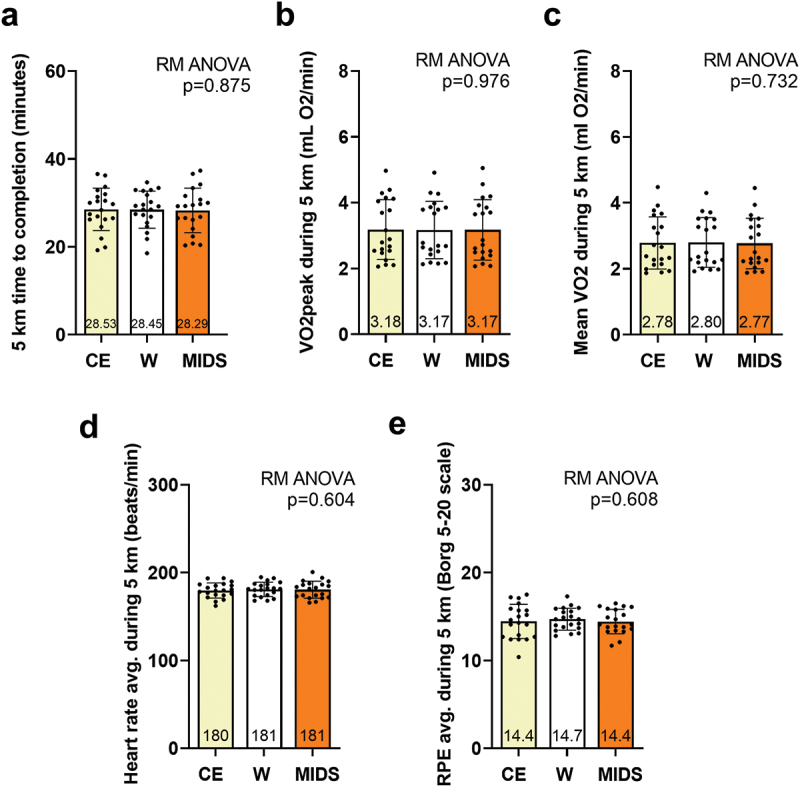
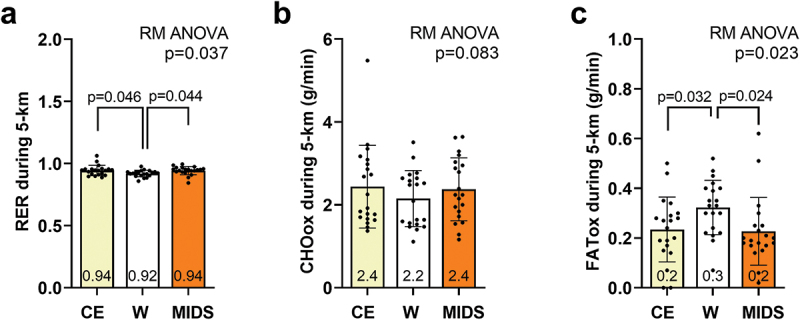
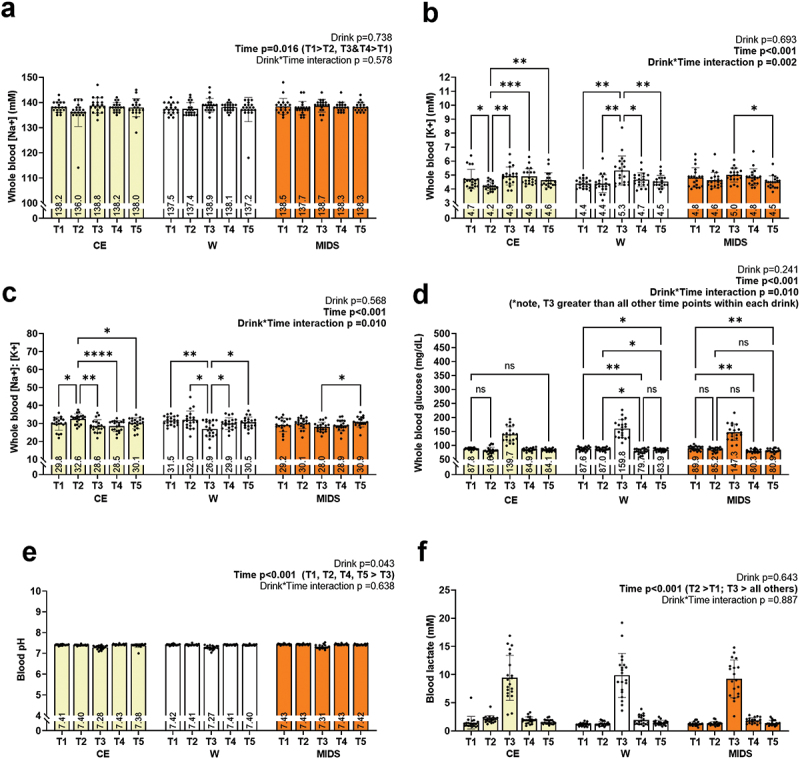
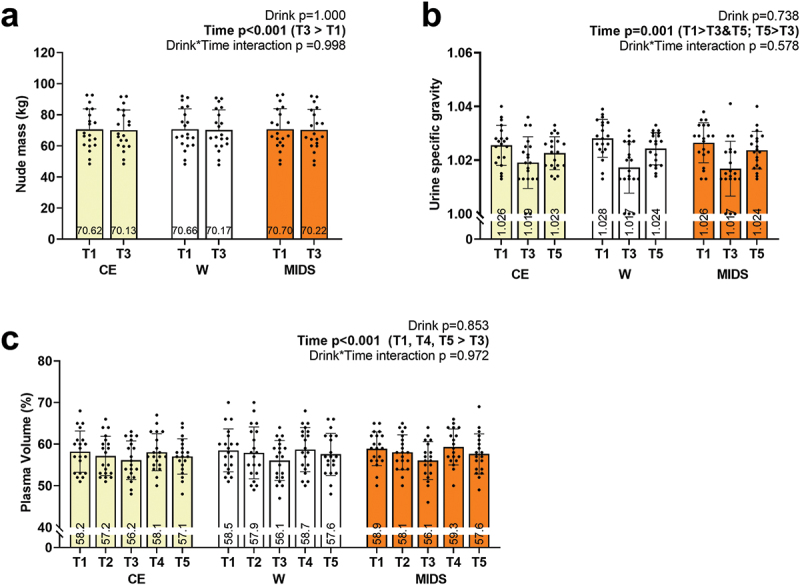
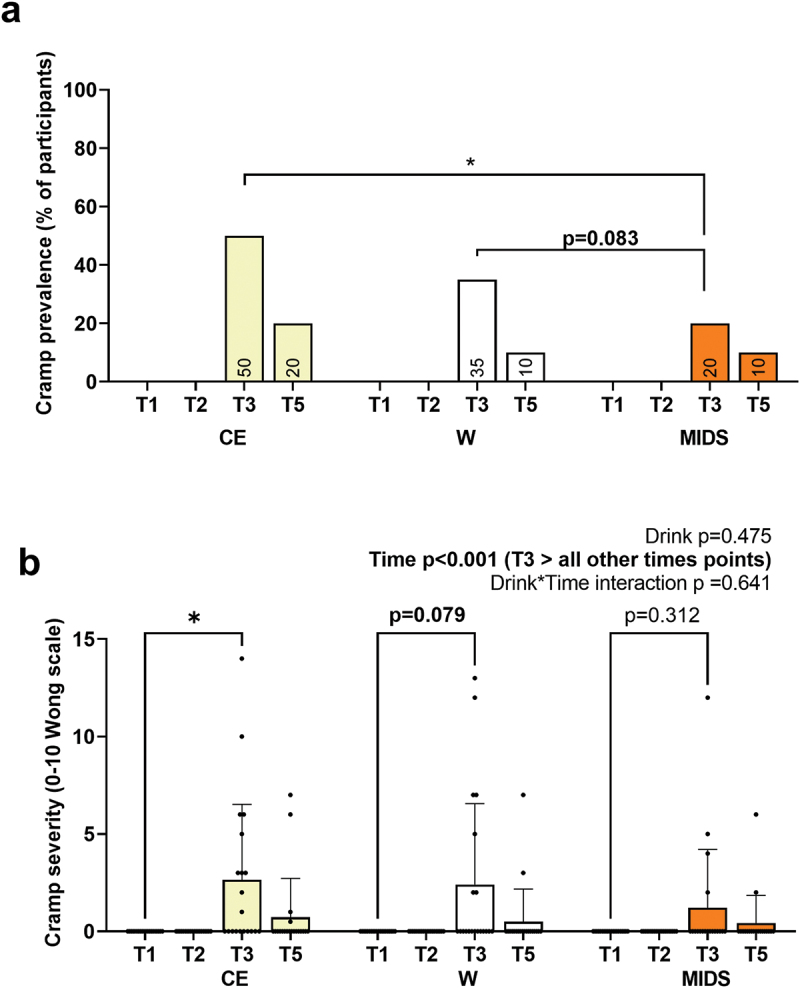
No differences occurred between conditions for 5-km time trial completion, indirect calorimetry outcomes during 5-km time trials, USG, or nude mass measurements ( > 0.05 for all relevant statistical tests). However, blood potassium and the sodium/potassium ratio displayed significant interactions ( < 0.05), and post hoc testing indicated these values were better maintained in the MIDS versus other conditions. Post-exercise cramp prevalence was greater in the CE ( < 0.05) and trended higher with W ( = 0.083) compared to the MIDS condition. Post-exercise cramp severity was also elevated with the W and CE beverages ( < 0.05) but not the MIDS ( = 0.211).

CONCLUSIONS

The MIDS did not affect 5-km time trial performance but exhibited favorable effects on blood electrolyte and post-exercise self-reporting cramp outcomes compared to the CE and W drinks.

摘要

目的

本研究旨在比较一种多成分、低热量膳食补充剂(MIDS,XTEND®健康补水)与碳水化合物-电解质饮料(CE,GATORADE®口渴终结者)和蒸馏水(W)对 5 公里(5-km)计时赛表现和血液电解质浓度的急性影响。

方法

在第一次访问(V1)中,参与者(10 名男性和 10 名女性,年龄 20-35 岁,BMI≤29kg/m,有规律的运动)报告至实验室,进行以下测试:i)身高和体重测量,ii)身体成分分析,iii)跑步机测试以测量最大有氧能力,iv)5-km 计时赛熟悉度。第二次访问(V2)在 V1 一周后的早上(0600-0900)进行,参与者禁食 12-14 小时(不进食或饮水)。第一次评估(V2-T1)包括裸体体重、尿比重(USG)、心境状态问卷(POMS)和视觉模拟量表(VAS)问卷,以量化抽筋。然后检查心率(HR)、血压(BP)、全身水合作用(通过生物电阻抗光谱法[BIS])。最后,通过手指穿刺进行血液标志物测量。参与者在 3 分钟内随机饮用一种饮料(MIDS 16 液盎司、W 16 液盎司或 CE 16 液盎司),然后休息 45 分钟。休息后,进行第二次评估(V2-T2),评估参与者的 USG,完成 POMS 和 VAS 问卷,测量 HR、BP 和血液标志物。然后,参与者进行 5 公里跑步机计时赛。计时赛结束后,参与者立即进行第三次测试(V2-T3),开始时进行血液标志物、HR 和 BP 评估,然后进行裸体体重评估,并进行 POMS 和 VAS 问卷。60 分钟后,进行第四次评估(V2-T4),包括 HR、BP 和血液标志物。安静坐 60 分钟后,进行第五次评估(V2-T5),包括参与者的 USG、POMS 和 VAS 问卷、HR、BP、血液标志物和全身水合作用。第三次访问(V3)和第四次访问(V4)遵循相同的方案,只是饮用不同的随机饮料(CE、MIDS 或 W 16 盎司);所有这些都间隔大约一周。

结果

在 5-km 计时赛完成、5-km 计时赛期间的间接测热结果、USG 或裸体体重测量方面,条件之间没有差异(所有相关统计检验均>0.05)。然而,血钾和钠/钾比值显示出显著的相互作用(<0.05),事后检验表明 MIDS 与其他条件相比,这些值得到了更好的维持。CE(<0.05)和 W 饮料(=0.083)的运动后抽筋发生率较高,与 MIDS 条件相比,运动后抽筋的严重程度也较高(<0.05)。

结论

MIDS 不会影响 5-km 计时赛表现,但与 CE 和 W 饮料相比,对血液电解质和运动后自我报告的抽筋结果有有利影响。
https://cdn.ncbi.nlm.nih.gov/pmc/blobs/7a10/10763896/dd8717d00564/RSSN_A_2296888_F0009_OC.jpg
https://cdn.ncbi.nlm.nih.gov/pmc/blobs/7a10/10763896/305bc4181a4f/RSSN_A_2296888_F0001_OC.jpg
https://cdn.ncbi.nlm.nih.gov/pmc/blobs/7a10/10763896/abc9a5e8d438/RSSN_A_2296888_F0002_OC.jpg
https://cdn.ncbi.nlm.nih.gov/pmc/blobs/7a10/10763896/be72208d64b3/RSSN_A_2296888_F0003_OC.jpg
https://cdn.ncbi.nlm.nih.gov/pmc/blobs/7a10/10763896/095acea36157/RSSN_A_2296888_F0004_OC.jpg
https://cdn.ncbi.nlm.nih.gov/pmc/blobs/7a10/10763896/7ff216195b55/RSSN_A_2296888_F0005_OC.jpg
https://cdn.ncbi.nlm.nih.gov/pmc/blobs/7a10/10763896/fa4120ca580d/RSSN_A_2296888_F0006_OC.jpg
https://cdn.ncbi.nlm.nih.gov/pmc/blobs/7a10/10763896/ee1589a348ac/RSSN_A_2296888_F0007_OC.jpg
https://cdn.ncbi.nlm.nih.gov/pmc/blobs/7a10/10763896/41b615b7f9b0/RSSN_A_2296888_F0008_OC.jpg
https://cdn.ncbi.nlm.nih.gov/pmc/blobs/7a10/10763896/dd8717d00564/RSSN_A_2296888_F0009_OC.jpg
https://cdn.ncbi.nlm.nih.gov/pmc/blobs/7a10/10763896/305bc4181a4f/RSSN_A_2296888_F0001_OC.jpg
https://cdn.ncbi.nlm.nih.gov/pmc/blobs/7a10/10763896/abc9a5e8d438/RSSN_A_2296888_F0002_OC.jpg
https://cdn.ncbi.nlm.nih.gov/pmc/blobs/7a10/10763896/be72208d64b3/RSSN_A_2296888_F0003_OC.jpg
https://cdn.ncbi.nlm.nih.gov/pmc/blobs/7a10/10763896/095acea36157/RSSN_A_2296888_F0004_OC.jpg
https://cdn.ncbi.nlm.nih.gov/pmc/blobs/7a10/10763896/7ff216195b55/RSSN_A_2296888_F0005_OC.jpg
https://cdn.ncbi.nlm.nih.gov/pmc/blobs/7a10/10763896/fa4120ca580d/RSSN_A_2296888_F0006_OC.jpg
https://cdn.ncbi.nlm.nih.gov/pmc/blobs/7a10/10763896/ee1589a348ac/RSSN_A_2296888_F0007_OC.jpg
https://cdn.ncbi.nlm.nih.gov/pmc/blobs/7a10/10763896/41b615b7f9b0/RSSN_A_2296888_F0008_OC.jpg
https://cdn.ncbi.nlm.nih.gov/pmc/blobs/7a10/10763896/dd8717d00564/RSSN_A_2296888_F0009_OC.jpg

相似文献

1
The effects of a sugar-free amino acid-containing electrolyte beverage on 5-kilometer performance, blood electrolytes, and post-exercise cramping versus a conventional carbohydrate-electrolyte sports beverage and water.无糖含氨基酸电解质饮料对 5 公里运动表现、血液电解质和运动后抽筋的影响与传统碳水化合物电解质运动饮料和水的对比。
J Int Soc Sports Nutr. 2024 Dec;21(1):2296888. doi: 10.1080/15502783.2023.2296888. Epub 2023 Dec 22.
2
An amino acid-electrolyte beverage may increase cellular rehydration relative to carbohydrate-electrolyte and flavored water beverages.相对于碳水化合物-电解质饮料和调味水饮料,氨基酸-电解质饮料可能会增强细胞水合作用。
Nutr J. 2014 May 26;13:47. doi: 10.1186/1475-2891-13-47.
3
The Beverage Hydration Index: Influence of Electrolytes, Carbohydrate and Protein.饮料水合指数:电解质、碳水化合物和蛋白质的影响。
Nutrients. 2021 Aug 25;13(9):2933. doi: 10.3390/nu13092933.
4
Effect of a carbohydrate-electrolyte beverage, lemon tea, or water on rehydration during short-term recovery from exercise.运动后短期恢复期内饮用碳水化合物-电解质饮料、柠檬茶还是水对补液的影响。
Int J Sport Nutr Exerc Metab. 2011 Aug;21(4):300-10. doi: 10.1123/ijsnem.21.4.300.
5
Impact of Nuun Electrolyte Tablets on Fluid Balance in Active Men and Women.运动男女体液平衡中润力电解质片的影响。
Nutrients. 2020 Oct 2;12(10):3030. doi: 10.3390/nu12103030.
6
Effects of isomaltulose ingestion on postexercise hydration state and heat loss responses in young men.异麦芽酮糖醇摄入对年轻男性运动后水合状态及散热反应的影响。
Exp Physiol. 2019 Oct;104(10):1494-1504. doi: 10.1113/EP087843. Epub 2019 Aug 26.
7
Comparing the rehydration potential of different milk-based drinks to a carbohydrate-electrolyte beverage.比较不同乳基饮品与碳水化合物电解质饮料的补液潜力。
Appl Physiol Nutr Metab. 2014 Dec;39(12):1366-72. doi: 10.1139/apnm-2014-0174. Epub 2014 Aug 14.
8
A metered intake of milk following exercise and thermal dehydration restores whole-body net fluid balance better than a carbohydrate-electrolyte solution or water in healthy young men.对于健康的年轻男性,运动及热脱水后定量摄入牛奶比摄入碳水化合物电解质溶液或水能更好地恢复全身净水平衡。
Br J Nutr. 2016 Sep;116(6):1013-21. doi: 10.1017/S0007114516002907. Epub 2016 Aug 1.
9
Age-related differences in water and sodium handling after commercial hydration beverage ingestion.商业补液饮料摄入后与年龄相关的水和钠处理差异。
J Appl Physiol (1985). 2019 Apr 1;126(4):1042-1048. doi: 10.1152/japplphysiol.01094.2018. Epub 2019 Feb 14.
10
The Effect of Ad Libitum Consumption of a Milk-Based Liquid Meal Supplement vs. a Traditional Sports Drink on Fluid Balance After Exercise.随意饮用乳基流食补充剂与传统运动饮料对运动后水平衡的影响。
Int J Sport Nutr Exerc Metab. 2016 Aug;26(4):347-55. doi: 10.1123/ijsnem.2015-0229. Epub 2015 Dec 16.

引用本文的文献

1
Hydration Strategies in Older Adults.老年人的水合作用策略
Nutrients. 2025 Jul 8;17(14):2256. doi: 10.3390/nu17142256.
2
Consumption of a Branched-Chain Amino Acids-Containing Sports Beverage During 21 km of Running Reduces Dehydration, Lowers Muscle Damage, and Prevents a Decline in Lower Limb Strength.在 21 公里跑步过程中饮用含支链氨基酸的运动饮料可减少脱水、降低肌肉损伤,并防止下肢力量下降。
Nutrients. 2024 Nov 5;16(22):3799. doi: 10.3390/nu16223799.

本文引用的文献

1
Effect of Glycerol-Induced Hyperhydration on a 5-kilometer Running Time-Trial Performance in the Heat in Recreationally Active Individuals.甘油诱导性水合过度对热环境中业余运动者 5 公里跑步计时赛成绩的影响。
Nutrients. 2023 Jan 24;15(3):599. doi: 10.3390/nu15030599.
2
Physiological Benefits and Performance of Sea Water Ingestion for Athletes in Endurance Events: A Systematic Review.海水中摄取对耐力项目运动员的生理益处和表现:系统综述。
Nutrients. 2022 Nov 2;14(21):4609. doi: 10.3390/nu14214609.
3
The influence of caffeinated and non-caffeinated multi-ingredient pre-workout supplements on resistance exercise performance and subjective outcomes.
含咖啡因和不含咖啡因的多种成分的健身前补剂对抗阻运动表现和主观结果的影响。
J Int Soc Sports Nutr. 2022 Apr 4;19(1):126-149. doi: 10.1080/15502783.2022.2060048. eCollection 2022.
4
Amino Acids and Their Metabolites for Improving Human Exercising Performance.氨基酸及其代谢产物在提高人体运动表现中的作用。
Adv Exp Med Biol. 2021;1332:151-166. doi: 10.1007/978-3-030-74180-8_9.
5
Revised Short Screening Version of the Profile of Mood States (POMS) From the German General Population.来自德国普通人群的情绪状态量表(POMS)修订短筛版本。
Front Psychol. 2021 May 31;12:631668. doi: 10.3389/fpsyg.2021.631668. eCollection 2021.
6
Muscle Glycogen Phosphorylase and Its Functional Partners in Health and Disease.肌肉糖原磷酸化酶及其在健康和疾病中的功能伙伴。
Cells. 2021 Apr 13;10(4):883. doi: 10.3390/cells10040883.
7
Trait Energy and Fatigue Modify the Effects of Caffeine on Mood, Cognitive and Fine-Motor Task Performance: A Post-Hoc Study.特质能量和疲劳度改变咖啡因对情绪、认知和精细运动任务表现的影响:一项事后研究。
Nutrients. 2021 Jan 28;13(2):412. doi: 10.3390/nu13020412.
8
Reviewing the current methods of assessing hydration in athletes.回顾目前评估运动员水分状态的方法。
J Int Soc Sports Nutr. 2020 Oct 30;17(1):52. doi: 10.1186/s12970-020-00381-6.
9
Effects of Three Modest Levels of Proximal Loading on Marathon Pace Running Economy.三种适度近端负荷水平对马拉松配速跑经济性的影响。
Int J Exerc Sci. 2020 Sep 1;13(7):1120-1131. doi: 10.70252/XIQU5513. eCollection 2020.
10
Correction: Sodium/potassium ratio change was associated with blood pressure change: possibility of population approach for sodium/potassium ratio reduction in health checkup.更正:钠/钾比值变化与血压变化相关:在健康体检中降低钠/钾比值的群体方法的可能性。
Hypertens Res. 2021 Feb;44(2):262. doi: 10.1038/s41440-020-00547-4.