School of Human Sciences, The University of Western Australia, Crawley 6009, Australia.
School of Molecular Sciences, The University of Western Australia, Crawley 6009, Australia.
Mol Biol Cell. 2020 Jul 21;31(16):1654-1662. doi: 10.1091/mbc.E20-02-0097. Epub 2020 Apr 15.
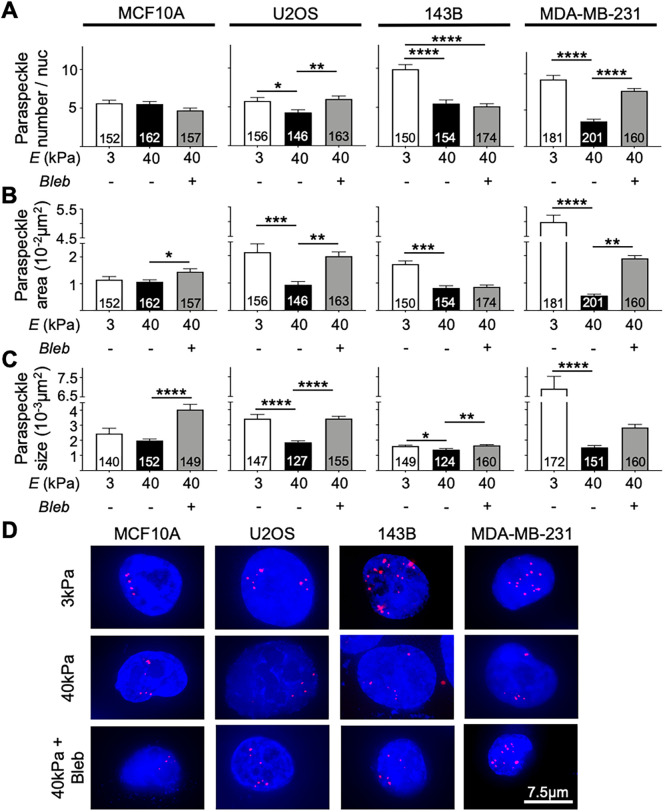
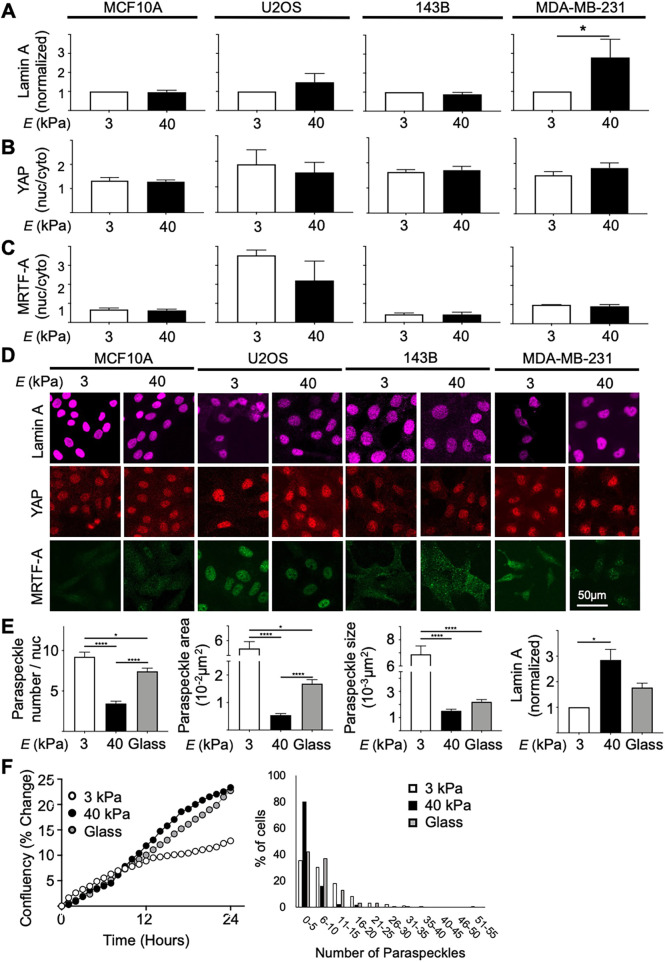
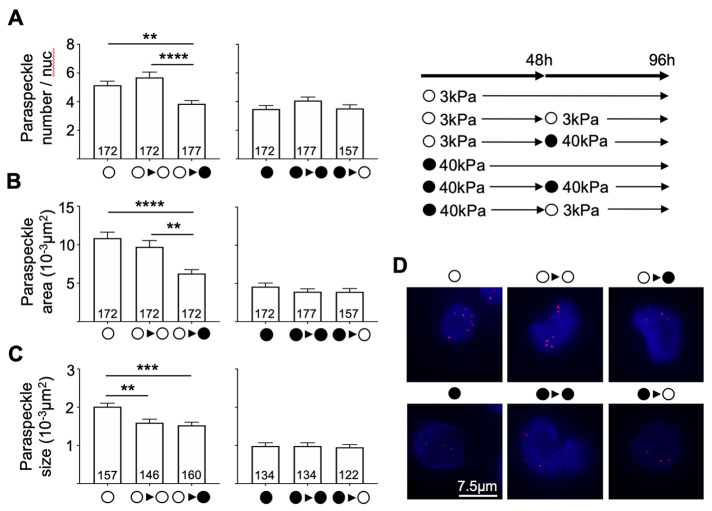
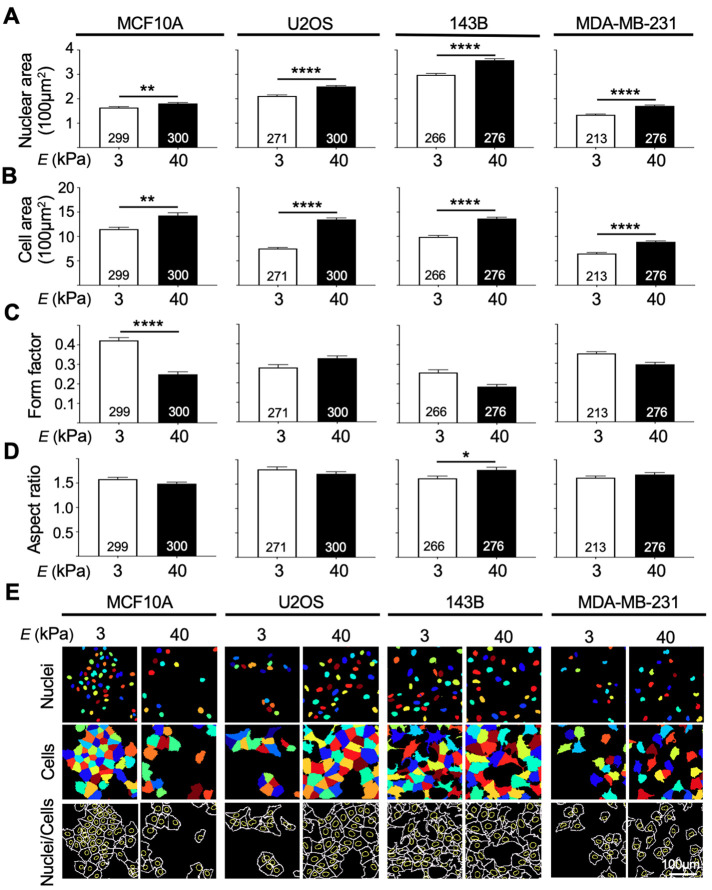
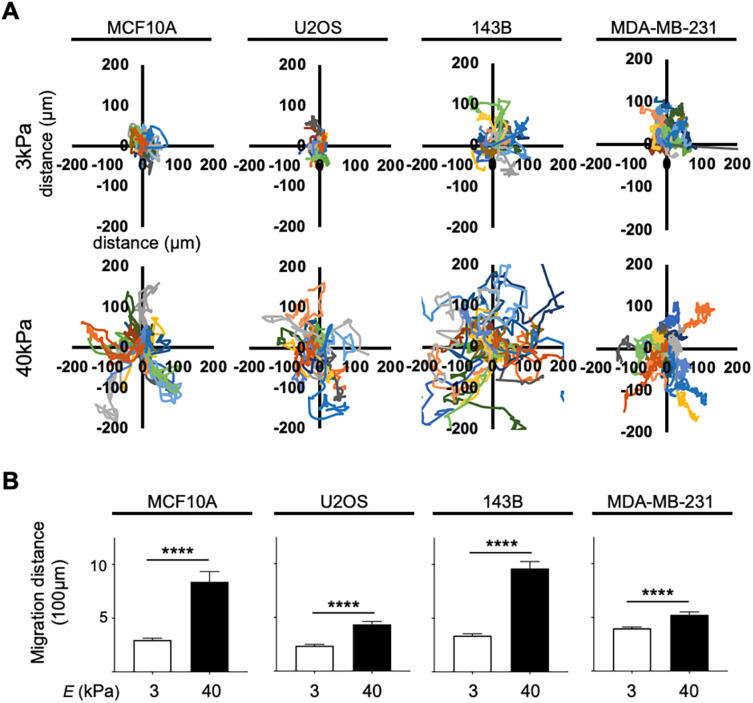
Cancer progression is influenced by changes in the tumor microenvironment, such as the stiffening of the extracellular matrix. Yet our understanding of how cancer cells sense and convert mechanical stimuli into biochemical signals and physiological responses is still limited. The long noncoding RNA nuclear paraspeckle assembly transcript 1 (NEAT1), which forms the backbone of subnuclear "paraspeckle" bodies, has been identified as a key genetic regulator in numerous cancers. Here, we investigated whether paraspeckles, as defined by NEAT1 localization, are mechanosensitive. Using tunable polyacrylamide hydrogels of extreme stiffnesses, we measured paraspeckle parameters in several cancer cell lines and observed an increase in paraspeckles in cells cultured on soft (3 kPa) hydrogels compared with stiffer (40 kPa) hydrogels. This response to soft substrate is erased when cells are first conditioned on stiff substrate, and then transferred onto soft hydrogels, suggestive of mechanomemory upstream of paraspeckle regulation. We also examined some well-characterized mechanosensitive markers, but found that lamin A expression, as well as YAP and MRTF-A nuclear translocation did not show consistent trends between stiffnesses, despite all cell types having increased migration, nuclear, and cell area on stiffer hydrogels. We thus propose that paraspeckles may prove of use as mechanosensors in cancer mechanobiology.
肿瘤微环境的改变,如细胞外基质的变硬,会影响癌症的进展。然而,我们对于癌细胞如何感知并将机械刺激转化为生化信号和生理反应的理解仍然有限。长链非编码 RNA 核斑蛋白组装转录本 1(NEAT1)形成核“斑蛋白”体的骨架,已被确定为许多癌症中的关键遗传调控因子。在这里,我们研究了斑蛋白(由 NEAT1 定位定义)是否对机械刺激敏感。我们使用可调聚丙稀酰胺水凝胶的极高硬度,测量了几种癌细胞系中的斑蛋白参数,并观察到在软(3 kPa)水凝胶上培养的细胞中的斑蛋白增加,而在硬(40 kPa)水凝胶上培养的细胞则减少。当细胞首先在硬基底上适应,然后转移到软水凝胶上时,这种对软基底的反应就会消失,这表明斑蛋白调节的上游存在机械记忆。我们还检查了一些特征明确的机械敏感标记物,但发现尽管所有细胞类型在硬水凝胶上的迁移、核和细胞面积都增加了,但层粘连蛋白 A 的表达以及 YAP 和 MRTF-A 的核转位并没有表现出一致的硬度趋势。因此,我们提出斑蛋白可能是癌症机械生物学中有用的机械感受器。