Department of Epidemiology and Biostatistics, West China School of Public Health and West China Fourth Hospital, Sichuan University, #16, Section 3, Renmin Nan Lu, Chengdu, Sichuan, 610041, People's Republic of China.
Department of Ophthalmology, West China Hospital, Sichuan University, Chengdu, China.
BMC Ophthalmol. 2020 Apr 15;20(1):146. doi: 10.1186/s12886-020-01410-3.
The prevalence of myopia and associated risk factors among children in Chongqing has not yet been determined. This study investigated the prevalence of myopia and possible relationships between myopia and several related factors among school children in Chongqing.
This cross-sectional study assessed a sample of 997 children (7-13 years of age) attending primary school in Chongqing. Data were obtained from visual acuity and refractive error measurements and a structured questionnaire. Myopia was defined as visual acuity < 5.0 and refractive error (spherical equivalent) of < - 0.50 diopters (D) in either eye. Multilevel modeling was applied to investigate potential risk factors.
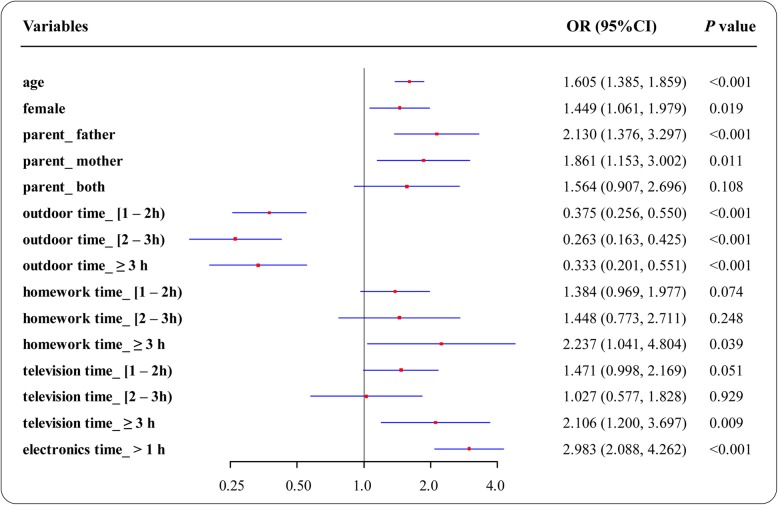
The overall prevalence of myopia was 33.9% [95% confidence interval (CI) = 31.0-36.8]; myopia prevalence significantly increased with age. Girls were at a higher risk of myopia than boys [odds ratio (OR) = 1.449, 95% CI = 1.060-1.979]. Children with paternal myopia (OR = 2.130, 95% CI = 1.376-3.297) or maternal myopia (OR = 1.861, 95% CI =1.153-3.002) had a higher risk of myopia than those without myopic parents. Children who spent more than 1 h daily outdoors were less likely to have myopia; meanwhile, children who did homework more than 3 h daily (OR = 2.237, 95% CI = 1.041-4.804), watched television more than 3 h daily (OR = 2.106, 95% CI = 1.200-3.697), or played electronics more than 1 h daily (OR = 2.983, 95% CI = 2.088-4.262) had a higher risk of myopia.
Myopia in school children is a serious public health problem in Chongqing. Myopia was significantly positively associated with higher age, female sex, parental myopia, and spending a long time indoors; notably, playing with electronics had the greatest influence on the risk of myopia.
重庆地区儿童近视的患病率及其相关危险因素尚未确定。本研究旨在调查重庆地区学龄儿童近视的患病率及其与近视相关的多种因素之间的关系。
这是一项横断面研究,共评估了 997 名来自重庆地区小学的 7-13 岁儿童。通过视力和屈光不正测量以及结构化问卷收集数据。近视定义为双眼视力<5.0 且等效球镜(球镜度数与柱镜度数的代数和)<-0.50 屈光度(D)。采用多水平模型分析潜在的危险因素。
总体近视患病率为 33.9%(95%置信区间:31.0%-36.8%);近视患病率随年龄增长而显著增加。与男生相比,女生近视的风险更高(优势比[OR]:1.449,95%置信区间[CI]:1.060-1.979)。父母一方或双方近视的儿童(OR:2.130,95% CI:1.376-3.297)比父母无近视的儿童发生近视的风险更高。每天户外活动时间超过 1 小时的儿童近视的风险较低;而每天做作业超过 3 小时(OR:2.237,95% CI:1.041-4.804)、每天看电视超过 3 小时(OR:2.106,95% CI:1.200-3.697)或每天玩电子设备超过 1 小时(OR:2.983,95% CI:2.088-4.262)的儿童发生近视的风险更高。
近视是重庆地区学龄儿童面临的严重公共卫生问题。近视与年龄较大、女性、父母近视和室内时间长显著正相关;值得注意的是,玩电子设备对近视风险的影响最大。