• 文献检索
  • 文档翻译
  • 深度研究
  • 学术资讯
  • Suppr Zotero 插件Zotero 插件
  • 邀请有礼
  • 套餐&价格
  • 历史记录
应用&插件
Suppr Zotero 插件Zotero 插件浏览器插件Mac 客户端Windows 客户端微信小程序
定价
高级版会员购买积分包购买API积分包
服务
文献检索文档翻译深度研究API 文档MCP 服务
关于我们
关于 Suppr公司介绍联系我们用户协议隐私条款
关注我们

Suppr 超能文献

核心技术专利:CN118964589B侵权必究
粤ICP备2023148730 号-1Suppr @ 2026

文献检索

告别复杂PubMed语法,用中文像聊天一样搜索,搜遍4000万医学文献。AI智能推荐,让科研检索更轻松。

立即免费搜索

文件翻译

保留排版,准确专业,支持PDF/Word/PPT等文件格式,支持 12+语言互译。

免费翻译文档

深度研究

AI帮你快速写综述,25分钟生成高质量综述,智能提取关键信息,辅助科研写作。

立即免费体验

屈光不正的患病率及危险因素:中国云南汉族和彝族成年人的横断面研究

Prevalence and risk factors of refractive error: a cross-sectional Study in Han and Yi adults in Yunnan, China.

作者信息

Wang Meng, Cui Jiantao, Shan Guangliang, Peng Xia, Pan Li, Yan Zhimei, Zhang Jie, Zhong Yong, Ma Jin

机构信息

Department of Ophthalmology, Peking Union Medical College Hospital, Chinese Academy of Medical Sciences & Peking Union Medical College, No. 1 Shuaifu Yuan, Dongcheng District, Beijing, 100730, China.

School of Medicine, Tsinghua University, Beijing, China.

出版信息

BMC Ophthalmol. 2019 Jan 25;19(1):33. doi: 10.1186/s12886-019-1042-0.

DOI:10.1186/s12886-019-1042-0
PMID:30683073
原文链接:https://pmc.ncbi.nlm.nih.gov/articles/PMC6347814/
Abstract

BACKGROUND

Few studies have investigated the prevalence of refractive error (RE) in older adults in China, and most have focused on East China. Our study determined the prevalence and risk factors of RE in Han and Yi adults aged 40-80 years in rural and urban areas in Yunnan Province, Southwest China.

METHODS

Our cross-sectional study is part of the China National Health Survey (CNHS). The age-adjusted prevalence rates of RE in Han and Yi adults aged 40-80 years in Yunnan were compared. We used a multivariate logistic regression model to identify risk factors for myopia and hyperopia.

RESULTS

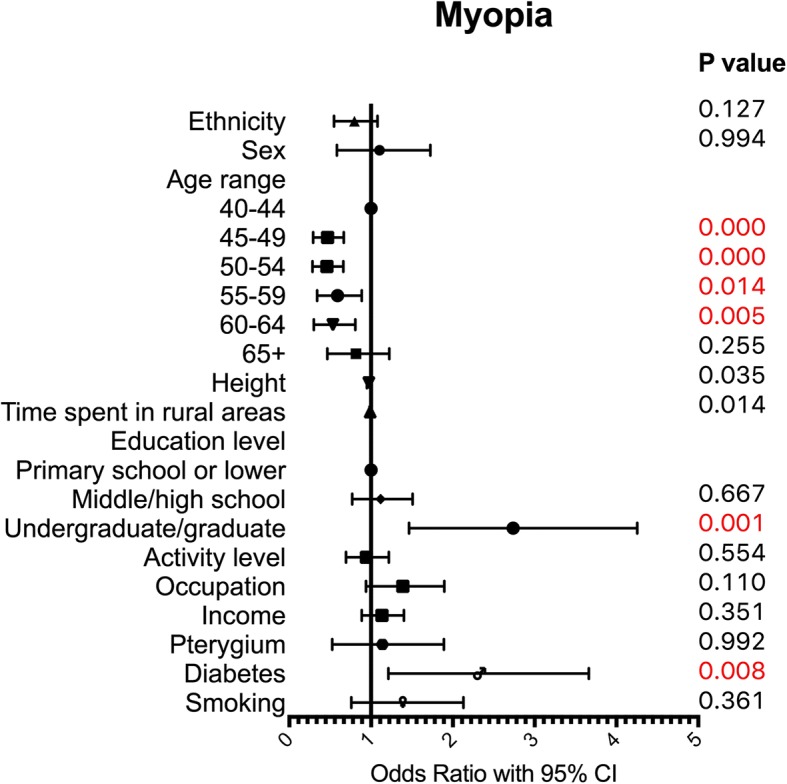
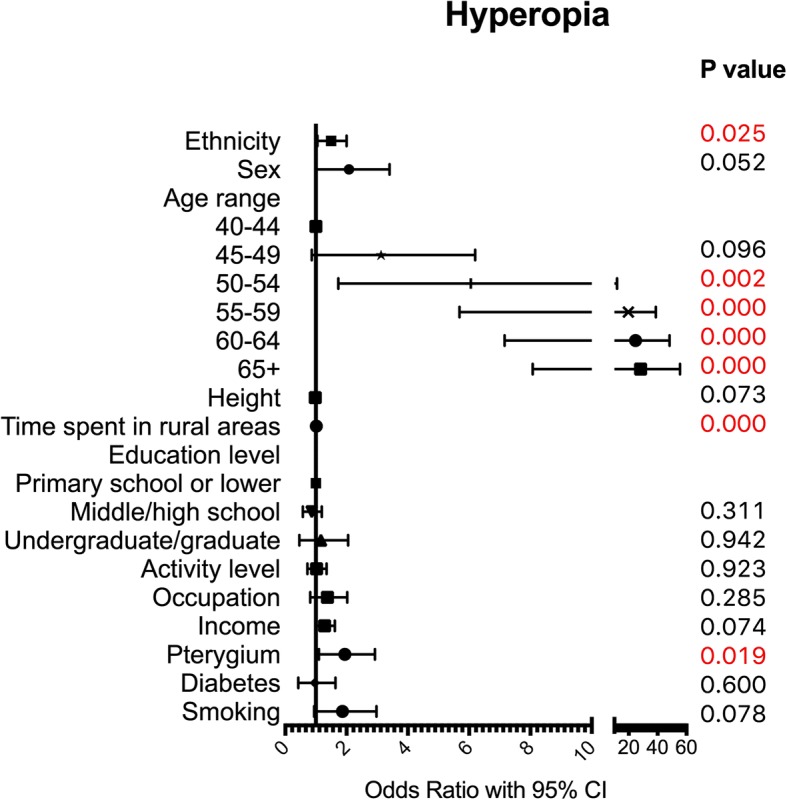
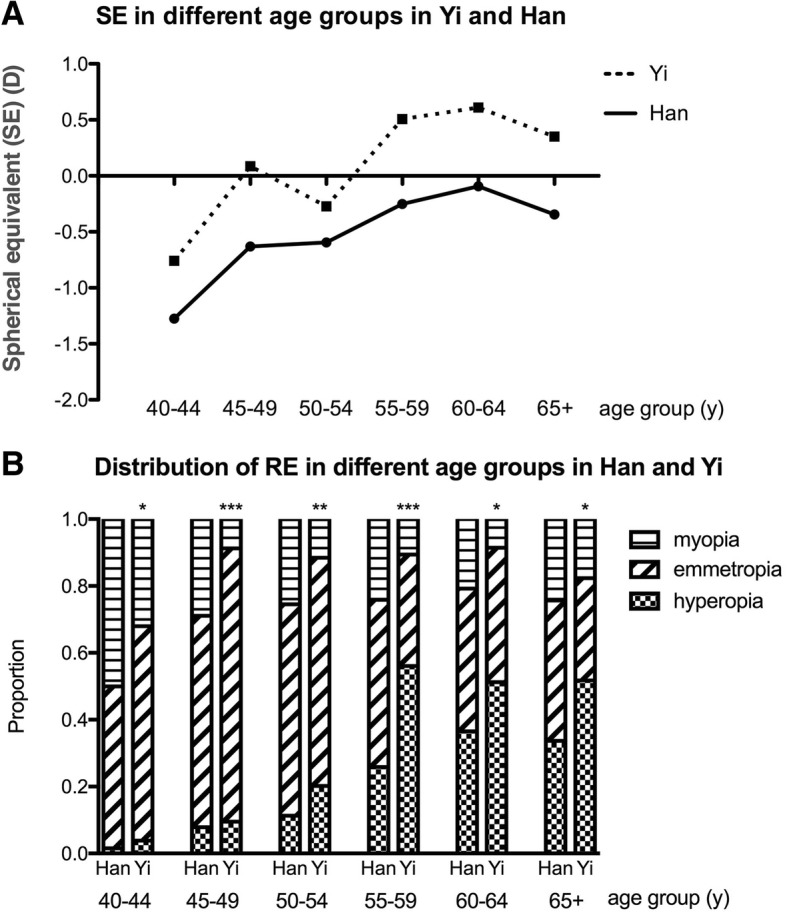
Among 1626 participants, the age-adjusted prevalence rates of myopia, hyperopia, high myopia and astigmatism were 26.35% (95%CI 24.01-28.70%), 19.89% (95%CI 18.16-21.61%), 2.64% (95%CI 1.75-3.53%), and 56.82% (95%CI 54.31-59.34%). Compared to the Yi population, the Han population had higher prevalence of myopia (31.50% vs 16.80%, p < 0.0001), high myopia (3.34% vs 1.31%, p = 0.049) and astigmatism (60.07% vs 50.67%, p = 0.026) but lower prevalence of hyperopia (16.58% vs 27.37%, p < 0.0001). In the multivariate logistic regression, individuals aged 45-49 (p < 0.001), 50-54 (p < 0.001), 55-59 (p = 0.014), and 60-64 years (p = 0.005) had a lower myopia risk than those aged 40-44 years, and individuals aged 50-54 (p = 0.002), 55-59, 60-64 and 65 years and older (all p < 0.001) had a higher hyperopia risk than those aged 40-44 years. Myopia was also associated with height (p = 0.035), time spent in rural areas (p = 0.014), undergraduate/graduate education level (p = 0.001, compared with primary school or lower education level) and diabetes (p = 0.008). The Yi population had a higher risk of hyperopia than the Han population (p = 0.025). Moreover, hyperopia was related to time spent in rural areas (p < 0.001) and pterygium (p = 0.019).

CONCLUSIONS

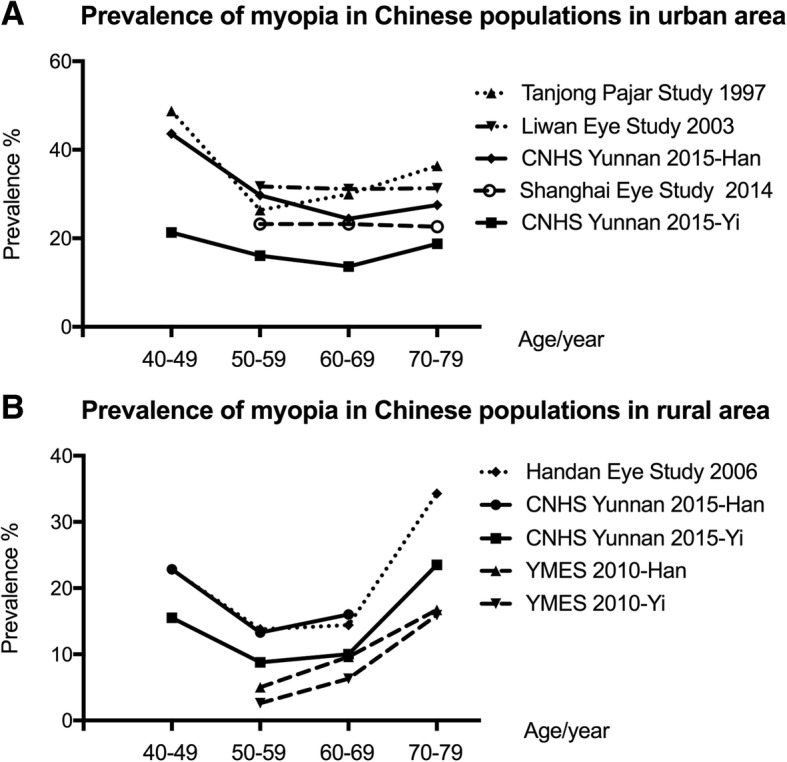
Our study investigated the overall prevalence of RE in older adults in rural and urban areas of Southwest China. Compared to the Yi population, the Han population had a higher prevalence of myopia, high myopia and astigmatism but a lower risk of hyperopia. The prevalence of myopia in the Han population in underdeveloped Southwest China was similar to that of residents in East China or of Chinese Singaporeans under urban or rural settings.

摘要

背景

很少有研究调查中国老年人屈光不正(RE)的患病率,且大多数研究集中在中国东部地区。我们的研究确定了中国西南部云南省农村和城市地区40 - 80岁汉族和彝族成年人中RE的患病率及危险因素。

方法

我们的横断面研究是中国国家健康调查(CNHS)的一部分。比较了云南省40 - 80岁汉族和彝族成年人中年龄调整后的RE患病率。我们使用多因素逻辑回归模型来确定近视和远视的危险因素。

结果

在1626名参与者中,年龄调整后的近视、远视、高度近视和散光患病率分别为26.35%(95%CI 24.01 - 28.70%)、19.89%(95%CI 18.16 - 21.61%)、2.64%(95%CI 1.75 - 3.53%)和56.82%(95%CI 54.31 - 59.34%)。与彝族人群相比,汉族人群近视(31.50%对16.80%,p < 0.0001)、高度近视(3.34%对1.31%,p = 0.049)和散光(60.07%对50.67%,p = 0.026)的患病率较高,但远视患病率较低(16.58%对27.37%,p < 0.0001)。在多因素逻辑回归中,45 - 49岁(p < 0.001)、50 - 54岁(p < 0.001)、55 - 59岁(p = 0.014)和60 - 64岁(p = 0.005)的个体近视风险低于40 - 44岁的个体,50 - 54岁(p = 0.002)、55 - 59岁、60 - 64岁和65岁及以上(所有p < 0.001)的个体远视风险高于40 - 44岁的个体。近视还与身高(p = 0.035)、在农村地区的时间(p = 0.014)、本科/研究生教育水平(p = 0.001,与小学或更低教育水平相比)和糖尿病(p = 0.008)有关。彝族人群远视风险高于汉族人群(p = 0.025)。此外,远视与在农村地区花费的时间(p < 0.001)和翼状胬肉(p = 0.019)有关。

结论

我们的研究调查了中国西南部农村和城市地区老年人RE的总体患病率。与彝族人群相比,汉族人群近视、高度近视和散光的患病率较高,但远视风险较低。中国西南部欠发达地区汉族人群的近视患病率与中国东部地区居民或城乡环境下的新加坡华人相似。
https://cdn.ncbi.nlm.nih.gov/pmc/blobs/faa8/6347814/306b840b4ea9/12886_2019_1042_Fig4_HTML.jpg
https://cdn.ncbi.nlm.nih.gov/pmc/blobs/faa8/6347814/0c5a2dd504f3/12886_2019_1042_Fig1_HTML.jpg
https://cdn.ncbi.nlm.nih.gov/pmc/blobs/faa8/6347814/1a83cbfbbd4c/12886_2019_1042_Fig2_HTML.jpg
https://cdn.ncbi.nlm.nih.gov/pmc/blobs/faa8/6347814/a58767c57832/12886_2019_1042_Fig3_HTML.jpg
https://cdn.ncbi.nlm.nih.gov/pmc/blobs/faa8/6347814/306b840b4ea9/12886_2019_1042_Fig4_HTML.jpg
https://cdn.ncbi.nlm.nih.gov/pmc/blobs/faa8/6347814/0c5a2dd504f3/12886_2019_1042_Fig1_HTML.jpg
https://cdn.ncbi.nlm.nih.gov/pmc/blobs/faa8/6347814/1a83cbfbbd4c/12886_2019_1042_Fig2_HTML.jpg
https://cdn.ncbi.nlm.nih.gov/pmc/blobs/faa8/6347814/a58767c57832/12886_2019_1042_Fig3_HTML.jpg
https://cdn.ncbi.nlm.nih.gov/pmc/blobs/faa8/6347814/306b840b4ea9/12886_2019_1042_Fig4_HTML.jpg

相似文献

1
Prevalence and risk factors of refractive error: a cross-sectional Study in Han and Yi adults in Yunnan, China.屈光不正的患病率及危险因素:中国云南汉族和彝族成年人的横断面研究
BMC Ophthalmol. 2019 Jan 25;19(1):33. doi: 10.1186/s12886-019-1042-0.
2
Prevalence of and risk factors for refractive error: a cross-sectional study in Han and Mongolian adults aged 40-80 years in Inner Mongolia, China.屈光不正的患病率及危险因素:中国内蒙古40-80岁汉族和蒙古族成年人的横断面研究
Eye (Lond). 2019 Nov;33(11):1722-1732. doi: 10.1038/s41433-019-0469-0. Epub 2019 Jun 3.
3
Prevalence and risk factors of refractive error in Qinghai, China: a cross-sectional study in Han and Tibetan adults in Xining and surrounding areas.中国青海屈光不正的患病率及危险因素:西宁及周边地区汉族和藏族成年人的横断面研究。
BMC Ophthalmol. 2021 Jun 19;21(1):260. doi: 10.1186/s12886-021-01996-2.
4
Prevalence and risk factor for refractive error in rural Chinese adults in Kailu, Inner Mongolia.内蒙古开鲁农村成年人屈光不正的患病率及危险因素。
Ophthalmic Physiol Opt. 2021 Jan;41(1):13-20. doi: 10.1111/opo.12745. Epub 2020 Oct 26.
5
Prevalence and risk factors for refractive error in older adults in eight ethnicities in China: The China national health survey.中国八个民族老年人屈光不正的患病率及危险因素:中国国家健康调查
Heliyon. 2024 Aug 15;10(17):e36354. doi: 10.1016/j.heliyon.2024.e36354. eCollection 2024 Sep 15.
6
Population-based survey of refractive error among school-aged children in rural northern China: the Heilongjiang eye study.中国北方农村学龄儿童屈光不正的人群调查:黑龙江眼病研究
Clin Exp Ophthalmol. 2014 May-Jun;42(4):379-84. doi: 10.1111/ceo.12198. Epub 2013 Sep 10.
7
Refractive errors in a Brazilian population: age and sex distribution.巴西人群的屈光不正:年龄和性别分布
Ophthalmic Physiol Opt. 2015 Jan;35(1):19-27. doi: 10.1111/opo.12164. Epub 2014 Oct 24.
8
Refractive error among the elderly in rural Southern Harbin, China.中国哈尔滨南部农村老年人的屈光不正情况。
Ophthalmic Epidemiol. 2009 Nov-Dec;16(6):388-94. doi: 10.3109/09286580903312285.
9
Prevalence of refractive errors in Colombia: MIOPUR study.哥伦比亚屈光不正患病率调查:MIOPUR 研究。
Br J Ophthalmol. 2018 Oct;102(10):1320-1323. doi: 10.1136/bjophthalmol-2018-312149. Epub 2018 Jun 26.
10
Refractive errors in a rural Korean adult population: the Namil Study.韩国农村成年人的屈光不正:Namil 研究。
Eye (Lond). 2013 Dec;27(12):1368-75. doi: 10.1038/eye.2013.195. Epub 2013 Sep 13.

引用本文的文献

1
Comparison of spherical equivalent and estimated prevalence of myopia in school-age children between Shanghai and Yunnan in China.中国上海和云南学龄儿童等效球镜度及近视估计患病率的比较。
Front Med (Lausanne). 2025 May 14;12:1571470. doi: 10.3389/fmed.2025.1571470. eCollection 2025.
2
Global trends in refractive disorders from 1990 to 2021: insights from the global burden of disease study and predictive modeling.1990年至2021年屈光不正疾病的全球趋势:来自全球疾病负担研究和预测模型的见解
Front Public Health. 2025 Mar 26;13:1449607. doi: 10.3389/fpubh.2025.1449607. eCollection 2025.
3
Trends in prevalence and disability-adjusted life years for refractive disorders in China and globally from 1990 to 2021: an analysis of the Global Burden of Disease Study 2021.

本文引用的文献

1
Prevalence and risk factors for myopia in older adult east Chinese population.中国东部老年人群近视的患病率及危险因素
BMC Ophthalmol. 2017 Oct 13;17(1):191. doi: 10.1186/s12886-017-0574-4.
2
Refractive error in Chinese with type 2 diabetes and its association with glycaemic control.2型糖尿病中国患者的屈光不正及其与血糖控制的关联。
Clin Exp Optom. 2018 Mar;101(2):213-219. doi: 10.1111/cxo.12606. Epub 2017 Oct 3.
3
Six-year changes in refraction and related ocular biometric factors in an adult Chinese population.中国成年人群体中屈光及相关眼生物测量因素的六年变化
1990年至2021年中国及全球屈光不正疾病的患病率和伤残调整生命年趋势:全球疾病负担研究2021分析
Front Public Health. 2025 Feb 12;13:1517056. doi: 10.3389/fpubh.2025.1517056. eCollection 2025.
4
Association between myopia and sleep duration among primary school students in minority regions of Southwest China: a school-based cross-sectional research.中国西南少数民族地区小学生近视与睡眠时间的关系:基于学校的横断面研究。
BMJ Open. 2024 Nov 2;14(11):e083016. doi: 10.1136/bmjopen-2023-083016.
5
Prevalence and risk factors for refractive error in older adults in eight ethnicities in China: The China national health survey.中国八个民族老年人屈光不正的患病率及危险因素:中国国家健康调查
Heliyon. 2024 Aug 15;10(17):e36354. doi: 10.1016/j.heliyon.2024.e36354. eCollection 2024 Sep 15.
6
Prevalence of Refractive Errors Among Children at a Tertiary Care Center in Karnataka: A Cross-Sectional Study.卡纳塔克邦一家三级护理中心儿童屈光不正的患病率:一项横断面研究。
Cureus. 2024 Jun 11;16(6):e62172. doi: 10.7759/cureus.62172. eCollection 2024 Jun.
7
Prevalence of Refractive Errors Among Medical Students of Raichur Institute of Medical Sciences, Raichur, Karnataka, India.印度卡纳塔克邦赖丘尔市赖丘尔医学科学研究所医学生屈光不正的患病率
Cureus. 2024 Apr 24;16(4):e58915. doi: 10.7759/cureus.58915. eCollection 2024 Apr.
8
Prevalence and associated factors of refractive error among adults in South Ethiopia, a community-based cross-sectional study.埃塞俄比亚南部成年人屈光不正的患病率及相关因素:一项基于社区的横断面研究。
PLoS One. 2024 Mar 25;19(3):e0298960. doi: 10.1371/journal.pone.0298960. eCollection 2024.
9
Prevalence and risk factors for astigmatism in 7 to 19-year-old students in Xinjiang, China: a cross-sectional study.中国新疆 7 至 19 岁学生远视的患病率及其危险因素:一项横断面研究。
BMC Ophthalmol. 2024 Mar 13;24(1):116. doi: 10.1186/s12886-024-03382-0.
10
The Magnitude of Refractive Error and Its Associated Factors Among Patients Visiting Ophthalmology Clinics in Southern Ethiopia, 2022.2022年埃塞俄比亚南部眼科门诊患者的屈光不正程度及其相关因素
Clin Ophthalmol. 2023 Jun 23;17:1801-1811. doi: 10.2147/OPTH.S408610. eCollection 2023.
PLoS One. 2017 Aug 30;12(8):e0183364. doi: 10.1371/journal.pone.0183364. eCollection 2017.
4
An Ecologic Study of Trends in the Prevalence of Myopia in Chinese Adults in Singapore Born from the 1920s to 1980s.新加坡 20 世纪 20 年代至 80 年代出生的中国成年人近视患病率趋势的生态学研究。
Ann Acad Med Singap. 2017 Jun;46(6):229-236.
5
Association among activities of daily living, instrumental activities of daily living and health-related quality of life in elderly Yi ethnic minority.彝族老年人日常生活活动、工具性日常生活活动与健康相关生活质量之间的关联
BMC Geriatr. 2017 Mar 22;17(1):74. doi: 10.1186/s12877-017-0455-y.
6
Population data for 20 autosomal STR loci in the Yi ethnic minority from Yunnan Province, Southwest China.中国西南部云南省彝族20个常染色体STR基因座的群体数据。
Forensic Sci Int Genet. 2017 May;28:e43-e44. doi: 10.1016/j.fsigen.2017.02.017. Epub 2017 Mar 1.
7
The Relationship between Crystalline Lens Power and Refractive Error in Older Chinese Adults: The Shanghai Eye Study.中国老年人群晶状体屈光力与屈光不正的关系:上海眼病研究
PLoS One. 2017 Jan 23;12(1):e0170030. doi: 10.1371/journal.pone.0170030. eCollection 2017.
8
Five-year change in refraction and its ocular components in the 40- to 64-year-old population of the Shahroud eye cohort study.沙赫鲁德眼队列研究中40至64岁人群屈光及其眼部组成部分的五年变化
Clin Exp Ophthalmol. 2016 Nov;44(8):669-677. doi: 10.1111/ceo.12753. Epub 2016 Apr 29.
9
Risk Factors for Pterygium in Korea: The Korean National Health and Nutrition Examination Survey V, 2010-2012.韩国翼状胬肉的危险因素:2010 - 2012年韩国国家健康与营养检查调查V
Medicine (Baltimore). 2015 Aug;94(32):e1258. doi: 10.1097/MD.0000000000001258.
10
Ethnic variations in myopia and ocular biometry among adults in a rural community in China: the Yunnan minority eye studies.中国一个乡村社区成年人近视及眼生物测量的种族差异:云南少数民族眼研究
Invest Ophthalmol Vis Sci. 2015 May;56(5):3235-41. doi: 10.1167/iovs.14-16357.