Simon Jessica, Etienne Anne-Marie, Bouchard Stéphane, Quertemont Etienne
Psychology and Neuroscience of Cognition-PsyNCogn, University of Liège, Liège, Belgium.
Interfaculties Research Unit on Health and Society-URiSS, University of Liège, Liège, Belgium.
Front Hum Neurosci. 2020 Mar 31;14:124. doi: 10.3389/fnhum.2020.00124. eCollection 2020.
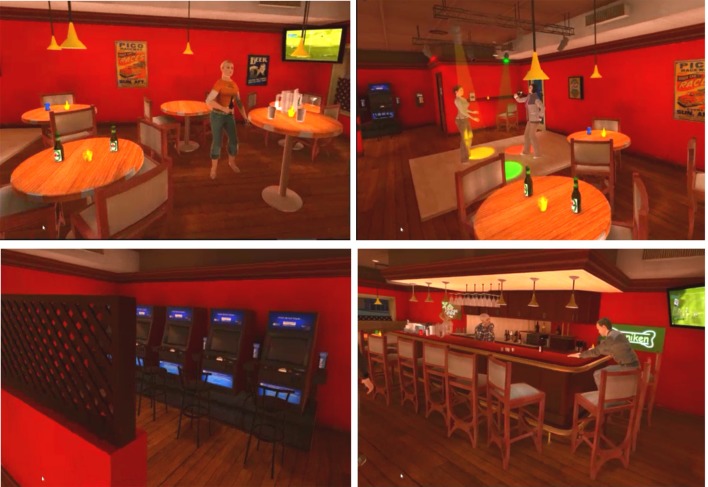
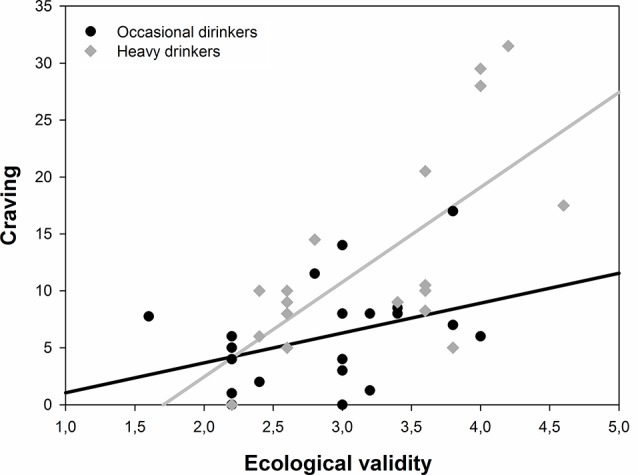
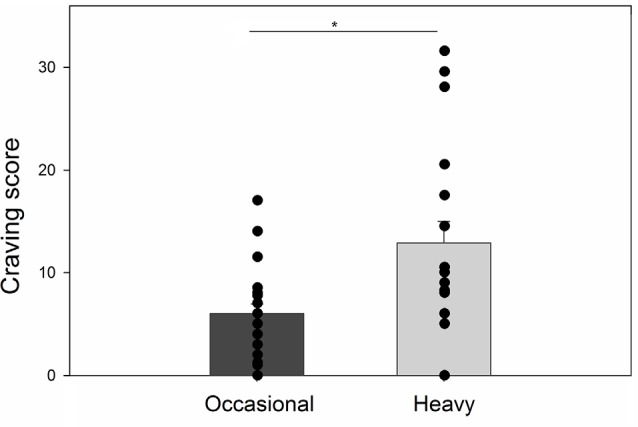
The development of new technologies, and more specifically the opportunity to immerse participants in virtual controlled environments, provides a new ecological framework for researchers to study complex behaviors. This experiment aimed to compare post-immersion craving in occasional and heavy alcohol drinkers. Twenty-two occasional drinkers and eighteen heavy drinkers were recruited and immersed in a virtual bar, including alcoholic beverages. After the exposure, heavy drinkers reported a significantly higher craving than occasional drinkers. Post-immersion alcohol craving was significantly related to the levels of perceived ecological validity of the virtual environment. Finally, a moderation analysis suggested that the levels of craving more strongly increased with perceived ecological validity in heavy drinkers than in occasional drinkers. Therefore, the perceived ecological validity was an important experimental parameter to study craving in a virtual environment. These results further suggested that virtual reality might be a useful tool for both the scientific study of alcohol addiction and the treatment of alcohol dependence and relapse.
新技术的发展,更具体地说是让参与者沉浸在虚拟可控环境中的机会,为研究人员研究复杂行为提供了一个新的生态框架。本实验旨在比较偶尔饮酒者和重度饮酒者在沉浸后的渴望程度。招募了22名偶尔饮酒者和18名重度饮酒者,并让他们沉浸在一个虚拟酒吧中,其中包括酒精饮料。暴露后,重度饮酒者报告的渴望程度明显高于偶尔饮酒者。沉浸后对酒精的渴望与对虚拟环境的感知生态效度水平显著相关。最后,一项调节分析表明,与偶尔饮酒者相比,重度饮酒者中渴望程度随感知生态效度的增加更为强烈。因此,感知生态效度是在虚拟环境中研究渴望的一个重要实验参数。这些结果进一步表明,虚拟现实可能是酒精成瘾科学研究以及酒精依赖和复发治疗的有用工具。