College of Pharmacy and Graduates School of Pharmaceutical Sciences, Ewha W. University, Seoul, Republic of Korea.
J Enzyme Inhib Med Chem. 2020 Dec;35(1):1045-1049. doi: 10.1080/14756366.2020.1754813.
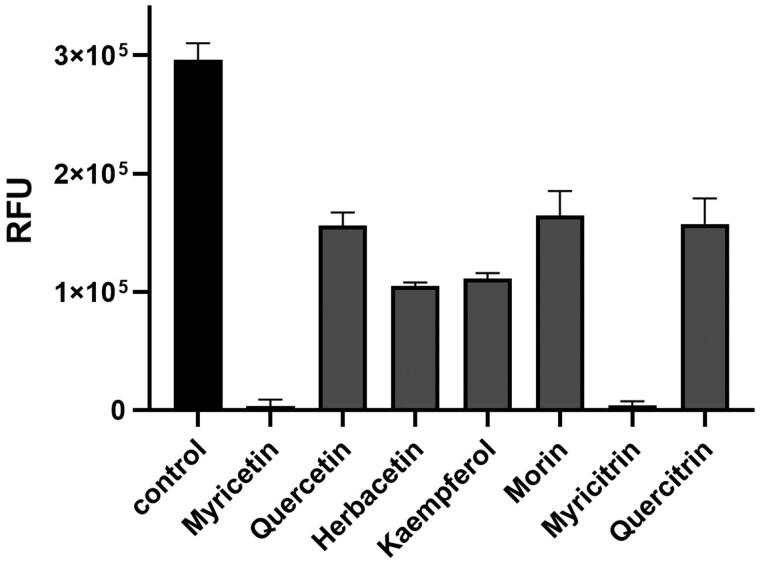
African swine fever (ASF) caused by the ASF virus (ASFV) is the most hazardous swine disease. Since a huge number of pigs have been slaughtered to avoid a pandemic spread, intense studies on the disease should be followed quickly. Recent studies reported that flavonoids have various antiviral activity including ASFV. In this report, ASFV protease was selected as an antiviral target protein to cope with ASF. With a FRET (Fluorescence resonance energy transfer) method, ASFV protease was assayed with a flavonoid library which was composed of sixty-five derivatives classified based on ten different scaffolds. Of these, the flavonols scaffold contains a potential anti-ASFV protease activity. The most prominent flavonol was myricetin with IC of 8.4 M. Its derivative, myricitrin, with the rhamnoside moiety was also showed the profound inhibitory effect on ASFV protease. These two flavonols apparently provide a way to develop anti-ASFV agents based on their scaffold.
非洲猪瘟(ASF)是由非洲猪瘟病毒(ASFV)引起的,是最危险的猪病。由于为了避免大流行传播而大量宰杀了猪,因此应迅速进行关于该疾病的深入研究。最近的研究报告称,类黄酮具有多种抗病毒活性,包括 ASFV。在本报告中,ASFV 蛋白酶被选为抗病毒靶标蛋白,以应对 ASF。采用荧光共振能量转移(FRET)方法,使用包含六十五种基于十种不同支架分类的衍生物的类黄酮文库对 ASFV 蛋白酶进行了测定。在这些类黄酮中,类黄酮醇支架含有潜在的抗 ASFV 蛋白酶活性。最突出的类黄酮醇是杨梅素,IC 为 8.4μM。其糖苷配基鼠李糖苷也显示出对 ASFV 蛋白酶的深刻抑制作用。这两种类黄酮醇显然为基于其支架开发抗 ASFV 药物提供了一种方法。